
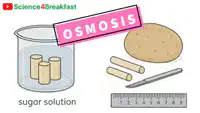
Osmosis Required Practical

Presentation
•
Chemistry
•
10th - 11th Grade
•
Practice Problem
•
Medium

Robert Wilcock
Used 2+ times
FREE Resource
20 Slides • 22 Questions
1

2

3
Open Ended
How might the mass of plant tissue change when placed in salt solutions of varying concentrations?
4
Multiple Choice
Why is osmosis important for plant tissues when exposed to different salt solutions?
It helps plants absorb nutrients from the soil.
It allows plants to photosynthesize more efficiently.
It prevents plants from losing water to the environment.
It enables plants to grow faster.
5

6
Multiple Choice
Which piece of equipment is used to measure the mass of the plant matter in this experiment?
Balance
Ruler
Boiling tube
Paper towel
7

8
Multiple Choice
Why is it important to tie back hair and tuck in ties during this experiment?
To avoid contamination of the experiment
To prevent accidents involving equipment
To keep the lab clean
To improve visibility
9

10
Fill in the Blanks
What is the independent variable in this experiment?
Type answer...
11

12
Open Ended
Explain why it is important to keep the length of the potato pieces the same in this experiment.
13

14
Multiple Select
Which steps in the method ensure that the experiment is a fair test? Select all that apply.
Cut all pieces into 2cm ensuring they are the same size
Add 10cm³ of the corresponding salt solution
Wait for 30 minutes
Tidy away equipment not in use
15

16
Multiple Choice
After removing the potatoes from the boiling tubes, what should you do before recording their mass?
Wash them with water
Dab them gently with a paper towel
Leave them to dry naturally
Weigh them immediately
17

18
Multiple Select
Which piece of equipment is used to cut potato cylinders of the same diameter in the osmosis method?
Scalpel
Cork borer
Ruler
Top pan balance
19

20
Open Ended
Why is it important to trim each potato cylinder to the same length before starting the osmosis experiment?
21

22

23

24
Multiple Select
Select all the variables that are kept constant in this osmosis experiment.
Volume of solution in each boiling tube
Concentration of sucrose solution
Length of potato cylinders
Time potato cylinders are left in solution
25
Multiple Choice
Which measurements must be recorded for each potato cylinder before placing them in the solutions?
Only the mass
Only the length
Both mass and length
Neither mass nor length
26

27
Open Ended
Explain how you would calculate the percentage change in mass for a potato cylinder after the experiment.
28
Fill in the Blanks
The potato cylinder in distilled water increased in mass. Fill in the blank: This is because water moved into the potato cells by
Type answer...
29

30

31
Open Ended
Explain why the mass of the potato does not change at a sucrose concentration of 0.3 mol/dm³.
32
Multiple Choice
At what concentration of sucrose does the mass of the potato not change, according to the graph?
0.2 mol/dm³
0.4 mol/dm³
0.6 mol/dm³
0.3 mol/dm³
33

34
Multiple Choice
Which of the following are important steps when planning a scientific experiment using the DISCERN method?
Dependent Variable, Step-by-Step Instructions, Control Variables, Repeat and calculate a mean
Independent Variable, Control Variables, Equipment, Guess the results
Step-by-Step Instructions, Use random equipment, Repeat and calculate a mean, Forget units
Dependent Variable, Ignore instructions, Control Variables, Check numbers only
35

36
Fill in the Blanks
The variable that is measured in an experiment is called the
Type answer...
37

38
Open Ended
Describe the sequence of steps you would follow to carry out the osmosis practical using the equipment shown.
39

40
Open Ended
Write your own method for the osmosis required practical. (6 marks)
41
Open Ended
How did this investigation help you understand the process of osmosis in plant tissues?
42
Multiple Choice
What effect do different salt solutions have on the mass of plant tissue?
They increase the mass of plant tissue.
They decrease the mass of plant tissue.
They have no effect on the mass of plant tissue.
They can either increase or decrease the mass depending on the concentration.
Show answer
Auto Play
Slide 1 / 42
SLIDE
Similar Resources on Wayground

40 questions
Writing and Naming Acids
Presentation
•
9th - 12th Grade
37 questions
Review Game 12/23
Presentation
•
10th - 11th Grade
34 questions
CP Ionic Compounds - writing formulas and polyatomic ions
Presentation
•
10th - 12th Grade
36 questions
Chemistry Final Review 5: Formulas and Moles
Presentation
•
11th Grade
33 questions
Solutions
Presentation
•
9th - 12th Grade
35 questions
Naming Ionic Compounds
Presentation
•
10th - 12th Grade
36 questions
Unit 2 Lesson 5: Nuclear Chemistry and Radiation
Presentation
•
10th - 12th Grade
38 questions
Rhetorical Appeals and Strategies
Presentation
•
9th Grade
Popular Resources on Wayground
10 questions
Safety Day 2026 – Student Review

Quiz
•
9th Grade
21 questions
Continents and Oceans
Quiz
•
6th Grade
20 questions
Parts of Speech
Quiz
•
5th Grade
16 questions
Subject & Predicate
Quiz
•
5th Grade
25 questions
Multiplication Facts
Quiz
•
5th Grade
12 questions
Map Skills
Quiz
•
3rd Grade
22 questions
Continents and Oceans
Quiz
•
5th Grade
15 questions
Rounding Decimals
Quiz
•
5th Grade
Discover more resources for Chemistry
20 questions
electron configurations and orbital notation
Quiz
•
9th - 12th Grade
20 questions
Periodic Table Trends
Quiz
•
11th Grade
25 questions
Writing and Naming Binary Ionic compounds
Quiz
•
10th Grade
20 questions
COUNTING ATOMS
Quiz
•
10th Grade
50 questions
Unit 3: Atomic Assault Summative Review
Quiz
•
11th Grade
20 questions
Physical or Chemical Change/Phases
Quiz
•
8th Grade - University
15 questions
Periodicity Module Exam Practice Quiz
Quiz
•
9th - 12th Grade
20 questions
Naming Ionic Compounds
Quiz
•
10th Grade