

U4 Demystifying Data Transmission Part 2

Presentation
•
Computers
•
9th - 12th Grade
•
Practice Problem
•
Easy

Terry Nguyen
Used 3+ times
FREE Resource
4 Slides • 12 Questions
1

2
Multiple Choice
A _____ is a physical artifact that can run a program. Some examples include computers, tablets, servers, routers, and smart sensors.
computing system
computing network
computing device
3
Multiple Choice
A _____ is a group of interconnected computing devices capable of sending or receiving data.
computing system
computing network
computing device
4
Multiple Choice
A _____ is a group of computing devices and programs working together for a common purpose.
computing system
computing network
computing device
5
Multiple Choice
Routing is the process of finding a path from sender to receiver.
True
False
6
Multiple Choice
The bandwidth of a computer network is the maximum amount of data that can be sent in a fixed amount of time. It is usually measured in bits per second.
True
False
7
Multiple Choice
The path between two computing devices on a computer network is a sequence of directly connected computing devices that begins at the sender and ends at the receiver.
True
False
8
9
10
11
Multiple Choice
In the context of authoring an email, which of the following elements is NOT considered metadata?
Sender's email address
Recipient's email address
Email content (ex: "To whom it may concern...Sincerely...)
Date and time the email was sent
12
Multiple Choice
The following dot decimal notation is used to represent: 127.0.35.20
What does that value represent?
IPv6 Address
IPv4 Address
TCP Port Number
UDP Port Number
13
Reorder
Reorder the following events when a user presses "Send" on an email.
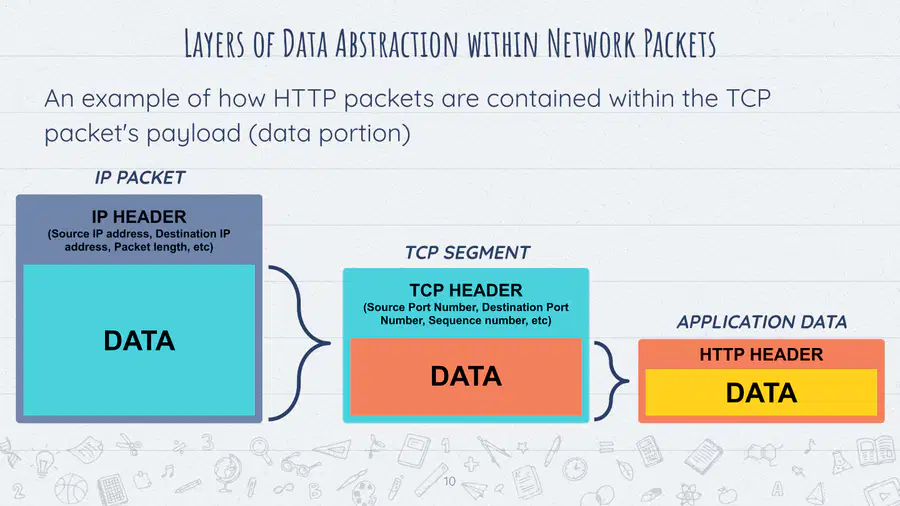
User’s computer sends a request to a DNS server to look up the recipient’s mail server IP address. The DNS server then sends the mail server’s IP address to the user’s computer.
The IP address is added to the IP packet headers.
Routers determine the path(s) to send the IP packets on and then IP Packets are sent over the calculated paths to their destination.
The packets are delivered to the port number identified by the TCP packets so that the correct software application receives them.
The TCP assembles the packets in their correct sequence to construct the original email message.
14
Multiple Select
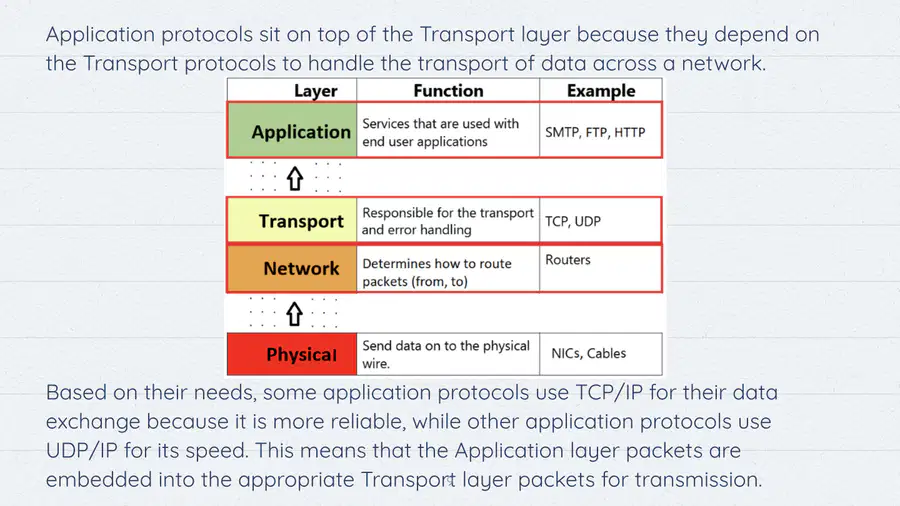
Which of the following FOUR are characteristics of the TCP?
It makes sure a reliable connection is established between the source and destination before sending the user data.
It ignores any packets that were lost during the transfer.
It checks for errors in packet transfer.
It includes the source and destination port numbers that identify the software applications the data packets belong to.
It includes a packet sequence number used to reassemble the packets in the correct order upon delivery.
15
Multiple Select
Which of the following THREE are characteristics of the UDP?
It resolves any duplicate data packets.
It is a much faster Transport protocol.
It is a Transfer protocol that is very suitable for streaming videos.
It includes a packet sequence number used to reassemble the packets in the correct order upon delivery.
It includes the source and destination port numbers that identify the software applications the data packets belong to.
16
Multiple Select
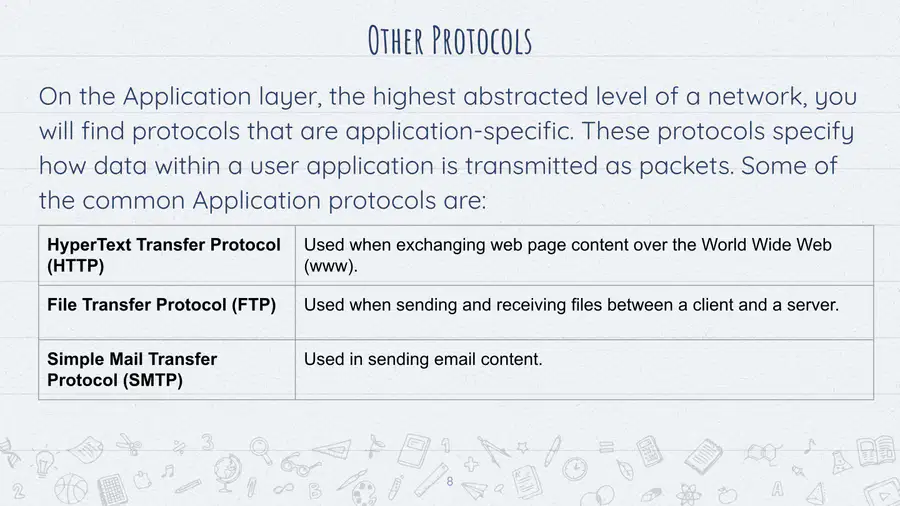
Which of the following TWO protocols manage the user’s Application data packets?
IP
HTTP
SMTP
TCP
Show answer
Auto Play
Slide 1 / 16
SLIDE
Similar Resources on Wayground

10 questions
Modeling with Quadratic
Presentation
•
9th - 12th Grade
11 questions
Molecular Geometry Bond Polarity, Polar or Nonpolar
Presentation
•
9th - 12th Grade
11 questions
Equations of Circles
Presentation
•
9th - 12th Grade
12 questions
What is Science?
Presentation
•
KG - 12th Grade
12 questions
Counterarguments and Rebuttals
Presentation
•
9th - 12th Grade
10 questions
Summarizing
Presentation
•
9th - 12th Grade
12 questions
Discriminant
Presentation
•
9th - 12th Grade
12 questions
Unit 7 Review
Presentation
•
9th - 12th Grade
Popular Resources on Wayground
10 questions
Safety Day 2026 – Student Review

Quiz
•
9th Grade
21 questions
Continents and Oceans
Quiz
•
6th Grade
20 questions
Parts of Speech
Quiz
•
5th Grade
16 questions
Subject & Predicate
Quiz
•
5th Grade
25 questions
Multiplication Facts
Quiz
•
5th Grade
12 questions
Map Skills
Quiz
•
3rd Grade
22 questions
Continents and Oceans
Quiz
•
5th Grade
15 questions
Rounding Decimals
Quiz
•
5th Grade