
6C Newton's 3rd Law

Presentation
•
Science
•
6th - 8th Grade
•
Practice Problem
•
Easy
Standards-aligned

Jo Johnson
Used 26+ times
FREE Resource
6 Slides • 3 Questions
1
Law of Motion
By Jo Johnson
2
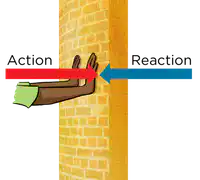
Equal strength and opposite in direction. Have you ever seen a balloon fly up in the air as the gases inside of it were coming out of the bottom? This is an example of Newton’s Third Law of Motion. The force pushing the balloon up into the air is equal in strength as to the gases coming out of the bottom and opposite in the direction. Forces that act on different objects that are of equal strength that opposite in direction are called action and reaction pairs.

3
Open Ended

What is an action and reaction pair?
4
Newton’s Third Law of Motion.
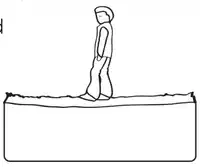
Action and reaction pairs are everywhere. You cannot push anything unless it pushes back. A dog pulls on his leash and the leash pulls back. The action and reaction are equal and opposite to one another. When you walk, you push backward on the ground with your feet. That is the action. The reaction is the ground pushing forward with equal but opposite force.
5
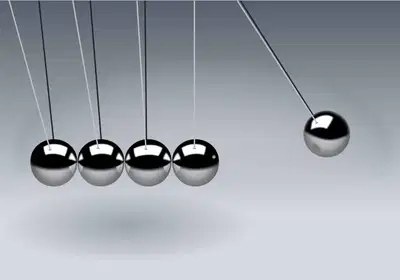
Newton’s Third Law of Motion states that for every action, there is an equal and opposite reaction. Another example of this law is a fireman with a firehose. The action is the water spraying out of the hose. The reaction is the fireman being pushed back from the force of the water coming out of the hose.
6
Open Ended

What does Newton's 3rd Law of Motion tell us?
7
Action and reaction forces. Action and reaction forces do not cancel each other out. This is because they work on different objects. A swimmer exerts a backward force on the water. The water then exerts an equal but opposite forward action of her hands. So, the action force is acting on the water and the reaction force acts on the hands.
Action & Reaction
8

Jet engines work because of Newton’s Third Law of Motion. When the air enters the front of the jet engine, it is squeezed into a combustion chamber. This makes the air really hot. In the combustion chamber, the hot air ignites the jet fuel to form burning gases. The gases expand and create pressure. The pressure forces the gases out of the back of the engine. That is the action. The reaction is the jet engine accelerating forward.
Jet Engines
9
Multiple Choice
Action and reaction forces acting on an object in opposite directions cancel each other out.
True
False
Law of Motion
By Jo Johnson
Show answer
Auto Play
Slide 1 / 9
SLIDE
Similar Resources on Wayground

10 questions
Variables
Presentation
•
6th - 8th Grade
7 questions
Using Absolute and Relative Age
Presentation
•
6th - 8th Grade
7 questions
Models of an Atom and Molecule
Presentation
•
6th - 8th Grade
10 questions
Bacteria- Lesson
Presentation
•
6th - 8th Grade
7 questions
ELPAC Listening Practice #3: Support an Opinion
Presentation
•
6th - 8th Grade
6 questions
Nervous System Intro
Presentation
•
6th - 8th Grade
7 questions
Plate Motion 2.2
Presentation
•
6th - 8th Grade
9 questions
CAST Practice 1
Presentation
•
6th - 8th Grade
Popular Resources on Wayground
10 questions
Safety Day 2026 – Student Review

Quiz
•
9th Grade
21 questions
Continents and Oceans
Quiz
•
6th Grade
20 questions
Parts of Speech
Quiz
•
5th Grade
16 questions
Subject & Predicate
Quiz
•
5th Grade
25 questions
Multiplication Facts
Quiz
•
5th Grade
12 questions
Map Skills
Quiz
•
3rd Grade
22 questions
Continents and Oceans
Quiz
•
5th Grade
15 questions
Rounding Decimals
Quiz
•
5th Grade
Discover more resources for Science
20 questions
Newton's Laws of Motion
Quiz
•
8th Grade
20 questions
Elements, compounds, and mixtures
Quiz
•
6th Grade
10 questions
6.6D - Relative Density Review
Quiz
•
6th Grade
15 questions
potential and kinetic energy
Quiz
•
8th Grade
21 questions
Newton's Laws of Motion
Quiz
•
8th Grade
20 questions
Elements, Compounds and Mixtures
Quiz
•
8th Grade
10 questions
Exploring Chemical and Physical Changes

Interactive video
•
6th - 10th Grade
20 questions
CONDUCTION,CONVECTION AND RADIATION
Quiz
•
6th Grade