

The Concept of Line Quality- Illustration

Presentation
•
Computers
•
12th Grade
•
Practice Problem
•
Easy

Jerome Suelto
Used 1+ times
FREE Resource
10 Slides • 20 Questions
1
2
3
4

5
Multiple Choice
Which of the following is NOT one of the four core characteristics of line quality?
Weight
Value
Perspective
Texture
6
7
Fill in the Blanks
Type answer...
8

9
Multiple Choice
Which of the following statements about line quality is correct?
Thicker, darker lines are used for distant objects.
Thinner, lighter lines are used for objects closer to the viewer.
Thicker, darker lines are used for objects closer to the viewer.
Line quality does not affect the illusion of depth.
10
11
Multiple Select
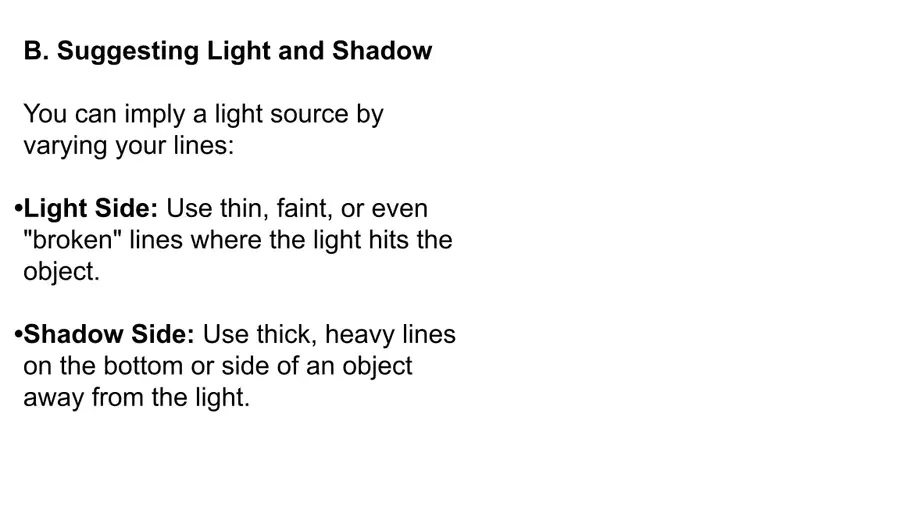
Select all the ways an artist can suggest a light source using line quality.
Using thick, heavy lines on the shadow side
Using thin, faint, or broken lines on the light side
Using only one type of line for the whole drawing
Varying line thickness depending on the light direction
12
Open Ended
Explain how varying line weight can create the illusion of depth and light in a drawing. Use examples from the lesson to support your answer.
13

14
Open Ended
How does the choice of line weight affect the way we perceive the weight of objects in a drawing?
15

16
Multiple Choice
Which of the following techniques helps build muscle memory for a more confident, smooth stroke when drawing lines?
Varying Pressure
The "Ghosting" Method
Speed Control
Chicken Scratching
17
18
Open Ended
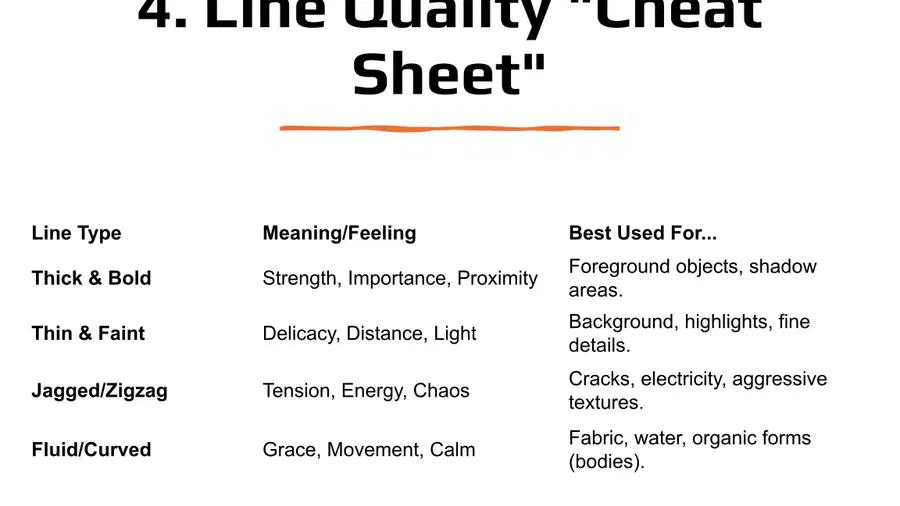
How do the meanings and best uses of thick & bold lines differ from thin & faint lines in drawing?
19
Multiple Choice
Which term is synonymous with 'Line Quality' and refers to the thickness or thinness of a line?
Line Weight
Line Length
Line Direction
Line Symmetry
20
Multiple Choice
According to the principles of atmospheric perspective, how should you draw objects that are further away from the viewer?
With thin, light lines
With fluid, curved lines
With thick, dark lines
With jagged, broken lines
21
Multiple Choice
If you want to suggest a strong light source hitting an object from above, where should the thickest lines be placed?
On the top edges where the light hits
Equally around the entire perimeter
In the center of the object
On the bottom edges and in the shadows
22
Multiple Choice
What does a 'broken' or 'implied' line often communicate in a drawing?
A mistake by the artist
Areas of highlight or disappearing form
High tension and energy
A sharp, metallic edge
23
Multiple Choice
Why is 'chicken scratching' (many small, overlapping strokes) generally discouraged for beginners?
It makes the lines too thick
It is a technique only used by masters
It makes the drawing look furry and indecisive
It takes too much ink/graphite
24
Multiple Choice
Which type of line quality would best represent a heavy, grounded boulder?
Wispy, light lines
Thick, rugged, and textured lines
Thin, perfectly smooth lines
Curved, fluid lines
25
Multiple Choice
What determines the 'value' of a line?
How long it is
How light or dark it is
The speed at which it was drawn
The price of the pencil used
26
Multiple Choice
Which characteristic of line quality is most affected by the medium (e.g., charcoal vs. digital pen)?
Direction
Continuity
Subject Matter
Texture
27
Multiple Choice
A line that varies from thick to thin within a single stroke is often called:
A dead line
A mechanical line
A tapered line
A cross-hatched line
28
Multiple Choice
Why might an artist use a fast, energetic line quality for a gesture drawing?
To hide their lack of skill
Because they are in a hurry
To capture the essence of movement
To make the drawing look like a photograph
29
Open Ended
After learning about line quality, what questions do you still have or what would you like to explore further about using lines in art?
30
Open Ended
How can you use line weight to communicate depth, light, and form in a 2D composition?
Show answer
Auto Play
Slide 1 / 30
SLIDE
Similar Resources on Wayground

20 questions
Nutrition in Plants
Presentation
•
12th Grade
23 questions
Past of the verb to be
Presentation
•
12th Grade
23 questions
ETECH - Introduction to Python
Presentation
•
12th Grade
22 questions
Transitive and Intransitive Verbs
Presentation
•
12th Grade
25 questions
Science Test Quizzes
Presentation
•
KG
20 questions
Tragedy
Presentation
•
12th Grade
20 questions
Skeletal System
Presentation
•
12th Grade
22 questions
Nuclear Power
Presentation
•
11th - 12th Grade
Popular Resources on Wayground
24 questions
PBIS-HGMS Day 10

Quiz
•
6th - 8th Grade
10 questions
HCS SCI 03 Summer School Review 3
Quiz
•
3rd Grade
11 questions
Home Scope
Quiz
•
7th - 8th Grade
15 questions
HCS SCI 05 Summer School Assessment 3 Review
Quiz
•
5th Grade
35 questions
Lufkin Road Middle School Student Handbook & Policies Assessment
Quiz
•
7th Grade
18 questions
Geo 11.3 Area of Circles and Sectors
Quiz
•
9th - 11th Grade