

DNA and Protein Synthesis

Presentation
•
Science
•
9th - 12th Grade
•
Practice Problem
•
Medium
Standards-aligned

Barbara White
Used 19+ times
FREE Resource
24 Slides • 12 Questions
1

DNA and Protein Synthesis
High School
2
Learning Objectives
Describe the structures of DNA and RNA and distinguish between them.
Explain the central dogma of biology, including replication, transcription, and translation.
Detail the specific roles of mRNA, tRNA, and rRNA in protein synthesis.
Analyze the relationship between genes, proteins, and traits.


3
Key Vocabulary
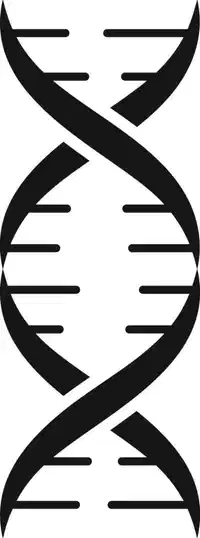
Gene
A section of DNA that contains the information to make a specific protein.
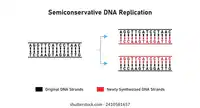
Replication
The process of producing two identical replicas of DNA from one original DNA molecule.
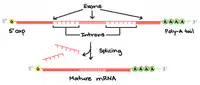
Transcription
The process of converting the genetic code from DNA into a messenger RNA molecule.
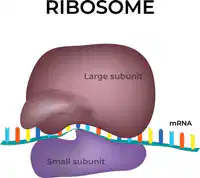
Translation
The process of converting information from an mRNA molecule into a sequence of amino acids.
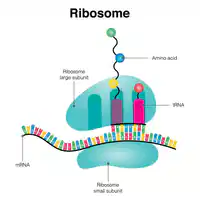
Codon
A sequence of three nucleotides on an mRNA strand that codes for one amino acid.
4
DNA vs. RNA
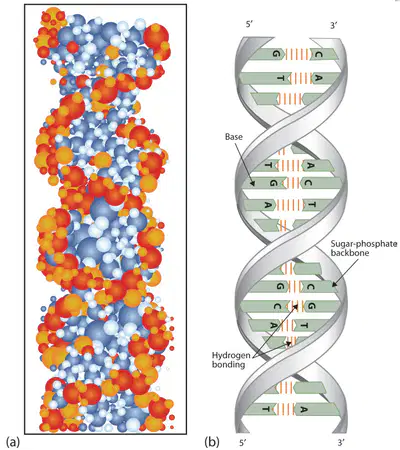
DNA and RNA are nucleic acids built from units called nucleotides.
DNA is a double-stranded molecule, while RNA is single-stranded.
DNA uses deoxyribose sugar and Thymine (T); RNA uses ribose sugar and Uracil (U).
Base pairing in DNA is A-T and G-C; for RNA, A pairs with U.
5
Solved Example 1
A DNA template strand has the base sequence TACGGTCCA. What is the complementary mRNA sequence that will be produced during transcription?
Step 1: Analyze and Sketch the Problem
Goal: Determine the sequence of the mRNA strand transcribed from a given DNA strand.
Knowns: The DNA template strand sequence is TACGGTCCA.
Unknown: The complementary mRNA sequence.
Formula: Apply the base-pairing rules for transcription: DNA Adenine (A) pairs with RNA Uracil (U), DNA Thymine (T) pairs with RNA Adenine (A), DNA Cytosine (C) pairs with RNA Guanine (G), and DNA Guanine (G) pairs with RNA Cytosine (C).
6
Solved Example 1
A DNA template strand has the base sequence TACGGTCCA. What is the complementary mRNA sequence that will be produced during transcription?
Step 2: Solve for the Unknown
Write down the DNA template strand: TAC GGT CCA.
Transcribe each DNA base to its complementary RNA base.
T (Thymine) in DNA pairs with A (Adenine) in RNA.
A (Adenine) in DNA pairs with U (Uracil) in RNA.
C (Cytosine) in DNA pairs with G (Guanine) in RNA.
G (Guanine) in DNA pairs with C (Cytosine) in RNA.
Applying these rules: TAC becomes AUG, GGT becomes CCA, and CCA becomes GGU.
Combine the new bases to form the mRNA sequence: AUG CCA GGU.
7
Solved Example 1
A DNA template strand has the base sequence TACGGTCCA. What is the complementary mRNA sequence that will be produced during transcription?
Step 3: Evaluate the Answer
To verify, check each base pair against the transcription rules: T in DNA pairs with A in mRNA, A with U, C with G, and G with C.
The final mRNA sequence AUG CCA GGU is the correct complement to the DNA template strand TAC GGT CCA.
8
Multiple Choice
Which of the following correctly describes a major difference between DNA and RNA?
Both DNA and RNA are single-stranded, but DNA uses Thymine and RNA uses Guanine.
DNA is single-stranded and uses Uracil, while RNA is double-stranded and uses Thymine.
RNA is double-stranded and contains the sugar deoxyribose, while DNA is single-stranded and contains ribose.
RNA contains the sugar ribose and uses Uracil, while DNA contains deoxyribose and uses Thymine.
9
The Three Types of RNA
Messenger RNA (mRNA)
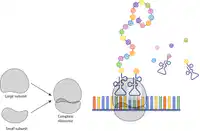
Carries genetic instructions from the DNA in the nucleus to the ribosomes.
Its sequence is complementary to the DNA strand it was copied from.
It acts as the template for building a specific protein chain.
Transfer RNA (tRNA)
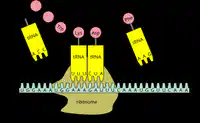
It delivers the correct amino acids to the ribosome for protein assembly.
It reads the message on the mRNA in three-letter sequences called codons.
Its anticodon is complementary to the codon on the mRNA strand.
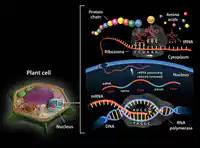
Ribosomal RNA (rRNA)
This RNA type is a major structural component of the ribosomes themselves.
Ribosomes are the cellular machines responsible for synthesizing all proteins.
It helps bond amino acids together to form a long polypeptide chain.
10
Solved Example 2
Given a DNA template strand of TAC GGT CCA, determine the complementary mRNA codons and the corresponding tRNA anticodons.
Step 1: Analyze and Sketch the Problem
Goal: Find the mRNA codons and tRNA anticodons for the given DNA sequence.
Knowns: DNA template strand is TAC GGT CCA.
Unknowns: mRNA sequence, tRNA sequence.
Rules: DNA to mRNA (A→U, T→A, C→G, G→C), mRNA to tRNA (A→U, U→A, C→G, G→C).
11
Solved Example 2
Given a DNA template strand of TAC GGT CCA, determine the complementary mRNA codons and the corresponding tRNA anticodons.
Step 2: Solve for the Unknown
First, transcribe the DNA template strand to find the mRNA codons.
DNA: T A C | G G T | C C A
mRNA: A U G | C C A | G G UNext, translate the mRNA codons to find the complementary tRNA anticodons.
mRNA: A U G | C C A | G G U
tRNA: U A C | G G U | C C A
12
Solved Example 2
Given a DNA template strand of TAC GGT CCA, determine the complementary mRNA codons and the corresponding tRNA anticodons.
Step 3: Evaluate the Answer
Check the transcription: TAC on DNA correctly pairs with AUG on mRNA, GGT with CCA, and CCA with GGU.
Check the translation: AUG on mRNA correctly pairs with UAC on tRNA, CCA with GGU, and GGU with CCA. The sequences follow the rules of complementary base pairing.
13
Multiple Choice
Which type of RNA is responsible for carrying the genetic code from the nucleus to the ribosome?
dRNA
rRNA
tRNA
mRNA
14
Genes, Proteins, and Traits
A gene is a section of DNA with instructions to build a protein.
Proteins are molecules made from smaller units called amino acids.
These proteins are essential for cell structures and reactions in your body.
This gene-to-protein flow determines your body’s specific traits.
15
Multiple Choice
What is the fundamental relationship between genes, proteins, and traits?
An organism's traits directly determine the structure of its genes and proteins.
Traits are the building blocks of proteins, which are coded by genes.
Proteins code for genes, which determine an organism's traits.
Genes contain the instructions to make proteins, which in turn determine an organism's traits.
16
Central Dogma & DNA Replication
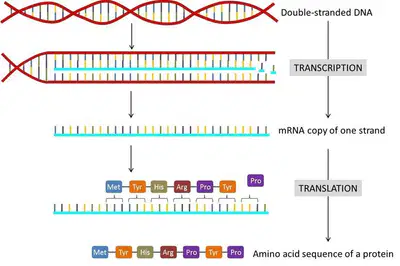
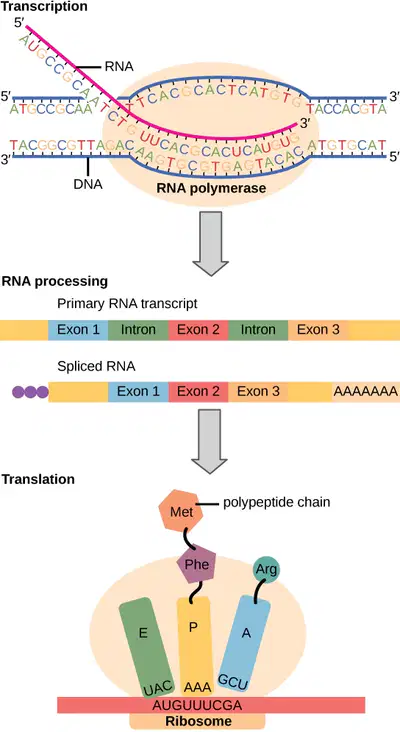
Central Dogma
Describes the one-way flow of genetic information within a biological system.
Information flows in one direction: from DNA to RNA to a protein.
This involves two main processes which are called transcription and translation.
DNA Replication
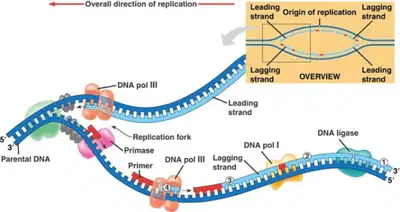
The process where a cell makes an identical copy of its DNA.
This must occur before a cell can divide and happens in the nucleus.
DNA Polymerase is the enzyme that builds and proofreads new DNA strands.
17
Solved Example 3
If a segment of DNA is 900 nucleotides long, how many amino acids will be in the resulting protein? (Assume no introns and the segment starts with a start codon and ends with a stop codon).
Step 1: Analyze and Sketch the Problem
Goal: Determine the number of amino acids coded by a DNA segment.
Knowns: The DNA segment is 900 nucleotides long. It starts with a start codon and ends with a stop codon.
Unknown: The number of amino acids in the protein.
Formula: Each codon consists of 3 nucleotides and codes for one amino acid. The stop codon does not code for an amino acid.
18
Solved Example 3
If a segment of DNA is 900 nucleotides long, how many amino acids will be in the resulting protein? (Assume no introns and the segment starts with a start codon and ends with a stop codon).
Step 2: Solve for the Unknown
19
Solved Example 3
If a segment of DNA is 900 nucleotides long, how many amino acids will be in the resulting protein? (Assume no introns and the segment starts with a start codon and ends with a stop codon).
Step 3: Evaluate the Answer
20
Multiple Choice
According to the central dogma and the process of replication, what is the primary purpose of DNA replication?
To correct errors in the genetic code before transcription.
To create RNA molecules for protein synthesis.
To ensure each new cell receives an identical copy of the DNA after cell division.
To directly assemble amino acids into proteins.
21
What is Transcription?
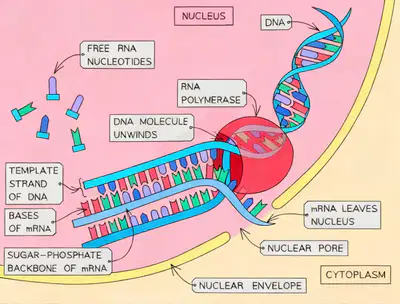
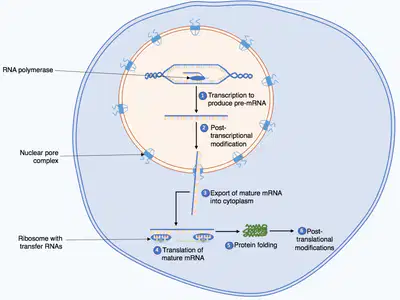
Transcription copies a DNA gene's code into a messenger RNA (mRNA) molecule.
The enzyme RNA polymerase reads the DNA template strand in the cell nucleus.
It adds complementary RNA bases, pairing Uracil (U) with DNA’s Adenine (A).
The finished mRNA molecule then leaves the nucleus to find a ribosome.
22
Multiple Choice
During transcription in a eukaryotic cell, where does the process occur and what is the role of RNA polymerase?
In the nucleus; its role is to replicate the entire DNA molecule before cell division.
In the cytoplasm; its role is to translate mRNA into protein.
In the nucleus; its role is to read the DNA template and synthesize a complementary mRNA strand.
In the ribosome; its role is to remove introns and splice exons.
23
The Three Types of RNA in Translation
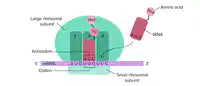
Messenger RNA (mRNA)
Carries genetic code from DNA in the nucleus to the ribosome.
The message is read in three-letter groups called codons.
Each codon specifies a particular amino acid for the protein chain.
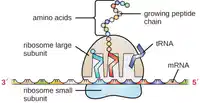
Ribosomal RNA (rRNA)
This is a key structural component of the cell's ribosomes.
It helps position mRNA and tRNA molecules during protein synthesis.
It helps form peptide bonds between the individual amino acids.
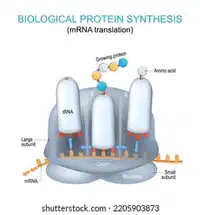
Transfer RNA (tRNA)
This acts as a molecular bridge connecting codons to amino acids.
It has a special sequence called an anticodon to match mRNA.
It carries specific amino acids to the ribosome to build proteins.
24
Multiple Choice
What is the primary event that occurs during translation?
DNA is copied into another molecule of DNA.
The ribosome reads mRNA codons to assemble a chain of amino acids.
An mRNA strand is created from a DNA template in the nucleus.
Introns are removed from the RNA strand.
25
Translating the Genetic Code
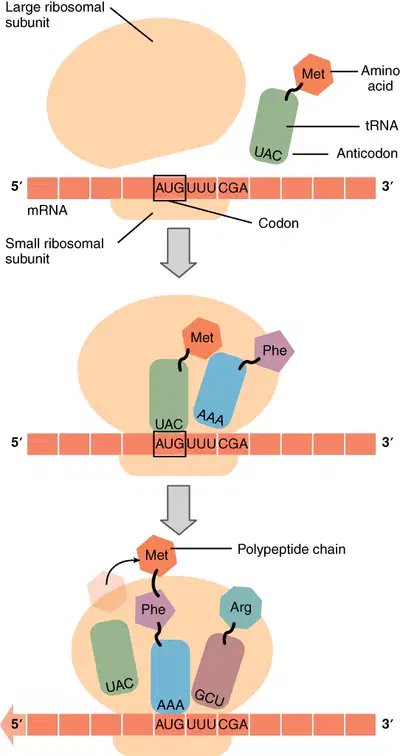
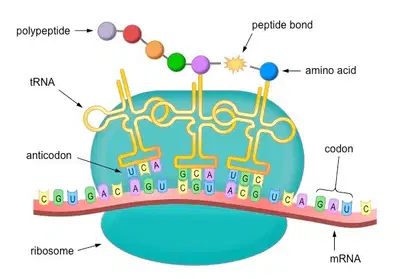
The genetic code is the set of rules for building proteins from mRNA instructions.
Information is read in three-nucleotide “words” called codons, which specify an amino acid.
Translation starts at the AUG codon and halts at one of three stop codons.
Transfer RNA (tRNA) delivers the correct amino acid by matching its anticodon to the codon.
26
Solved Example 6
Given the mRNA codon sequence AUG-GGC-UCA, determine the complementary tRNA anticodon sequence that will bind to it during translation.
Step 1: Analyze and Sketch the Problem
Goal: Find the tRNA anticodon sequence that is complementary to the given mRNA codon sequence.
Knowns: The mRNA codon sequence is AUG-GGC-UCA.
Key Concept: The base pairing rules for RNA are Adenine (A) pairs with Uracil (U), and Guanine (G) pairs with Cytosine (C).
27
Solved Example 6
Given the mRNA codon sequence AUG-GGC-UCA, determine the complementary tRNA anticodon sequence that will bind to it during translation.
Step 2: Solve for the Unknown
Break down the mRNA sequence into individual codons: AUG, GGC, and UCA.
Apply the complementary base pairing rules to each nucleotide in the sequence.
For the first codon (AUG): A pairs with U, U pairs with A, G pairs with C. The tRNA anticodon is UAC.
For the second codon (GGC): G pairs with C, G pairs with C, C pairs with G. The tRNA anticodon is CCG.
For the third codon (UCA): U pairs with A, C pairs with G, A pairs with U. The tRNA anticodon is AGU.
28
Solved Example 6
Given the mRNA codon sequence AUG-GGC-UCA, determine the complementary tRNA anticodon sequence that will bind to it during translation.
Step 3: Evaluate the Answer
Verify the pairings: A pairs with U, and G pairs with C. The pairings for each codon (AUG → UAC, GGC → CCG, UCA → AGU) are correct.
The final combined tRNA anticodon sequence is UAC-CCG-AGU.
29
Multiple Choice
What is the function of a tRNA molecule's anticodon during translation?
To carry the genetic message from the nucleus to the ribosome.
To signal the end of protein synthesis.
To remove non-coding introns from the mRNA strand.
To bind to the corresponding mRNA codon and deliver the correct amino acid.
30
Common Misconceptions About DNA
Misconception | Correction |
|---|---|
DNA makes proteins directly. | DNA holds instructions; RNA acts as the messenger and builder. |
Every part of a DNA strand codes for a protein. | DNA has non-coding regions (introns); only exons are expressed. |
RNA is just a simple copy of DNA. | There are three distinct types of RNA with specific roles. |
One gene is responsible for only one trait. | Many traits are polygenic, influenced by multiple genes. |
31
Multiple Choice
If a template DNA strand reads 3'-TAC-GCA-TGG-5', what will the resulting mRNA sequence be after transcription?
5'-UAC-GCA-UGG-3'
5'-AUG-CGU-ACC-3'
3'-AUG-CGU-ACC-5'
5'-ATG-CGT-ACC-3'
32
Multiple Choice
What is the primary difference in the location of protein synthesis between prokaryotic and eukaryotic cells?
In prokaryotes, it occurs in the cytoplasm only; in eukaryotes, it begins in the nucleus (transcription) and finishes in the cytoplasm (translation).
In prokaryotes, it occurs in the nucleus; in eukaryotes, it occurs only in the cytoplasm.
In both cell types, the entire process is split between the nucleus and the cytoplasm.
In both cell types, the entire process occurs exclusively in the cytoplasm.
33
Multiple Choice
A genetic mutation occurs that changes a DNA codon from AGA to TGA. Analyze the potential impact on the protein being synthesized.
The mutation would have no effect on the protein because both codons code for the same amino acid.
The resulting protein would be longer than intended because the STOP codon is removed.
A different amino acid would be inserted, but the protein length would remain the same.
The resulting protein would be terminated prematurely because the mutated DNA would be transcribed into a STOP codon (UGA).
34
Multiple Choice
If a toxin specifically destroyed all the ribosomes in a cell, what would be the immediate and most significant consequence for the processes described in the central dogma?
Translation would be completely halted, preventing the synthesis of proteins from mRNA.
DNA replication would stop because ribosomes are essential for copying DNA.
Transcription would fail, as RNA polymerase requires a functioning ribosome to bind to DNA.
The cell would be unable to edit mRNA by removing introns.
35
Summary
The Central Dogma describes genetic flow: DNA is transcribed to RNA, which is translated to protein.
DNA stores genetic instructions, while RNA, in forms like mRNA, tRNA, and rRNA, builds proteins.
DNA replication is the process of creating identical copies of DNA for cell division.
The expression of genes as proteins is what ultimately determines an organism's traits.
36
Poll
On a scale of 1-4, how confident are you about the concepts covered in today's review?
1
2
3
4
DNA and Protein Synthesis
High School
Show answer
Auto Play
Slide 1 / 36
SLIDE
Similar Resources on Wayground

28 questions
Lesson 1 - Introduction to Plant Reproduction
Presentation
•
9th - 12th Grade
27 questions
DE_Chem_1.2_Thermochemistry
Presentation
•
9th - 12th Grade
33 questions
life cycle of stars
Presentation
•
8th - 12th Grade
32 questions
Binary Ionic Compounds
Presentation
•
9th - 12th Grade
28 questions
Viruses
Presentation
•
8th - 12th Grade
30 questions
Carbon: A Central Building Block: Tutorial
Presentation
•
9th - 12th Grade
30 questions
Unit 10: Plant Systems Overview & Notes
Presentation
•
9th - 12th Grade
28 questions
Food Chains and Webs
Presentation
•
9th - 12th Grade
Popular Resources on Wayground
24 questions
PBIS-HGMS Day 10

Quiz
•
6th - 8th Grade
10 questions
HCS SCI 03 Summer School Review 3
Quiz
•
3rd Grade
11 questions
Home Scope
Quiz
•
7th - 8th Grade
15 questions
HCS SCI 05 Summer School Assessment 3 Review
Quiz
•
5th Grade
35 questions
Lufkin Road Middle School Student Handbook & Policies Assessment
Quiz
•
7th Grade
18 questions
Geo 11.3 Area of Circles and Sectors
Quiz
•
9th - 11th Grade