

Classification of Living Things

Presentation
•
Science
•
9th - 12th Grade
•
Medium
Standards-aligned

Barbara White
Used 6+ times
FREE Resource
18 Slides • 12 Questions
1

Classification of Living Things
High School
2
Learning Objectives
Describe the hierarchical system for classifying organisms from kingdom to species.
Explain the rules and importance of binomial nomenclature for scientific naming.
Compare the key characteristics of the three domains and four kingdoms of Eukarya.
Differentiate between modern classification methods like cladograms and phylogenetic trees.


3
Key Vocabulary
Taxonomy
The science of organizing, classifying, and naming all living things based on shared features.
Binomial Nomenclature
The two-part scientific naming system for organisms, which uses the genus and species names.

Species
A group of individuals that can successfully interbreed in nature to produce fertile offspring.
Phylogeny
The complete evolutionary past and ancestral history of a particular group of organisms.

Cladogram
A special branching diagram that illustrates the evolutionary relationships among different groups of organisms.
4
What is Taxonomy?
Taxonomy is the science of classifying and naming all living things.
It helps scientists study the great diversity of life on Earth.
Swedish scientist Carolus Linnaeus developed this modern system of classification over 200 years ago.
He grouped organisms together based on their similar features and structures.
5
Solved Example 1
A species of bear is in the family Ursidae, which belongs to the order Carnivora. The order is in the class Mammalia, which is in the phylum Chordata. What are the first four levels of its classification?
Step 1: Analyze and Sketch the Problem
Goal: Identify the first four levels of classification for the bear.
Knowns: Family is Ursidae, order is Carnivora, class is Mammalia, phylum is Chordata.
Unknown: The first four classification levels.
Formula: The levels are Domain, Kingdom, Phylum, Class.
6
Solved Example 1
A species of bear is in the family Ursidae, which belongs to the order Carnivora. The order is in the class Mammalia, which is in the phylum Chordata. What are the first four levels of its classification?
Step 2: Solve for the Unknown
The domain for all animals is Eukarya.
Since it's an animal, the Kingdom is Animalia.
The problem gives the phylum as Chordata. This is the third level.
The problem gives the class as Mammalia. This is the fourth level.
7
Solved Example 1
A species of bear is in the family Ursidae, which belongs to the order Carnivora. The order is in the class Mammalia, which is in the phylum Chordata. What are the first four levels of its classification?
Step 3: Evaluate the Answer
The first four levels are Domain, Kingdom, Phylum, and Class.
We identified them as Eukarya, Animalia, Chordata, and Mammalia.
The answer correctly lists the first four levels in order from most general to most specific.
8
Multiple Choice
According to the text, what is the primary purpose of taxonomy?
To determine how organisms behave in their environment.
To assign common names to newly discovered animals.
To make it easier to study the vast diversity of life on Earth.
To study the evolutionary history of a single organism.
9
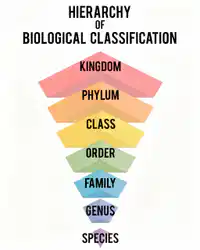
The 8 Levels of Classification
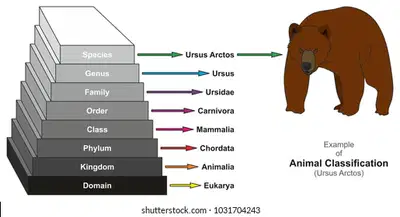
The classification system is hierarchical and has eight main levels of organization.
The levels are Domain, Kingdom, Phylum, Class, Order, Family, Genus, and Species.
As you go down the levels, organisms become more physically and genetically similar.
Use this mnemonic: Dear King Philip Came Over For Good Spaghetti.
10
Solved Example 2
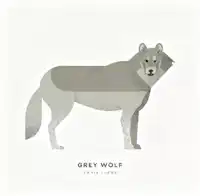
Classify the Gray Wolf (Canis lupus) using the 8 levels of classification, from the most general to the most specific level.
Step 1: Analyze and Sketch the Problem
Goal: List the complete taxonomic classification for the Gray Wolf.
Knowns: The scientific name is Canis lupus, which gives us the Genus and Species. We need to find the other six levels.
Order: The classification must go from most general (Domain) to most specific (Species).
11
Solved Example 2
Classify the Gray Wolf (Canis lupus) using the 8 levels of classification, from the most general to the most specific level.
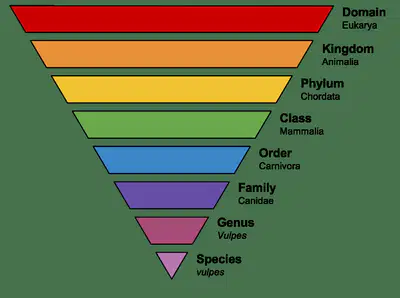
Step 2: Solve for the Unknown
Domain: Eukarya (cells with a nucleus)
Kingdom: Animalia (multicellular, heterotrophic)
Phylum: Chordata (has a spinal cord)
Class: Mammalia (mammal)
Order: Carnivora (carnivore)
Family: Canidae (dog family)
Genus: Canis (related to dogs, coyotes)
Species: lupus (wolf)
12
Solved Example 2
Classify the Gray Wolf (Canis lupus) using the 8 levels of classification, from the most general to the most specific level.
Step 3: Evaluate the Answer
The classification is ordered correctly from the broadest level (Domain) to the most specific (Species), with each level accurately reflecting the Gray Wolf's characteristics.
The final, verified classification is Eukarya, Animalia, Chordata, Mammalia, Carnivora, Canidae, Canis, lupus.
13
Multiple Choice
When moving down the levels of classification from kingdom to species, what is the observed trend?
Organisms become more similar, and their numbers increase.
Organisms become more similar, and their numbers decrease.
Organisms remain equally similar, and their numbers are constant.
Organisms become less similar, and their numbers increase.
14
Binomial Nomenclature: A Universal Naming System
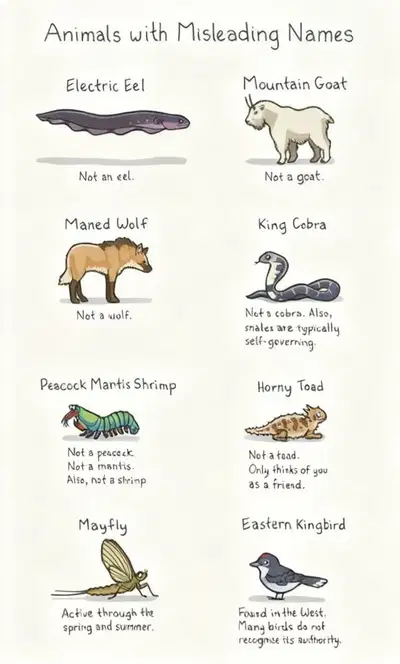
This is the formal system for an organism's two-part scientific name.
The name combines the Genus (capitalized) and species (lowercase), written in italics.
The Genus groups similar species, while the species name is entirely unique.
This universal system avoids confusion from varied common names across different regions.
15
Multiple Choice
Which of the following is a correctly written scientific name according to binomial nomenclature?
Ursus Maritimus
Ursus Maritimus
Ursus maritimus
ursus maritimus
16
The Three Domains of Life
Domain Bacteria
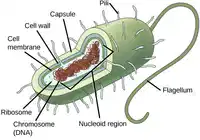
These organisms are prokaryotic, so their cells lack a nucleus.
They are unicellular, meaning they exist only as single cells.
Their cell walls contain a unique substance known as peptidoglycan.

Domain Archaea
These are also prokaryotic, so their cells have no nucleus.
They are unicellular and known for living in extreme environments.
Their cell walls do not contain the substance peptidoglycan.

Domain Eukarya
All organisms in this domain are eukaryotic, with a nucleus.
They can be unicellular or consist of many cells (multicellular).
This diverse domain includes protists, fungi, plants, and all animals.
17
Multiple Choice
What key characteristic distinguishes the Domain Bacteria from the Domain Archaea?
Bacteria have cell walls with peptidoglycan, while Archaea do not.
Bacteria are unicellular, while Archaea are multicellular.
Bacteria live in normal environments, while all Archaea are producers.
Bacteria are prokaryotic, while Archaea are eukaryotic.
18
The Kingdoms of Eukarya
Protista is a diverse kingdom of mostly unicellular organisms that can be producers or consumers.
Fungi are mostly multicellular consumers with cell walls made of a substance called chitin.
Plants are multicellular producers with cellulose cell walls and chloroplasts for photosynthesis.
Animals are multicellular consumers whose cells lack a cell wall and chloroplasts.
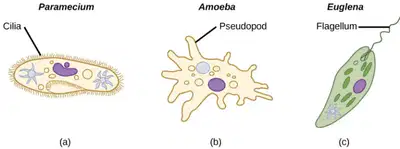
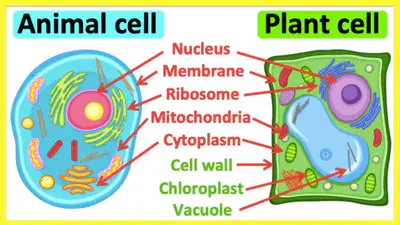
19
Multiple Choice
An organism is multicellular, cannot move on its own, has a cell wall containing cellulose, and is a producer. To which kingdom does it most likely belong?
Protista
Plantae
Animalia
Fungi
20
Modern Classification Tools
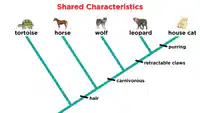
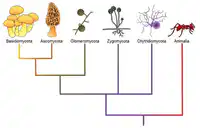
Cladogram
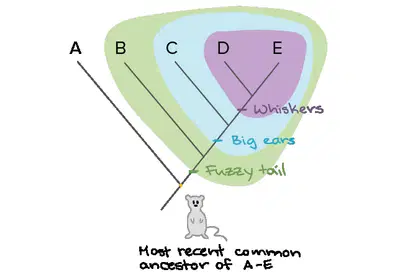
Cladistics determines relationships based on shared ancestral and derived characters.
These relationships are visualized in a branching diagram called a cladogram.
Modern classification uses DNA and an organism's evolutionary history, or phylogeny.

Phylogenetic Tree
This diagram shows the evolutionary relationships between different organisms over time.
It is similar to a cladogram but incorporates the element of time.
This shows how long ago a common ancestor may have existed.
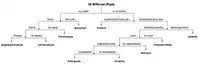
Dichotomous Key
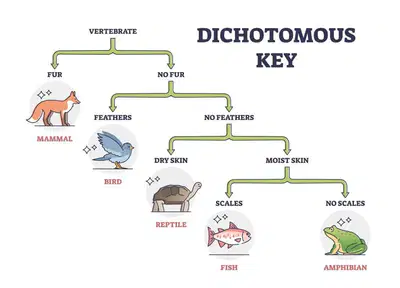
This is a practical tool used to identify an unknown organism.
It works by presenting a series of two choices at each step.
Choices narrow possibilities until the organism is finally identified.
21
Multiple Choice
What is the primary difference between a cladogram and a phylogenetic tree as described in the content?
Phylogenetic trees use a dichotomous key, while cladograms do not.
Phylogenetic trees incorporate the element of time, while cladograms typically do not.
Cladograms use DNA, while phylogenetic trees use physical traits.
Cladograms show current relationships, while phylogenetic trees show past ones.
22
Key Evolutionary Concepts in Classification
Ancestral vs. Derived
An ancestral character is a feature shared by multiple groups from a common ancestor.
A derived character is a new evolutionary feature that is unique to a particular group.
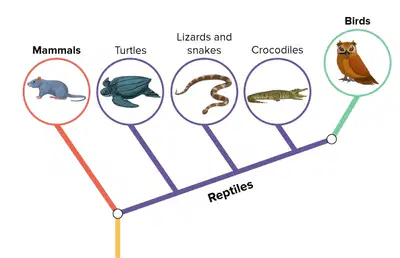
For example, a backbone is ancestral, while feathers in birds are a derived character.
Convergent Evolution
Unrelated organisms independently evolve similar traits when they adapt to similar environments or lifestyles.
This process creates analogous characters, which have similar functions but different underlying structures.
For example, the wings of a bird and the wings of a butterfly are analogous.
23
Multiple Choice
The wings of a bird and the wings of a butterfly both allow for flight but evolved from different ancestral structures. What term best describes these wing structures?
Ancestral characters
Phylogenetic characters
Analogous characters
Derived characters
24
Common Misconceptions about Classification
Misconception | Correction |
|---|---|
Organisms that look alike must be closely related. | Physical similarity can result from convergent evolution, not a close evolutionary relationship. |
Fungi, like mushrooms, are a type of plant. | Fungi are heterotrophs whose cell walls are made of chitin, not cellulose. |
A mule is its own species. | A species must produce fertile offspring. Mules are sterile. |
Prokaryotes (Bacteria and Archaea) are all the same. | Archaea and Bacteria have different RNA and cell wall composition. |
25
Multiple Choice
A scientist discovers a new organism that is unicellular, has no nucleus, and its cell wall does not contain peptidoglycan. It was found in a boiling hot spring. How should this organism be classified?
In the Domain Eukarya, because it has a cell wall.
In the Kingdom Protista, because it is a single-celled organism.
In the Domain Archaea, because it is prokaryotic and lives in an extreme environment.
In the Domain Bacteria, because it is unicellular.
26
Multiple Choice
Why is using the scientific name Felis catus more advantageous for scientists globally than using a common name like 'house cat'?
Scientific names are easier to pronounce than common names.
Binomial nomenclature is a new system that is not yet widely accepted.
Scientific names are universal and specific, avoiding confusion caused by regional differences in common names.
Common names are too long, while scientific names are always short.
27
Multiple Choice
A cladogram shows that birds and crocodiles share a recent common ancestor, while lizards are on a more distant branch. What does this imply about a derived character like feathers, which only birds possess?
Crocodiles must have once had feathers but lost them over time.
The evolution of feathers occurred after birds diverged from their common ancestor with crocodiles.
Feathers are an ancestral character shared by birds, crocodiles, and lizards.
Lizards are more closely related to birds than crocodiles are.
28
Multiple Choice
Predict the classification of an organism that is multicellular, heterotrophic, has no cell walls, and is capable of movement. Justify your answer by contrasting it with other kingdoms.
Kingdom Protista, because it is capable of movement.
Kingdom Animalia, because it is a multicellular consumer without cell walls.
Kingdom Fungi, because it is heterotrophic.
Kingdom Plantae, because it is multicellular.
29
Summary
Organisms are classified in a hierarchy of 8 levels, from Domain to Species.
Binomial nomenclature provides a universal two-part name, avoiding confusion.
The three domains are the highest level, based on cell structure.
Kingdoms in Eukarya are grouped by cell type, nutrition, and mobility.
Modern classification uses DNA and phylogeny to create tools like cladograms.
Derived characters show evolutionary links, while analogous characters do not.
30
Poll
On a scale of 1-4, how confident are you about classifying organisms using the hierarchical system?
1
2
3
4
Classification of Living Things
High School
Show answer
Auto Play
Slide 1 / 30
SLIDE
Similar Resources on Wayground

21 questions
Germ Theory EOC Review
Presentation
•
9th - 12th Grade
21 questions
Climate Change and Weather
Presentation
•
9th - 12th Grade
22 questions
Day 1 of Classification of Matter
Presentation
•
9th - 12th Grade
25 questions
Unit 5 - Phase Change
Presentation
•
9th - 12th Grade
21 questions
Lesson: Hydrocarbons
Presentation
•
9th - 12th Grade
24 questions
Types of Forces
Presentation
•
9th - 12th Grade
22 questions
Chemical Bonding Notes
Presentation
•
9th - 12th Grade
24 questions
Symbiosis
Presentation
•
9th - 12th Grade
Popular Resources on Wayground
24 questions
PBIS-HGMS Day 10

Quiz
•
6th - 8th Grade
10 questions
HCS SCI 03 Summer School Review 3
Quiz
•
3rd Grade
11 questions
Home Scope
Quiz
•
7th - 8th Grade
15 questions
HCS SCI 05 Summer School Assessment 3 Review
Quiz
•
5th Grade
35 questions
Lufkin Road Middle School Student Handbook & Policies Assessment
Quiz
•
7th Grade
18 questions
Geo 11.3 Area of Circles and Sectors
Quiz
•
9th - 11th Grade