

Chromatography (Chapter 7)

Presentation
•
Chemistry
•
University
•
Practice Problem
•
Hard

Premila Jayakumar
FREE Resource
10 Slides • 4 Questions
1
PAPER CHROMATOGRAPHY
By Group 13
2

Paper chromatography is a liquid partition chromatography
The end of the paper is dipped in solvent mixture consisting of aqueous and organic components
The solvent soaks in paper by capillary action because of fibrous nature of paper
The aqueous component of the solvent binds to the cellulose paper and thereby forms stationary phase with it
The organic component of the solvent binds continues migrating, thus forming the mobile phase
BASIC CONCEPT
3
Mobile Phase rises up by capillary action
Testing sample is concentrated as a minute spot at the bottom of the filter paper
Sample mixture gradually rises up with the mobile phase which is liquid
Compounds in the mixture will be separated according to their ability of solubility
More Polar substances will move slower and less polar substances will travel faster.
SEPARATION PRINCIPLE
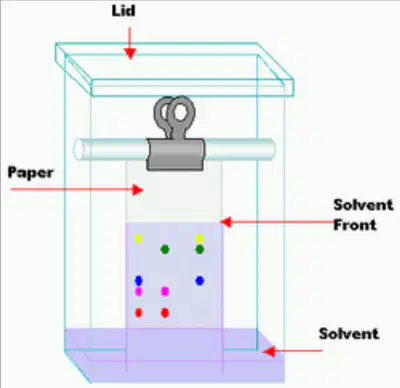
4


A specialized, highly uniform and absorbent filter paper (cellulose)
Chromatography Paper (Stationary Phase)
A liquid (often water, ethanol, or a mixture of organic solvents) placed in the container
Solvent (Mobile Phase)
A container (like a beaker or jar) that holds the mobile phase and the paper. It is usually covered to ensure the atmosphere is saturated with solvent vapor, which prevents the solvent from evaporating as it moves up the paper
Chromatographic Chamber
MAIN COMPONENTS OF THE EQUIPMENT
5


The mixture (e.g., ink, dye, plant extract) applied as a small, concentrated spot near the bottom of the paper
Sample (Baseline)
Used to draw the baseline and apply the sample spots
Pencil/Capillary Tube
6


Used to check the progress of a chemical reaction over time by monitoring the presence of reactants and the appearance of products
Reaction Monitoring
Used extensively for the separation and detection of free amino acids, sugars and related compounds in biochemical analysis
Amino acids, Carbohydrates & Peptides
APPLICATIONS IN LABORATORY OR INDUSTRY
7


Used for the qualitative analysis of drug purity, identifying active compounds and potential impurities in drug development and manufacturing control
Pharmaceutical Industry
Essential for analyzing and identifying both natural and synthetic food colours, additives and dyes in products(e.g. soft drinks, jams, sweets) to ensure compliance with regulatory standards
Food & Beverage Industry
Used to test for and analyze pollutants and contaminants in environmental samples, such as detecting pesticides or heavy metals in water and soil
Environmental Monitoring
8

Simplicity & Ease of Use : The setup and procedure are very straightforward, requiring minimal training to perform
Cost : Inexpensive method, require only basic, readily available equipment (filter paper, solvent and container)
Minimal Sample Requirement : Only small amount of the sample mixture for analysis
Non-Destructive : The separated components can be recovered from the paper after analysis if needed further testing
Versatility : It can be adapted to separate both inorganic and organic compounds with varying polarities
Excellence : Effective for determining what components are present in mixture (e.g. separating plant pigments or food dyes)
ADVANTAGES OF PAPER CHROMATOGRAPHY
9
LIMITATIONS OF PAPER CHROMATOGRAPHY
Low Resolution : It often fails to adequately separate compounds that have similar properties, resulting in overlapping spots and making precise identification difficult
Limited Sample Capacity : Not suitable for separating or purifying large amounts of a sample
Slow Process : While often rapid, the seperation process can sometimes take a long time(hours) depending on the solvent and the complexity of the mixture
Inability : For mixtures with many components, the limited resolution makes the chromatogram difficult to interpret
Not Suitable for Volatile Substances : Compounds that evaporate easily may be lost before the separation is complete, leading to inaccurate results
Difficulty in Reproducing Results : Results can be highly dependent on environmental conditions (temperature & chamber saturation), the quality of paper and manual technique, making it hard to achieve consistent, reproducible results
10
Multiple Choice
What is the main purpose of paper chromatography?
To determine the pH of a solution
To separate components in a mixture
To measure the concentration of a solution
To determine the melting point of a substance
11
Multiple Choice
What is the stationary phase in paper chromatography?
Solvent
Chromatography paper
Sample
Air
12
Multiple Choice
A food safety laboratory is testing a batch of imported candy to ensure no illegal, non-permitted colorants have been added. Which application of paper chromatography is most directly relevant to this quality control task?
Separation of free amino acids for clinical diagnostics
DNA and RNA fingerprinting
Qualitative analysis of food dyes and additives
Monitoring of polymerization reactions in chemical manufacturing
13
Multiple Choice
A student successfully uses paper chromatography to separate a dye mixture into four distinct coloured spots. What is the primary limitation of this technique that prevents the student from precisely determining the mass or concentration of each individual separated dye?
The technique is inherently a qualitative method and lacks the necessary instrumentation and precision for accurate quantitative analysis
The high cost of the specialized cellulose paper makes quantitative analysis prohibitively expensive
It can only be used with inorganic compounds, and dye mixtures are organic
The resolution is too high, causing the spots to overlap and making measurement impossible
14
THANK
YOU
PAPER CHROMATOGRAPHY
By Group 13
Show answer
Auto Play
Slide 1 / 14
SLIDE
Similar Resources on Wayground

13 questions
ACCOUNTING
Presentation
•
University
13 questions
Changing fractions to decimals; decimals to fractions
Presentation
•
University
8 questions
The Periodic Table
Presentation
•
University
12 questions
What is Science?
Presentation
•
KG - 12th Grade
10 questions
Writing: In-Text Citation
Presentation
•
University
14 questions
Electron Math
Presentation
•
9th - 12th Grade
10 questions
ICT QUIZIZZ
Presentation
•
University
10 questions
REPORT TEXT
Presentation
•
12th Grade - University
Popular Resources on Wayground
24 questions
PBIS-HGMS Day 10

Quiz
•
6th - 8th Grade
10 questions
HCS SCI 03 Summer School Review 3
Quiz
•
3rd Grade
11 questions
Home Scope
Quiz
•
7th - 8th Grade
15 questions
HCS SCI 05 Summer School Assessment 3 Review
Quiz
•
5th Grade
35 questions
Lufkin Road Middle School Student Handbook & Policies Assessment
Quiz
•
7th Grade
18 questions
Geo 11.3 Area of Circles and Sectors
Quiz
•
9th - 11th Grade