Forces That Shape Our Earth
Presentation
•
Science
•
9th - 12th Grade
•
Practice Problem
•
Easy
+5
Standards-aligned
JANICE MCKENNA
Used 3+ times
FREE Resource
21 Slides • 23 Questions
1
2
3
4
Labeling
Label each plate boundary.
Convergent
Transform
Divergent
5
6
Multiple Choice
Hotter, less dense magma near the core...
rises.
sinks.
7
Multiple Choice
Colder, more dense magma near the crust...
rises.
sinks.
8
Multiple Choice
Convection currents occur due to...
rotation of earth
differences in temperature and density
electrons moving
gravitational pull
9
10
Multiple Choice
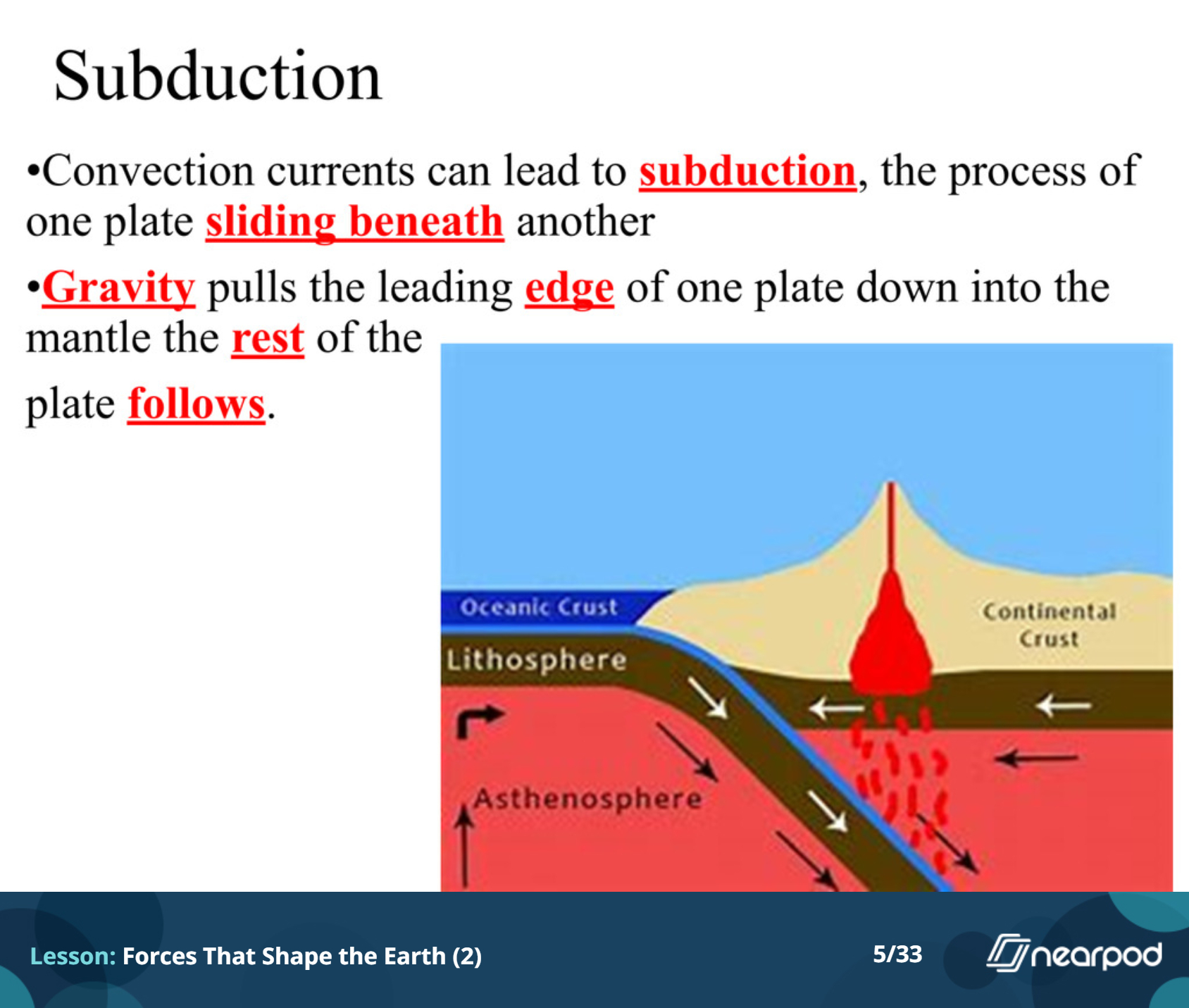
Which of the following statements about subduction is correct?
Subduction occurs when one plate slides beneath another due to convection currents.
Subduction occurs when plates move apart from each other.
Subduction is the process where plates move horizontally past each other.
Subduction happens only at mid-ocean ridges.
11
12
Multiple Select
Select all the major tectonic plates shown in the image.
Pacific Plate
Eurasia Plate
Indian Plate
Antarctic Plate
13
14
Fill in the Blanks
Plate boundaries are areas where the edges of Earth's plates meet and
15
16
Dropdown
17
18
Drag and Drop
divergent
transform
insurgent
19
Multiple Choice
Which type of plate boundary is responsible for the formation of mountains?
Ocean-Continental Convergent Boundary
Ocean-Ocean Convergent Boundary
Continental-Continental Convergent Boundary
Transform Boundary
20
21
Dropdown
22
23
Fill in the Blanks
Fill in the blank: Stress is the measure of the amount of
24
25
Multiple Select
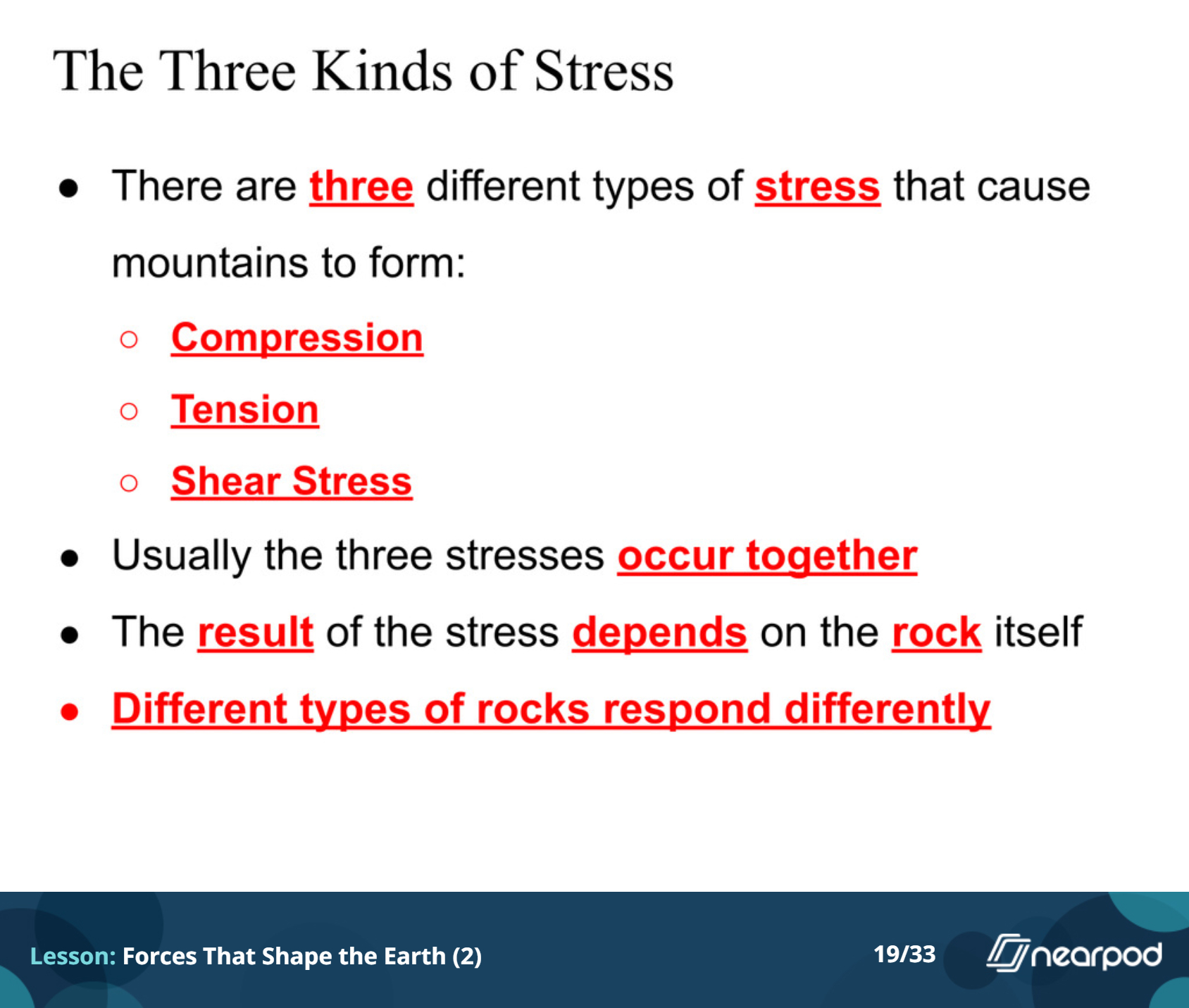
Which of the following are types of stress that cause mountains to form?
Compression
Tension
Shear Stress
Expansion
26
27
Multiple Choice
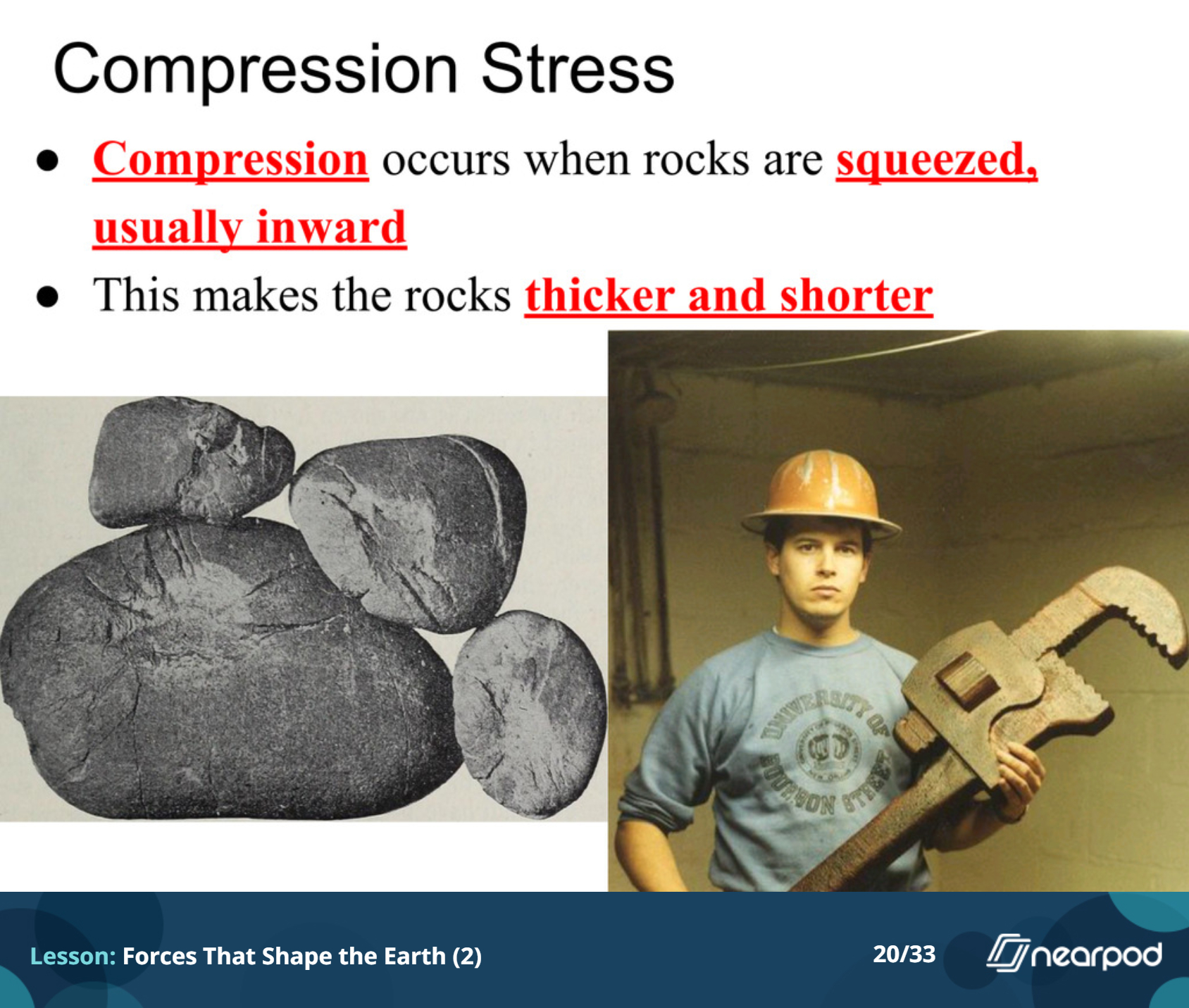
What happens to rocks when compression stress is applied to them?
They become thinner and longer
They become thicker and shorter
They break into small pieces
They melt
28
29
30
Multiple Choice
What type of stress causes rocks to be pushed in different and opposite directions, resulting in a distorted appearance?
Shear stress
Compression stress
Tension stress
Elastic stress
31
32
Multiple Select
Which of the following can result from faults in the Earth's lithosphere?
Earthquakes
Mountain building
Volcanic eruptions
Flooding
33
Label the Fault in your notes
34
Fill in the Blanks
The surface between the two moving pieces of crust at a fault is called the
35
36
Multiple Choice
In a normal fault, what happens to the hanging wall?
It moves down
It moves up
It stays in place
It splits apart
37
38
39
Multiple Choice
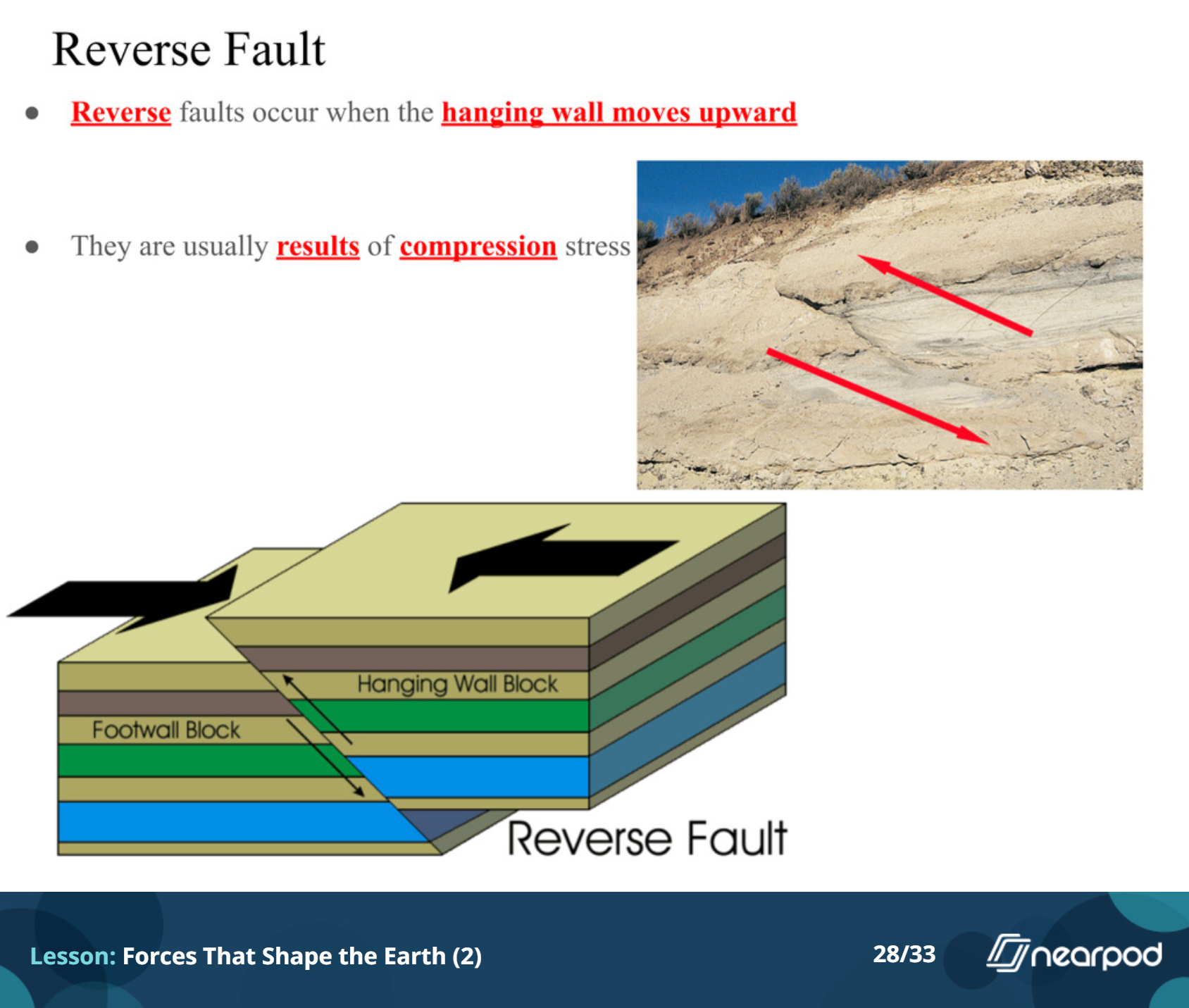
Reverse faults are usually the result of which type of stress?
Compression
Tension
Shear
Elastic
40
41
Multiple Choice
What is a strike-slip fault and how does it differ from other types of faults?
It occurs when rocks move horizontally past each other on either side of the fault plane.
It occurs when rocks move vertically past each other on either side of the fault plane.
It occurs when rocks move diagonally past each other on either side of the fault plane.
It occurs when rocks do not move at all on either side of the fault plane.
42
Multiple Choice
Which type of fault is characterized by two blocks of rock sliding horizontally past each other in opposite directions?
Strike-slip fault
Normal fault
Reverse fault
Thrust fault
43
Multiple Choice
Which type of boundary is responsible for the formation of rift valleys and ocean ridges?
Convergent boundary
Divergent boundary
Transform boundary
Subduction zone
44
Open Ended
Reflecting on today's lesson about forces that shape the surface of the Earth, what is one question you still have or one concept you would like to explore further?
Show answer
Auto Play
Slide 1 / 44
SLIDE

Similar Resources on Wayground
41 questions
12.1 Water
Presentation
•
9th - 12th Grade
37 questions
Energy and Energy Transformations
Presentation
•
9th - 12th Grade
41 questions
Earthquakes Notes w/ videos
Presentation
•
9th - 12th Grade
41 questions
Air Pollution Lesson
Presentation
•
9th - 12th Grade
40 questions
Work, Power and Machines AMA and IMA
Presentation
•
9th - 12th Grade
36 questions
Lab Safety Rules
Presentation
•
9th - 12th Grade
36 questions
Levels of Organization - Cells to Biome
Presentation
•
KG
39 questions
Renewable and Nonrenewable Resources
Presentation
•
9th Grade - University
Popular Resources on Wayground
10 questions
Safety Day 2026 – Student Review
Quiz
•
9th Grade
21 questions
Continents and Oceans
Quiz
•
6th Grade
20 questions
Parts of Speech
Quiz
•
5th Grade
16 questions
Subject & Predicate
Quiz
•
5th Grade
25 questions
Multiplication Facts
Quiz
•
5th Grade
12 questions
Map Skills
Quiz
•
3rd Grade
22 questions
Continents and Oceans
Quiz
•
5th Grade
15 questions
Rounding Decimals
Quiz
•
5th Grade
Discover more resources for Science
10 questions
Exploring Chemical and Physical Changes
Interactive video
•
6th - 10th Grade
20 questions
Atomic Structure
Quiz
•
9th Grade
10 questions
Exploring the Electromagnetic Spectrum for Middle School Science
Interactive video
•
6th - 10th Grade
10 questions
Exploring Force and Motion Concepts
Interactive video
•
6th - 10th Grade
10 questions
Exploring Air Masses and Weather Fronts
Interactive video
•
6th - 10th Grade
14 questions
Periodic Trends
Interactive video
•
11th Grade
10 questions
Exploring the States of Matter
Interactive video
•
6th - 10th Grade
10 questions
Exploring Forces: Net Force, Normal Force, Gravity, and Friction
Interactive video
•
6th - 10th Grade