

Unit 305 Testing & Commissioning

Presentation
•
Construction
•
1st Grade
•
Practice Problem
•
Medium

Christopher Formenti
Used 2+ times
FREE Resource
25 Slides • 27 Questions
1

2

3
Open Ended
What are some key steps involved in preparing a hot water system for soundness testing and commissioning?
4
Multiple Choice
Why is it important to test and commission hot water systems before they are put into operation?
To ensure safety and compliance with industry standards
To reduce installation costs
To speed up the installation process
To avoid using system additives
5

6
Multiple Choice
Which certificate must be issued for all installations to ensure compliance with Building Regulations?
Benchmark certificate
Building Regulations Compliance Certificate
Domestic Heating Compliance Guide
Manufacturer’s instructions
7
8
Fill in the Blanks
Type answer...
9

10
Open Ended
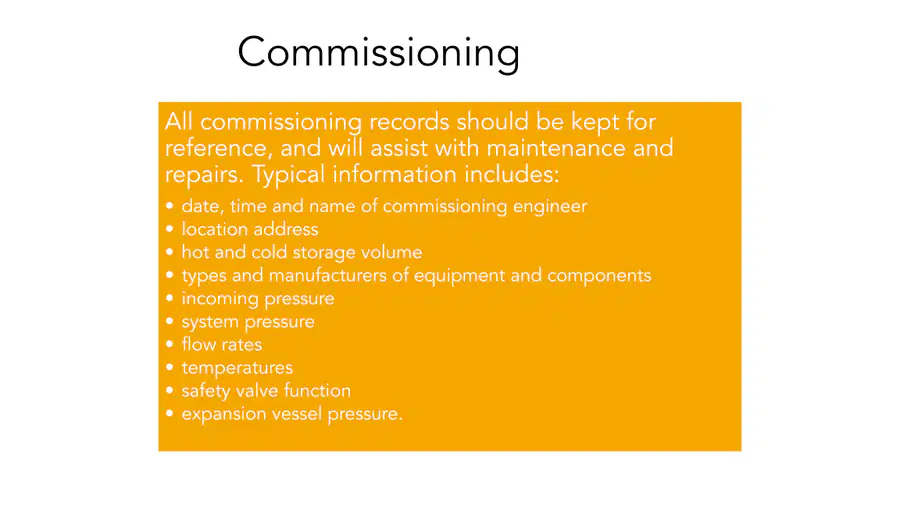
After a system has been tested and commissioned, what documentation must be handed over to the customer?
11

12
Multiple Choice
Which of the following statements about soundness testing of water fittings is correct?
Water fittings should withstand a pressure equal to the maximum operating pressure.
Water fittings should withstand an internal water pressure of at least 1.5 times the maximum operating pressure.
Soundness tests are only required for underground pipework.
Defects found during soundness tests do not need to be rectified.
13

14
Multiple Choice
According to WRAS guidance G12.2, what must happen during the one-hour period after the test pressure is applied to rigid pipework?
The pressure should drop below the test pressure.
Visible leakage is acceptable.
The pressure must not drop below the test pressure and there should be no visible leakage.
Further pumping is required throughout the hour.
15

16
Multiple Choice
When testing rigid pipe systems, what should be done to all outlets and float operated valves before increasing water pressure?
Leave them open
Seal all outlets and cap off or isolate float operated valves
Increase pressure without sealing
Disconnect all valves
17

18
Multiple Choice
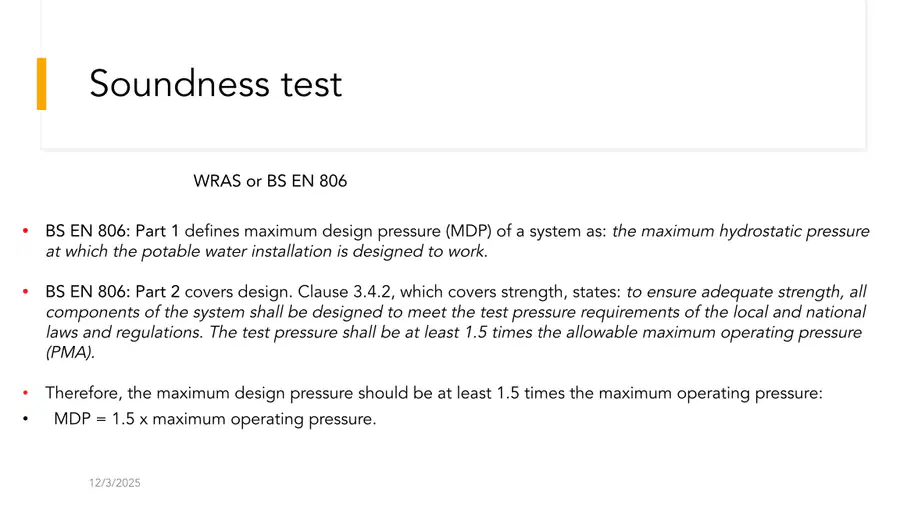
According to BS EN 806, what is the recommended pressure at which plumbing installations and fittings should be tested, and how does this compare to the Water Supply (Water Fittings) Regulations requirement?
1.1 times the maximum working pressure, which is lower than the Water Fittings Regulations
1.5 times the maximum working pressure, which is higher than the Water Fittings Regulations
1.1 times the maximum working pressure, which is higher than the Water Fittings Regulations
1.5 times the maximum working pressure, which is lower than the Water Fittings Regulations
19
20
Open Ended
Explain the difference between the maximum design pressure (MDP) and the maximum operating pressure as defined in BS EN 806.
21
22
Multiple Select
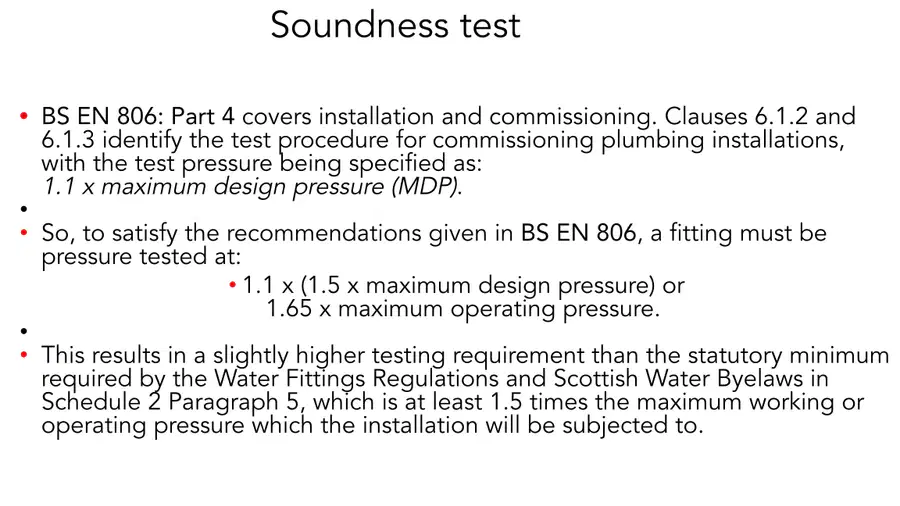
Which of the following statements about BS EN 806 Part 4 soundness test requirements is/are correct?
The test pressure should be 1.1 times the maximum design pressure.
The statutory minimum required by Water Fittings Regulations is 1.5 times the maximum operating pressure.
BS EN 806 requires a lower test pressure than UK national requirements.
A fitting must be pressure tested at 1.65 times the maximum operating pressure.
23

24
Fill in the Blanks
Type answer...
25
26
Open Ended
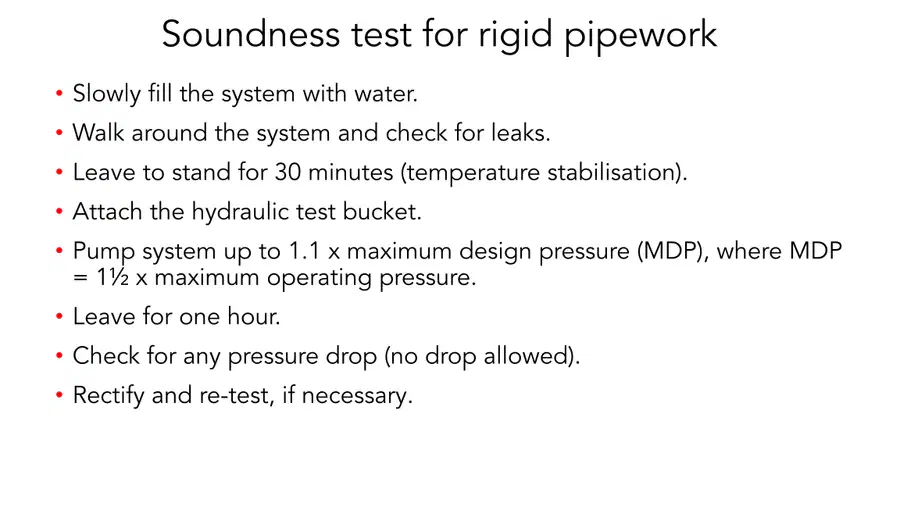
List the steps involved in conducting a soundness test for rigid pipework according to BS EN 806.
27
28
Open Ended
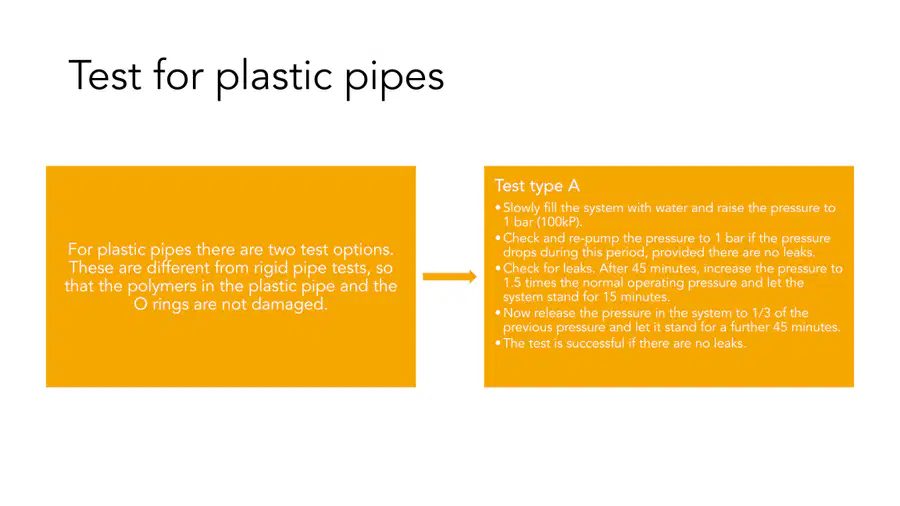
Why are the test procedures for plastic pipes different from those for rigid pipes, and what is the purpose of these differences?
29
30
Multiple Choice
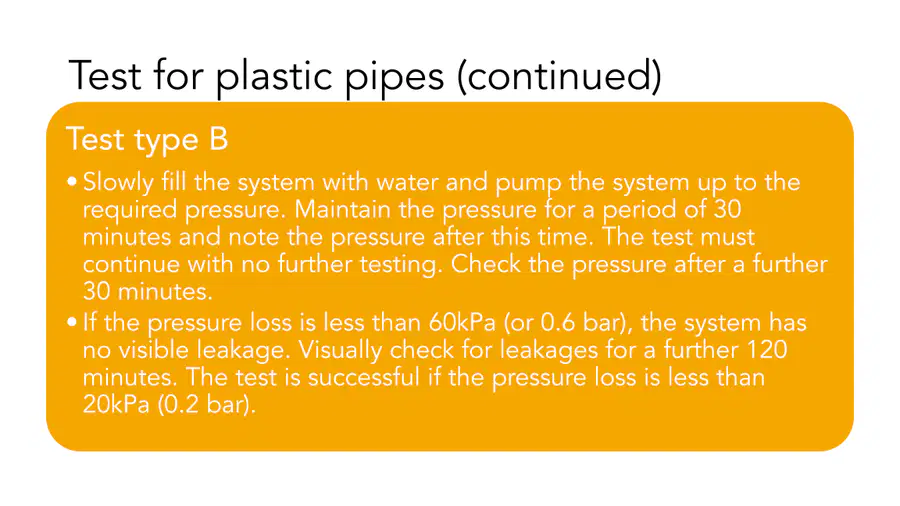
Which of the following steps is NOT part of the procedure for Test type B for plastic pipes?
Pump the system up to the required pressure and maintain for 30 minutes
Check the pressure after a further 30 minutes
Visually check for leakages for 120 minutes
Increase the pressure if loss is detected
31

32
Multiple Choice
What should be checked and rectified before pressure testing a pipe installation?
Pipe material
Pipe color
Joint integrity and installation conformity
Water temperature
33

34
Open Ended
Explain why it is necessary to flush a new water service pipe before putting it into use.
35

36
Multiple Select
Which of the following are steps in the flushing procedure for newly installed pipes?
Open all terminal fittings to produce high flow
Allow water to run until visually clear
Confirm water clarity using a clear vessel
Add chlorine to the water
37

38
Fill in the Blanks
Type answer...
39

40
Multiple Choice
After flushing, what is the minimum free residual chlorine level required for successful disinfection at the end of one hour?
10ppm
20ppm
30ppm
50ppm
41
42
Multiple Choice
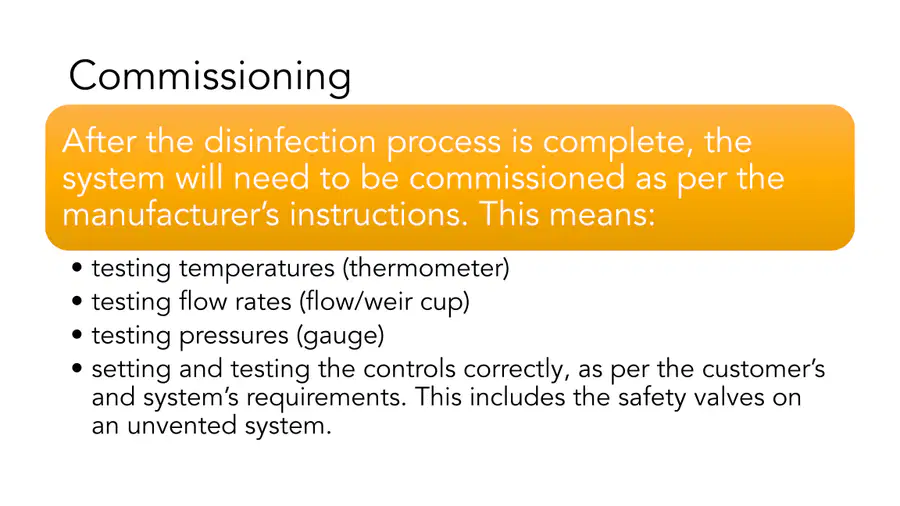
Which of the following steps is NOT part of the commissioning process after disinfection, according to the manufacturer's instructions?
Testing temperatures
Testing flow rates
Testing pressures
Visual inspection
43

44
Open Ended
Describe the sequence of steps involved in the whole process of installing and commissioning a water system, as shown in the diagram.
45

46
Multiple Select
Which of the following statements about hard water and water softeners is/are correct?
A water softener removes calcium carbonates from hard water.
The feed to the kitchen sink is treated by the water softener.
The customer must refill the softener with salt tablets.
A water softener is connected to the rising mains in the property.
47

48
Open Ended
Explain why a neutraliser pack and a primary pipework inhibitor may be necessary in a hot water system.
49
Fill in the Blanks
Type answer...
50

51
Multiple Choice
Which of the following is a requirement for flushing new and existing hot water systems according to industry standards?
Use of system additives
Ignoring system additives
Partial flushing only
No flushing required
52
Open Ended
Reflecting on today's session about hot water systems, what is one key aspect of testing and commissioning that you would like to learn more about or found most challenging?
Show answer
Auto Play
Slide 1 / 52
SLIDE
Similar Resources on Wayground

48 questions
Grade 1 - Mid-term Review
Presentation
•
1st Grade
47 questions
untitled
Presentation
•
KG
46 questions
Colors
Presentation
•
1st Grade
48 questions
Wh Questions
Presentation
•
KG
45 questions
A1 Practica de conocimientos #5
Presentation
•
1st Grade
45 questions
EF Intermediate Unit 1
Presentation
•
KG
49 questions
m4 unit 6
Presentation
•
1st Grade
45 questions
Biological Evidence of Evolution: Comparative Anatomy
Presentation
•
1st Grade
Popular Resources on Wayground
10 questions
HCS SCI 03 Summer School Review 4

Quiz
•
3rd Grade
11 questions
HSMS - Standard Response Protocol
Quiz
•
6th - 8th Grade
16 questions
1.1-1.2 Quiz Review
Quiz
•
9th - 12th Grade
12 questions
Exponent Expressions
Quiz
•
6th Grade
20 questions
Adding and Subtracting Integers
Quiz
•
6th - 7th Grade
11 questions
Northeast States
Quiz
•
3rd - 4th Grade
10 questions
Characterization
Quiz
•
3rd - 7th Grade
10 questions
Common Denominators
Quiz
•
5th Grade