

Strategic Capacity Planning - OPM400

Presentation
•
Education
•
University
•
Practice Problem
•
Hard

Marie Tu Doan
Used 4+ times
FREE Resource
30 Slides • 26 Questions
1

2
Open Ended
List 5 actions to improve your grades in OPM400 for this semester and which one should be your priority 1?
3
4
Open Ended
How do capacity strategies impact the overall effectiveness of an organization?
5
Multiple Choice
Why is strategic capacity planning important for organizations?
It helps organizations meet future demand efficiently.
It reduces the need for employee training.
It eliminates all production bottlenecks.
It guarantees maximum profit.
6
Multiple Choice
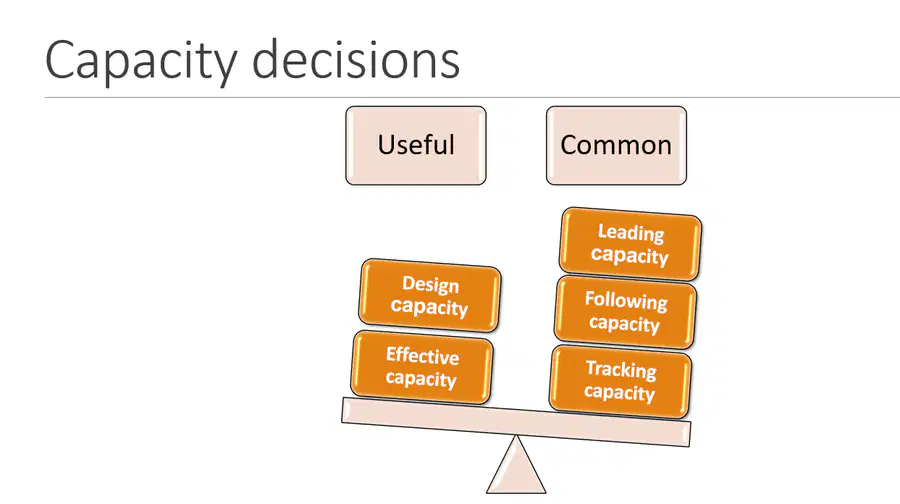
Which of the following is considered a 'useful' capacity decision?
Design capacity
Leading capacity
Tracking capacity
Following capacity
7
8
9
Multiple Select
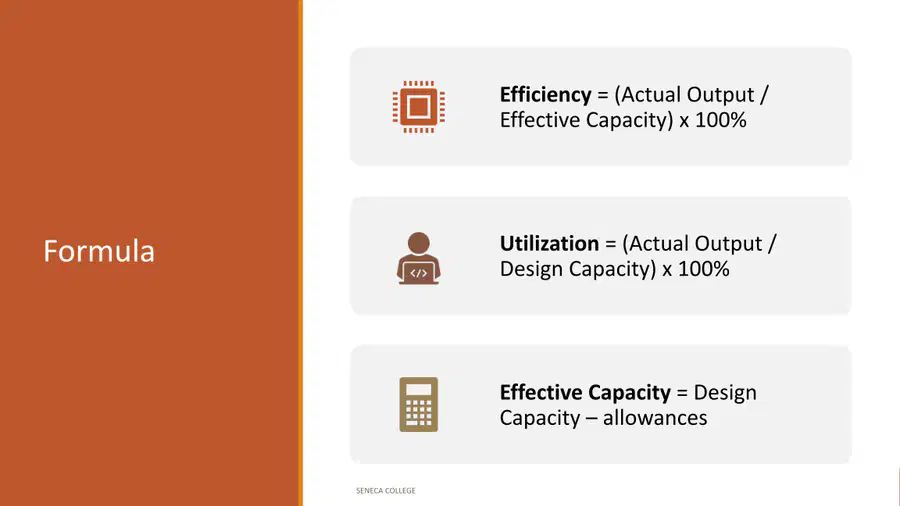
Select all the correct formulas for calculating capacity metrics.
Efficiency = (Actual Output / Effective Capacity) x 100%
Utilization = (Actual Output / Design Capacity) x 100%
Effective Capacity = Design Capacity + allowances
Effective Capacity = Design Capacity - allowances
10
11
Multiple Choice
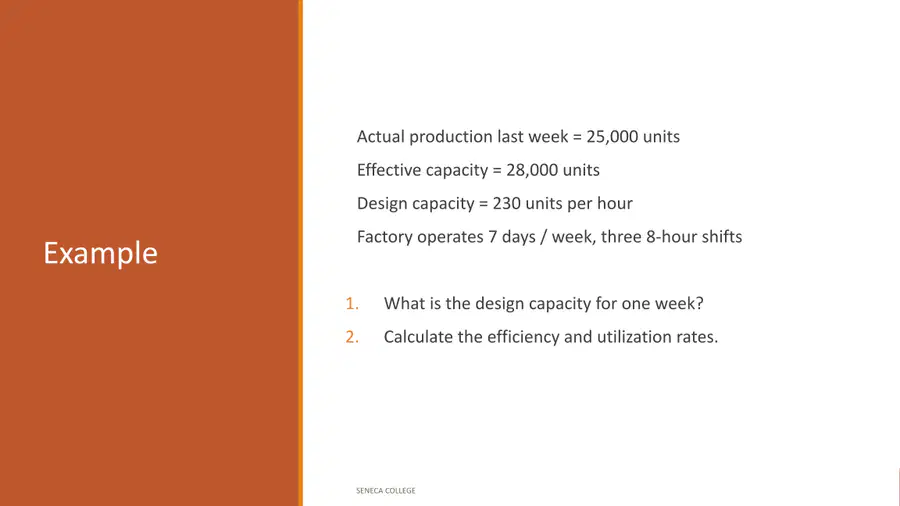
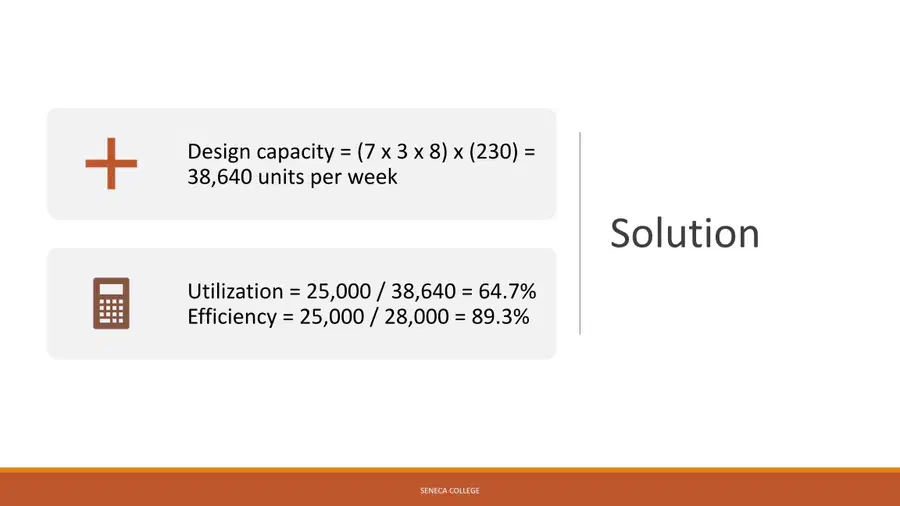
Actual production last week was 25,000 units, effective capacity was 28,000 units, and design capacity was 230 units per hour. The factory operates 7 days a week, three 8-hour shifts. What the Design capacity for one week, Utilization factor, & Efficiency Factor?
38,640 units per week, 64.7%, 89.3%
38,640 units per week, 66.7%, 89.3%
39,640 units per week, 64.7%, 89.3%
38,640 units per week, 64.7%, 98.3%
12
13
Multiple Choice
Actual production last week was 35,000 units, effective capacity was 48,000 units, and design capacity was 430 units per hour. The factory operates 7 days a week, three 8-hour shifts. What the Design capacity for one week, Utilization factor, & Efficiency Factor?
"Design Capacity for one week": 72240, "Utilization Factor": 0.7492, "Efficiency Factor": 0.484
"Design Capacity for one week": 72240, "Utilization Factor": 0.7292, "Efficiency Factor": 0.484
"Design Capacity for one week": 72240, "Utilization Factor": 0.7292, "Efficiency Factor": 0.484
"Design Capacity for one week": 72240, "Utilization Factor": 0.7292, "Efficiency Factor": 0.484
14
15
Multiple Choice
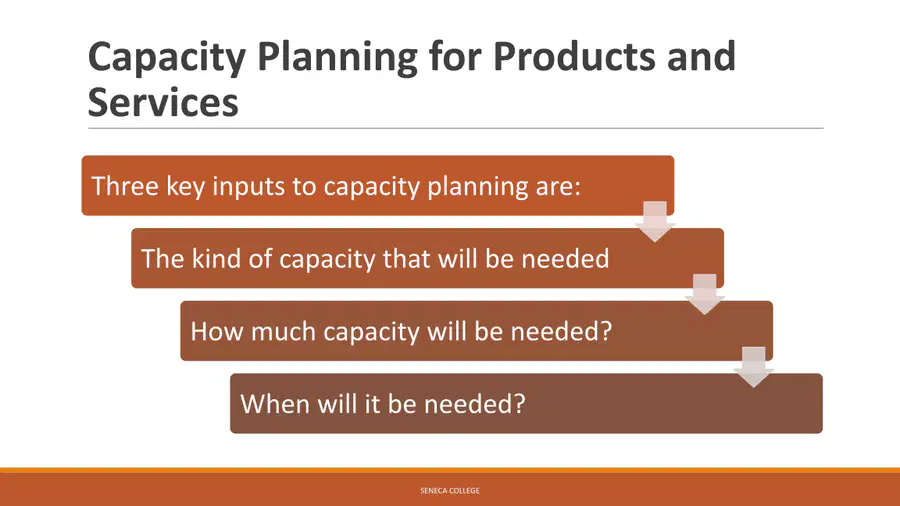
What are the three key inputs to capacity planning for products and services?
Kind of capacity, amount of capacity, timing of capacity
Labour hours, available beds, floor space
Design capacity, effective capacity, tracking capacity
Actual output, allowances, utilization
16
17
Multiple Select
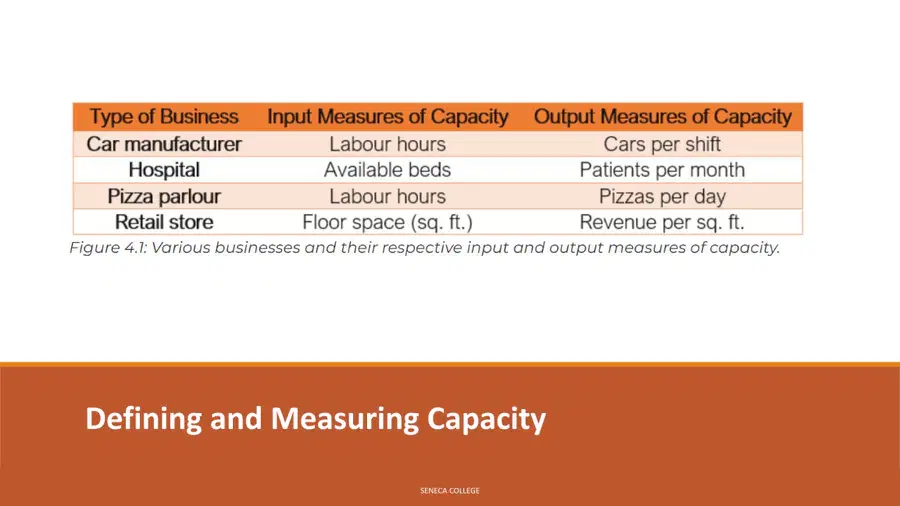
Match each type of business with its corresponding input and output measures of capacity.
Pizza store: Available Beds, Pizza
Hospital: Available beds, Patients per month
Car manufacturer: Labor hours, Cars
Retailer: Labor hours, Floor space
18
19
Multiple Choice
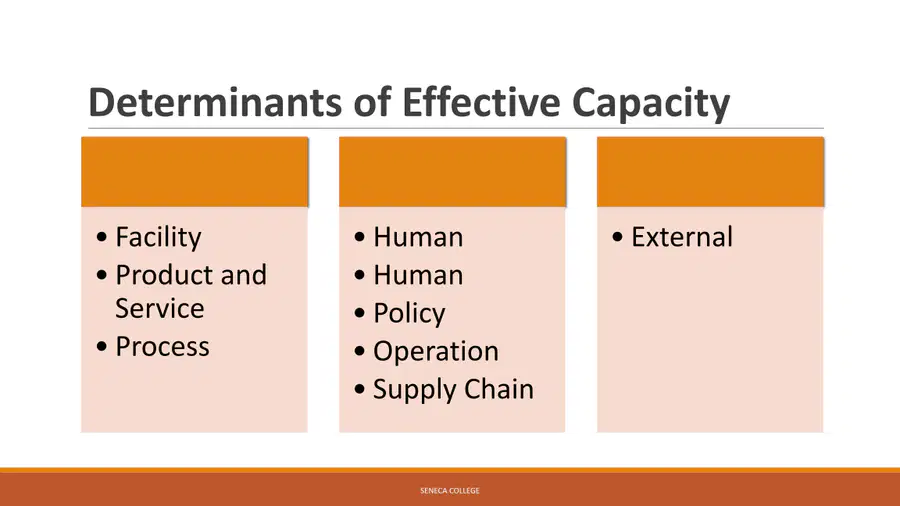
Which of the following is NOT a determinant of effective capacity according to the slide?
Facility
Human
External
Finance
20

21
22
Open Ended
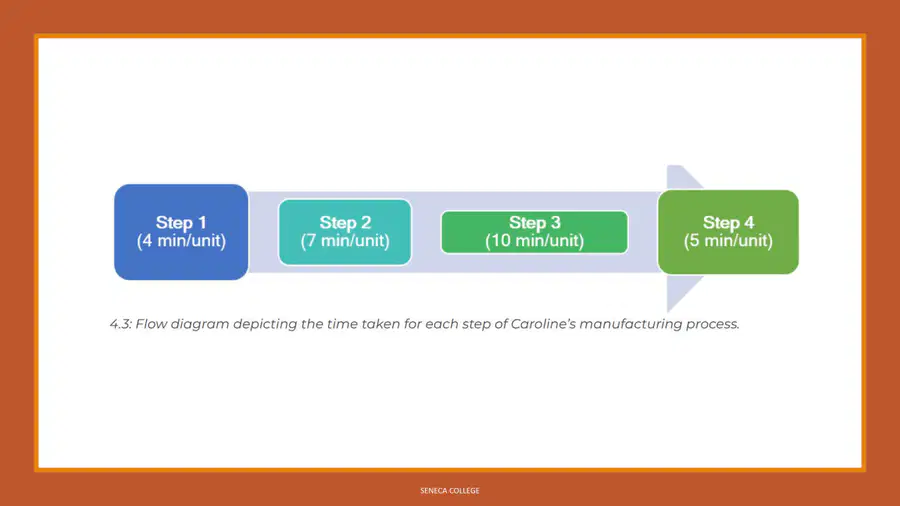
Explain how a bottleneck affects the overall capacity of a production process, using the diagrams provided.
23
24
Multiple Choice
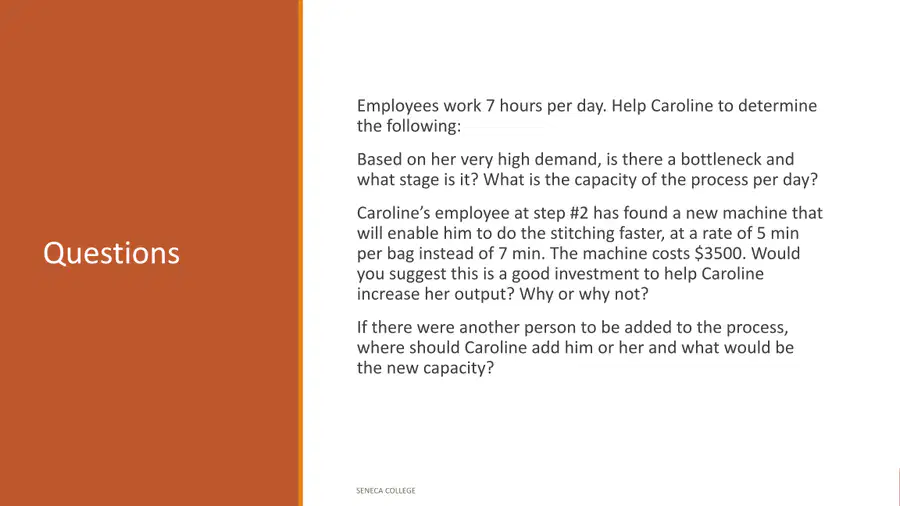
Employees work 7 hours per day and produce 60 units/hour. Help Caroline to determine the following: Based on her very high demand, is there a bottleneck and what stage is it? What is the capacity of the process per day?
S4, S1 = 105, S2 = 90, S3 = 42, S4 = 84
S3, S1 = 105, S2 = 60, S3 = 42, S4 = 98
S2, S1 = 109, S2 = 60, S3 = 42, S4 = 84
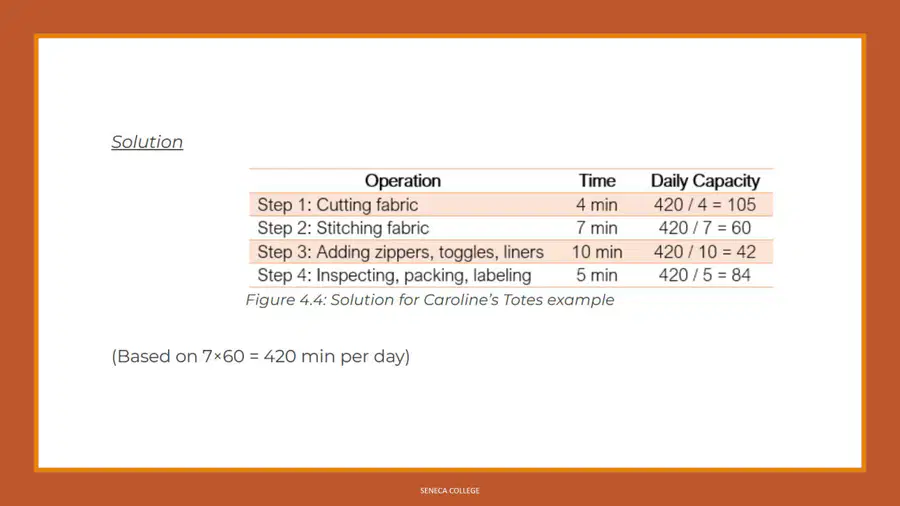
S3, S1 = 105, S2 = 60, S3 = 42, S4 = 84
25
26
The maximum output is 42 units, because that is what the bottleneck can do.
The bottleneck is at stage #3.
Caroline should NOT invest any funds into step #2.
If Caroline added another person, she should add it to step #3. (Install zippers/ toggles/ liner).
- The capacity at stage three would now double to 84 units per day.
- The new capacity for the whole process would now be 60 units per day, as determined by Step 2 (Basic stitching) which is the new bottleneck of the process.
27
28
Multiple Choice
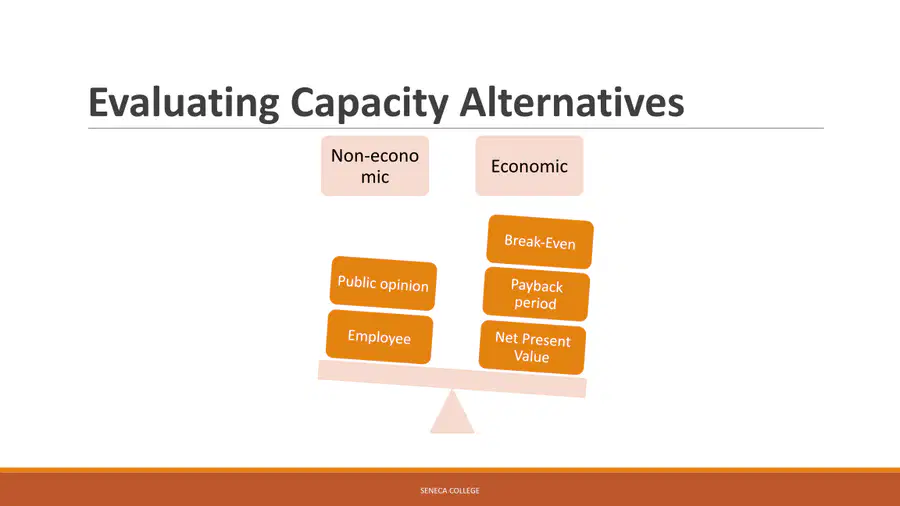
Which of the following is an economic factor used in evaluating capacity alternatives?
Public opinion
Employee
Break-Even
Policy
29
30
Multiple Choice
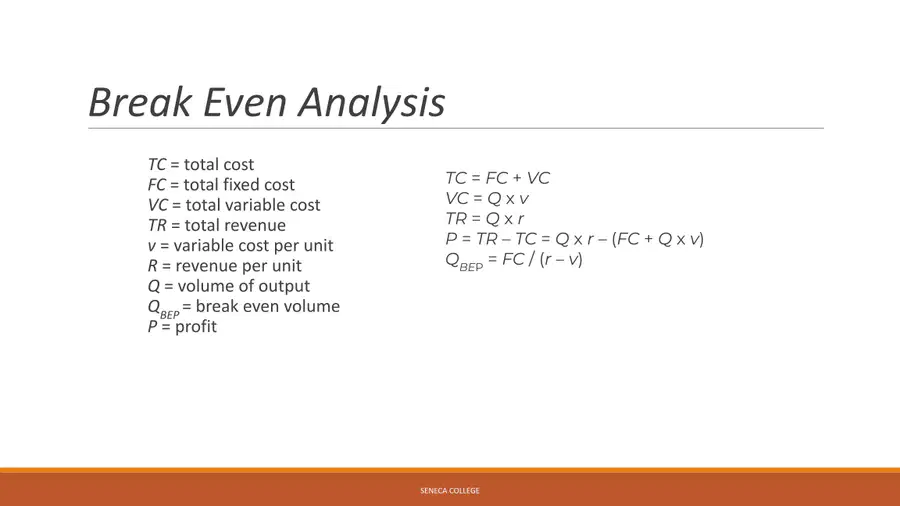
Which of the following statements about break-even analysis is correct?
Break-even volume is the point where total revenue equals total cost.
Profit is maximized at the break-even volume.
Fixed costs are irrelevant in break-even analysis.
Variable cost per unit does not affect the break-even point.
31
Multiple Choice
Which formula is used to calculate the break-even volume in break-even analysis?
Q_BEP = FC / (r - v)
Q_BEP = VC / (r - v)
Q_BEP = TC / (r - v)
Q_BEP = FC / (v - r)
32
33
Multiple Choice
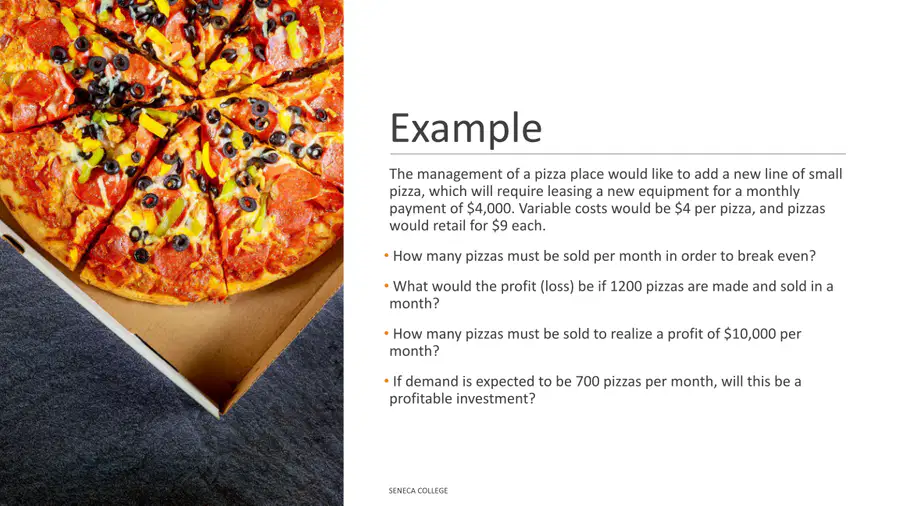
The management of a pizza place would like to add a new line of small pizza, which will require leasing a new equipment for a monthly payment of $4,000. Variable costs would be $4 per pizza, and pizzas would retail for $9 each.
1.How many pizzas must be sold per month in order to break even?
2.What would the profit (loss) be if 1200 pizzas are made and sold in a month?
3.How many pizzas must be sold to realize a profit of $10,000 per month?
4.If demand is expected to be 700 pizzas per month, how much is profit/loss?
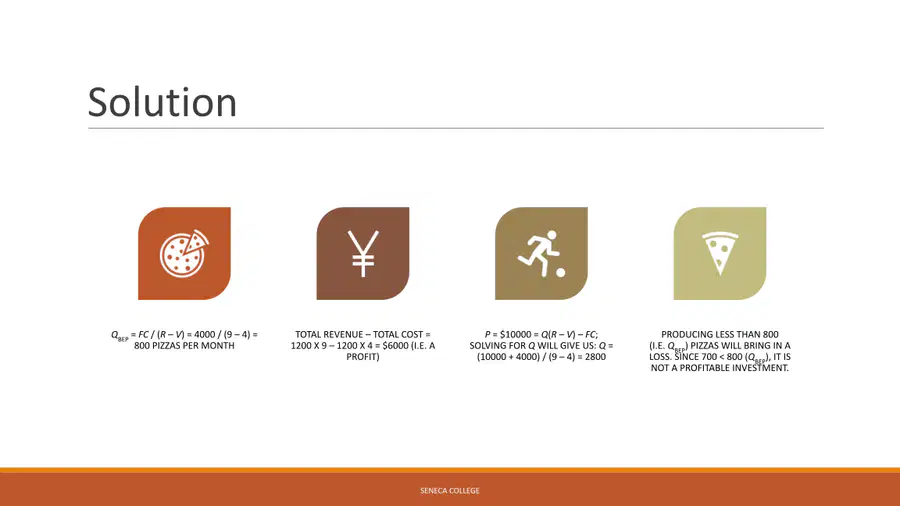
1.Q_BEP = 800
2.P= $5,000
3.Q = 2,800
4.L=-500
1.Q_BEP = 800
2.P= $6,000
3. Q = 2,800
4.L=-500
1.Q_BEP = 800
2.P= $6,000
3.Q = 3,800
4.L=-500
1.Q_BEP = 800
2.P= $6,000
3.Q = $2,800
4.L=-700
34
35
Multiple Choice
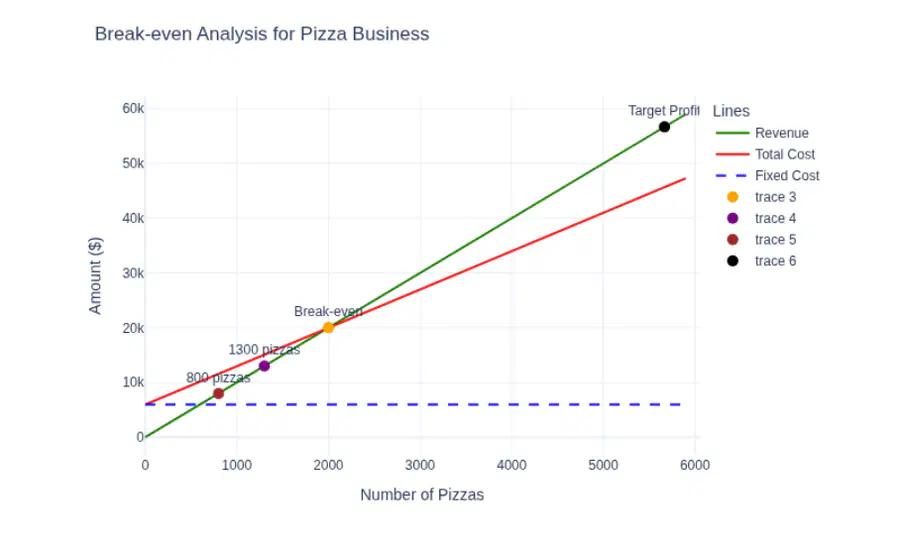
The management of a pizza place would like to add a new line of small pizza, which will require leasing a new equipment for a monthly payment of $6,000. Variable costs would be $7 per pizza, and pizzas would retail for $10 each.
1.How many pizzas must be sold per month in order to break even?
2.What would the profit (loss) be if 1,300 pizzas are made and sold in a month?
3.How many pizzas must be sold to realize a profit of $11,000 per month?
4.If demand is expected to be 800 pizzas per month, how much is profit/loss?
1.Q_BEP = 2000
2.L= -$2,100
3.Q = 5,667
4.L=-3,600
1.Q_BEP = 2000
2.L= -$3,100
3.Q = 5,667
4.L=-3,600
1.Q_BEP = 2000
2.L= -$2,100
3.Q = 5,767
4.L=-3,600
1.Q_BEP = 2000
2.L= -$2,100
3. Q = 5,667
4.L=-4,600
36
Break-even = Fixed cost / Contribution margin = 6,000/ (10 - 7) = 2,000 pizzas
Profit= (Sales)−(Variable cost)−(Fixed cost)
(1300×10)−(1300×7)−6000=13,000−9,100−6,000=−$2,100 (Loss)
Fixed cost = $6,000, Variable cost per pizza = $7, Selling price per pizza = $10
Pizzas needed for $11,000 profit
Required pizzas = (Fixed cost + Target profit) / Contribution margin = (36000+11000) / (10-7) ≈ 5,667 pizzas
Profit/Loss for 800 pizzas
(800×10)−(800×7)−6000=8,000−5,600−6,000=−$3,600 (Loss)
37
38
39
40
41
Multiple Choice
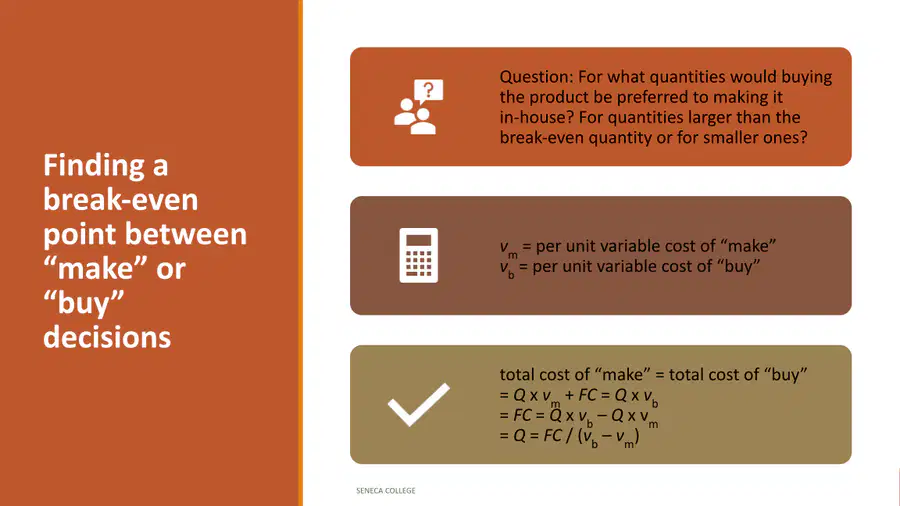
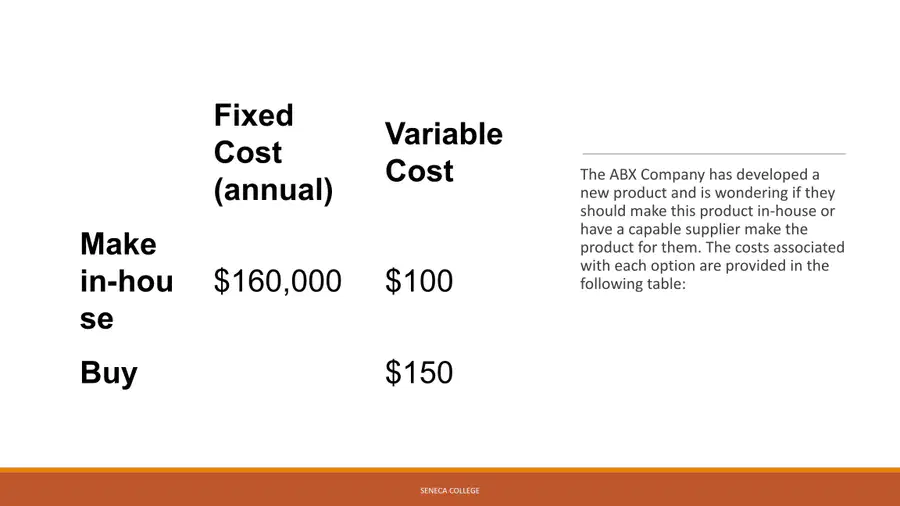
The ABX Company has developed a new product and is wondering if they should make this product in-house or have a capable supplier make the product for them.
Option 1: The Fixed Cost (annual) is $160,000 for Make in-house with Variable Cost is $100.
Option 2: Buy$150.
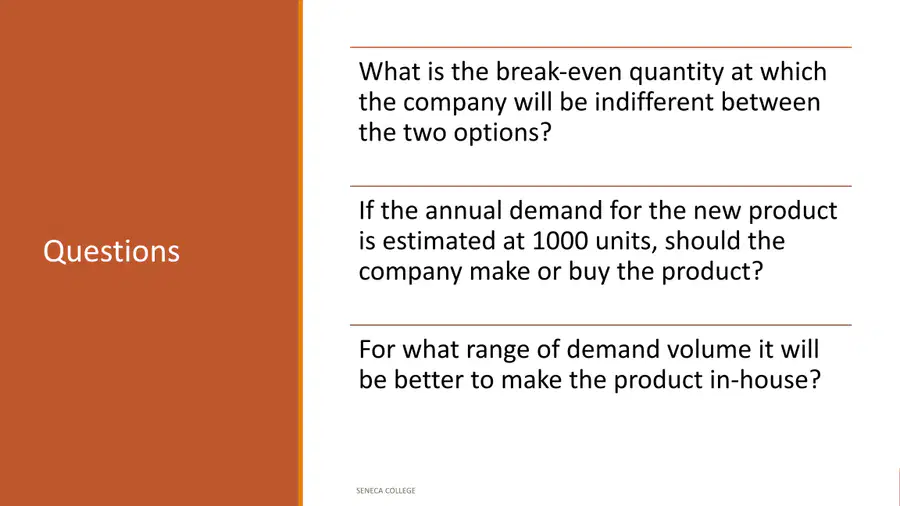
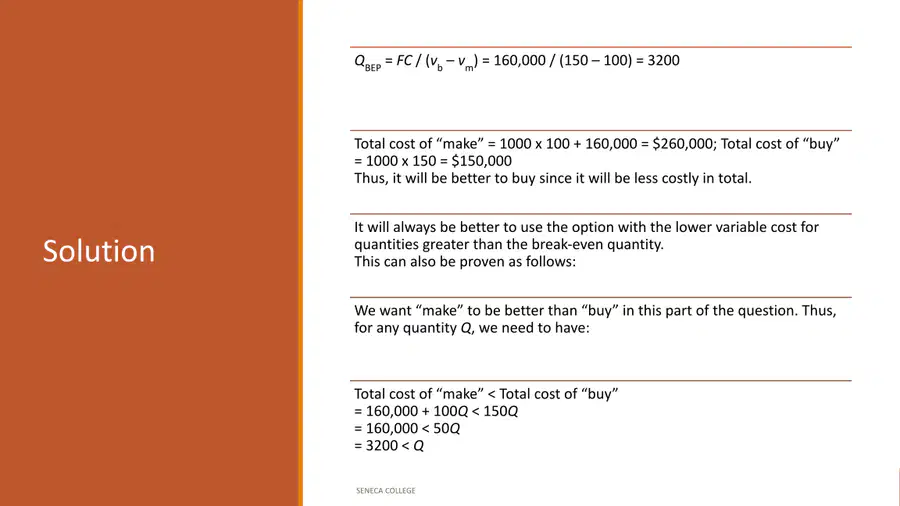
If the annual demand for the new product is estimated at 1000 units, should the company make or buy the product? Justify your answer using the cost data provided.
42
Fill in the Blanks
What is the break-even quantity at which the company will be indifferent between making in-house and buying?
43
44
Multiple Choice
The ABX Company has developed a new product and is wondering if they should make this product in-house or have a capable supplier make the product for them.
Option 1: The Fixed Cost (annual) is $260,000 for Make in-house with Variable Cost is $50.
Option 2: Buy $150.
1.If the annual demand for the new product is estimated at 5000 units, should the company make or buy the product?
2.From which quantity should they consider the option make or buy?
1.Make.
2."2,600 units" is the Indifference point.
1.Make
2."3,600 units" is the Indifference point.
1.Buy
2."1,600 units" is the Indifference point.
1.Buy
2."2,600 units" is the Indifference point.
45
Make in-house total cost
260,000+(50×5,000) =260,000+250,000 = $510,000
Buy total cost
150×5,000 = $750,000
1. Make-in-house: Fixed cost = $260,000, Variable cost = $50/unit,
2. Buy: cost/unit = $150
3. Annual demand = 5,000 units
Indifference Point (Make = Buy)
Fixed cost / (buy Price - Variable Cost) = (260,000 /(150-50) ≈ 2,600 units
46
47
Multiple Choice
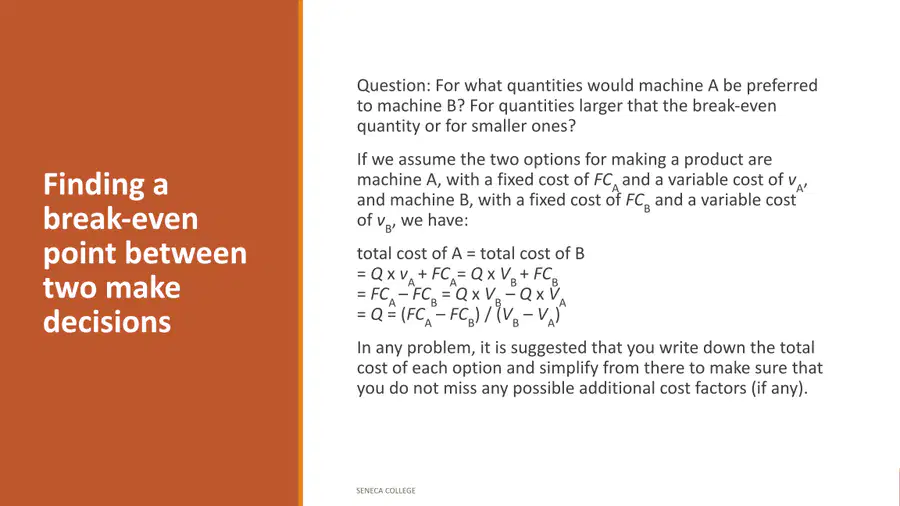
Why is it suggested to write down and simplify the total cost of each option before making a decision between suppliers?
48
49
50
Multiple Choice
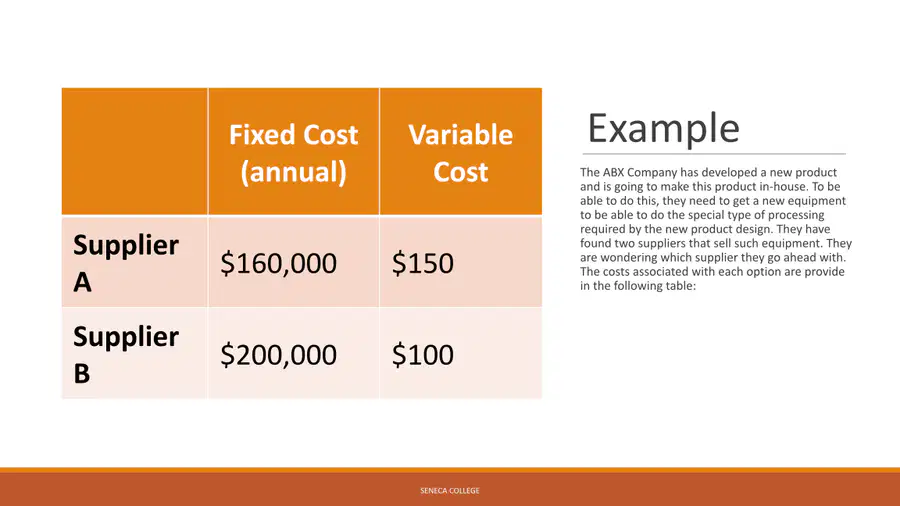
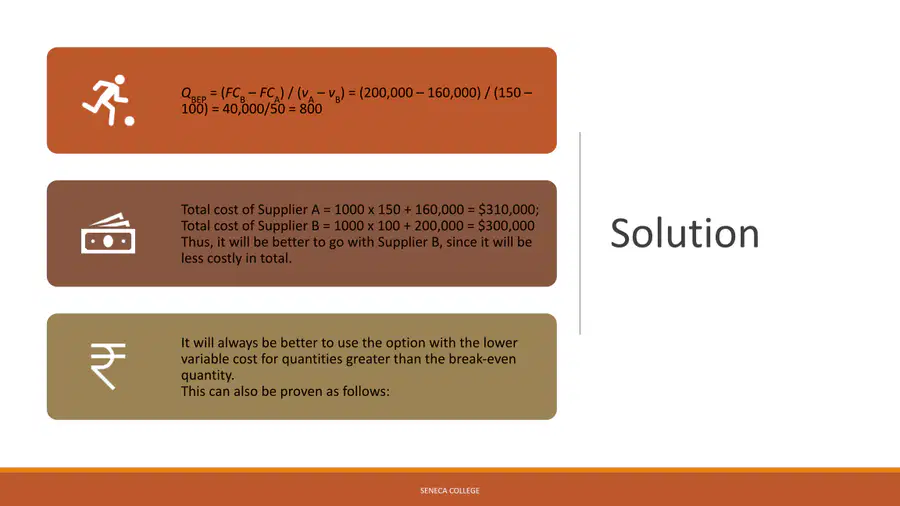
If the annual demand for the new product is estimated at 1000 units, which supplier should the company use? What is the cost for each supplier?
Supplier A. The cost for Supplier A is 300k and for Supplier B is 310k.
Supplier B. The cost for Supplier A is 310k and for Supplier B is 300k.
Both suppliers are equally good. The cost for Supplier A and B is 310k each.
Supplier B. The cost for Supplier A is 210k and for Supplier B is 200k.
51
Multiple Choice
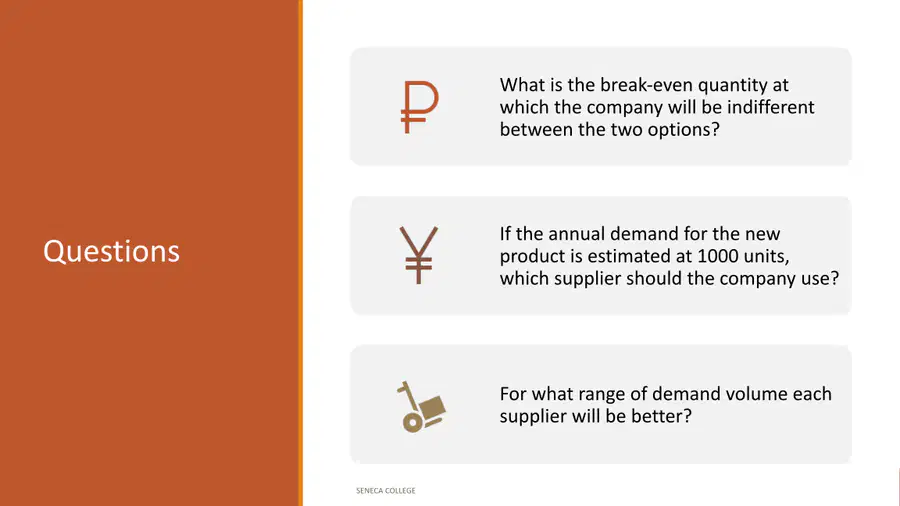
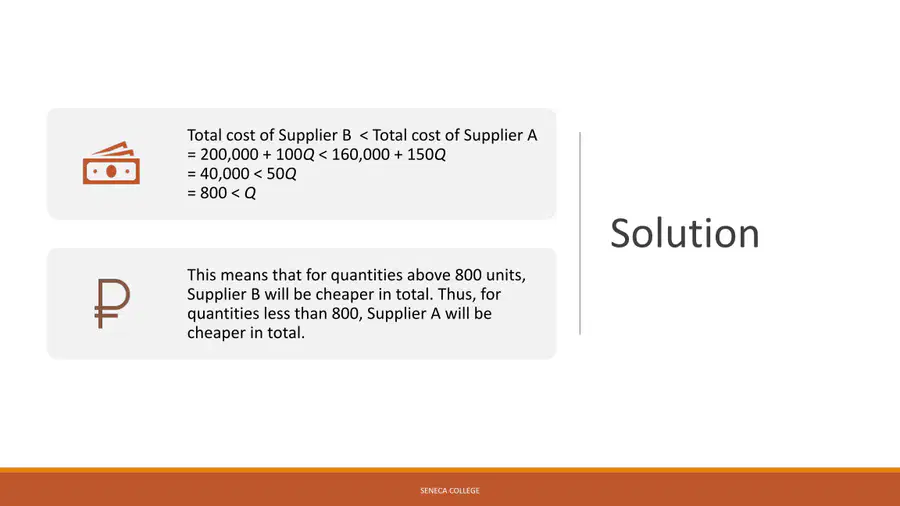
For what range of demand volume will Supplier B be better than Supplier A?
For quantities above 800 units
For quantities below 800 units
For quantities above 1000 units
For quantities below 1000 units
52
Multiple Choice
Given the fixed and variable costs for Supplier A and Supplier B, what is the break-even quantity at which the company will be indifferent between the two options?
800 units
1000 units
3200 units
500 units
53
Fill in the Blanks
The total cost of Supplier B is less than the total cost of Supplier A when the quantity Q is greater than
54
55
56
Open Ended
How would you apply the steps of capacity planning to solve a bottleneck in a real-world process?
Show answer
Auto Play
Slide 1 / 56
SLIDE
Similar Resources on Wayground

52 questions
Celic, Christina M. Ch.1
Presentation
•
University
50 questions
APA Formatting Lesson
Presentation
•
University
49 questions
Chapter 4.2
Presentation
•
University
50 questions
Unit 1 level 333
Presentation
•
University
46 questions
Writing Essays - The development of a paragraph
Presentation
•
University
47 questions
Xmas Quiz
Presentation
•
University
52 questions
Wednesday
Presentation
•
KG
Popular Resources on Wayground
10 questions
Safety Day 2026 – Student Review

Quiz
•
9th Grade
21 questions
Continents and Oceans
Quiz
•
6th Grade
20 questions
Parts of Speech
Quiz
•
5th Grade
16 questions
Subject & Predicate
Quiz
•
5th Grade
25 questions
Multiplication Facts
Quiz
•
5th Grade
12 questions
Map Skills
Quiz
•
3rd Grade
22 questions
Continents and Oceans
Quiz
•
5th Grade
15 questions
Rounding Decimals
Quiz
•
5th Grade