
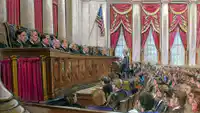
Supreme Court Cases

Presentation
•
History
•
8th Grade
•
Practice Problem
•
Easy

Teresa Smith
Used 7+ times
FREE Resource
8 Slides • 10 Questions
1
Bell Ringer
By Teresa Smith
7 minutes Students you will complete a vocabulary matching Quiz.

2
Standard:8.4-Analyze the challenges and central ideas involved in creating the new nation.
Objective:8.4.4-Analyze the significance of early Supreme Court cases and explain their impacts on the United States (e.g., Marbury vs Madison (1803), McCulloch vs Maryland (1819), Dartmouth College vs Woodward (1819), Worcester vs Georgia (1832), etc.).
I Can Statement: “I can analyze how early Supreme Court cases expanded the power of the federal government.”
3
The Impact of Early Supreme Court Cases on the United States
The Supreme Court of the United States plays a crucial role in interpreting the Constitution and shaping the law. Several landmark cases from the early years of the Court laid the groundwork for how American law operates today. Understanding these cases helps us appreciate the development of justice and governance in the United States.

4
One of the most significant cases is Marbury vs. Madison (1803). This case arose When William Marbury sued Secretary of State James Madison because he didn't receive his appointment as a judge before Thomas Jefferson became president. the Court, led by Chief Justice John Marshall, ruled that the law giving Marbury his job was unconstitutional. This ruling asserted the power of the Court to review acts of Congress and the executive branch, reinforcing the system of checks and balances. The Impactt of this case established a judicial review—the power of the Supreme Court to decide whether laws or actions are constitutional. The significance of this case strengthened the judicial branch and made it an equal part of government.
Marbury vs Madison (1803)
5
Multiple Choice
Who was the Chief Justice who ruled in this case?
Thomas Jefferson
John Adams
John Marshall
James Madison
6
Multiple Choice
When did this case occur?
1833
1803
1840
1819
7
McCulloch vs. Maryland (1819)
Another important case is McCulloch v. Maryland (1819). This case addressed the issue of state versus federal power. The state of Maryland attempted to tax the Bank of the United States, but the Supreme Court ruled that states cannot tax the federal government. The impact of this case confirmed that Congress has implied powers under the Constitution. Chief Justice Marshall stated that "the power to tax involves the power to destroy," emphasizing that states cannot tax federal institutions. the significance of this case strengthened the federal government over state laws.


8
Multiple Choice
What was the main issue in McCulloch v. Maryland?
Taxing a federal bank
Regulating trade between states
. Freedom of speech
Presidential powers
9
Multiple Choice
The Supreme Court ruled that:
Congress had no power to create a bank
States cannot tax the federal government
States could tax the federal government
Federal law was weaker than state law
10
Dartmouth College vs. Woodward (1819)
Another crucial case was Dartmouth College vs. Woodward, which dealt with the issue of private contracts from government interference. The New Hampshire legislative tried to change Dartmouth College from a private institution to a public institution. The Supreme Court ruled that the charter, a legal document that establishes an institution or agreement as a contract under the Constitution, the state couldn’t interfere with Dartmouth’s private contract. The impact of this case protected private property and business contracts from government interference. The significance of this case encouraged economic growth, the protection of private property and business rights.

11
Drag and Drop
12
Worcester vs. Georgia (1832)
Worcester vs. Georgia, this case addressed Georgia passed laws trying to control the Cherokee Native Americans territories. Samuel Worcester, a missionary argued that the state had no right to do so. The Supreme Court ruled that the Cherokee Native American territory was a distinct community and that Georgia laws did not apply there. The impact of this case was a decision that supported Native American sovereignty, the right and power of a nation to govern itself without interference from other countries, but President Andrew Jackson ignored it. The significance of this case showed tensions between the legislative and executive branches of government.

13
Multiple Choice
The Court ruled that:
Georgia had full control over Cherokee lands
The Cherokee were not a distinct nation
Worcester had broken state law
Georgia laws did not apply in Cherokee territory
14
Multiple Choice
What is the meaning of sovereignty?
the right and power to freedom of speech
the right and power of a nation to govern itself
the right and power of states to govern nations
the right and power of a nation to govern states
15
These early Supreme Court cases had lasting impacts on the United States by establishing key legal principles related to judicial review, federalism, contract rights, and the relationship between state and tribal governments. They not only shaped the legal landscape of the nation but also influenced the balance of power among the branches of government. By analyzing these cases, we gain insight into the evolution of American law and the significance of the Supreme Court in protecting constitutional rights. Understanding these foundational cases is essential for appreciating the complexities of the legal system and its role in American democracy.
A Lasting Impact
16
Fill in the Blanks
17
Multiple Choice
the Supreme Court did not protect Constitutional rights
True
False
18
Open Ended
Exit Ticket: What is one take away you learned about the Supreme Court Cases?
Bell Ringer
By Teresa Smith
7 minutes Students you will complete a vocabulary matching Quiz.
Show answer
Auto Play
Slide 1 / 18
SLIDE
Similar Resources on Wayground

13 questions
Lesson 2.5.2 - Life During the Civil War
Presentation
•
8th - 9th Grade
10 questions
Yorktown and Treaty of Paris of 1783
Presentation
•
8th Grade
12 questions
Life in Medieval Europe: An Intro
Presentation
•
7th Grade
12 questions
History
Presentation
•
7th Grade
14 questions
Cuban Missile Crisis
Presentation
•
7th Grade
11 questions
SS8H7b. Analyze how rights were denied to African Americans
Presentation
•
8th Grade
14 questions
Ancient Greece Democracy
Presentation
•
8th Grade
Popular Resources on Wayground
24 questions
PBIS-HGMS Day 10

Quiz
•
6th - 8th Grade
10 questions
HCS SCI 03 Summer School Review 3
Quiz
•
3rd Grade
11 questions
Home Scope
Quiz
•
7th - 8th Grade
15 questions
HCS SCI 05 Summer School Assessment 3 Review
Quiz
•
5th Grade
35 questions
Lufkin Road Middle School Student Handbook & Policies Assessment
Quiz
•
7th Grade
18 questions
Geo 11.3 Area of Circles and Sectors
Quiz
•
9th - 11th Grade