

Unit 4: Hair evidence

Presentation
•
Chemistry
•
9th Grade
•
Practice Problem
•
Easy

Zineb Adnani
Used 4+ times
FREE Resource
24 Slides • 29 Questions
1

2
Multiple Choice
the passing of evidence, such as fiber, from victim to suspect or vice versa.
polymer
monomer
secondary transfer
direct transfer
3
Multiple Choice
the smallest indivisible unit of a textile, it must be at least 100 times longer than wide.
fiber
yarn
textile
monomer
4
Multiple Choice
5
Multiple Choice
An eyewitness statement is an example of
direct evidence
circumstantial evidence
6
Multiple Choice
A clothing fiber found at a crime scene is an example of
direct evidence
circumstantial evidence
7

8
Open Ended
What are some microscopic features of hair that forensic scientists examine to distinguish between individuals or species?
9
Multiple Choice
Why is hair evidence important in forensic investigations?
It can link a suspect to a crime scene
It is always unique to one person
It cannot be contaminated
It is the easiest evidence to analyze
10

11
Multiple Choice
Which of the following is NOT a reason why hair is considered less reliable for establishing identity in a crime scene?
It is not possible to show with certainty that two hairs came from the same person or animal.
Hair can be used to rule out certain suspects or scenarios.
Hair can only corroborate other physical evidence if consistent with the rest of the evidence.
Hair is always unique to each individual.
12

13
Multiple Select
Hair analysis can help determine which of the following?
Whether the hair is from a human or animal
The exact identity of the individual
The presence of drugs or heavy metals
The body region from which the hair came
14

15
Fill in the Blanks
The average human has approximately
Type answer...
16

17
Multiple Choice
What is secondary transfer in the context of hair evidence at a crime scene?
When hair is transferred from one person to another directly
When hair is transferred from a source to another location via an intermediate object or person
When hair is analyzed for DNA evidence
When animal hair is mistaken for human hair
18

19

20
Fill in the Blanks
The hair shaft is composed of the protein
Type answer...
21
Open Ended
Explain the structure and function of the hair follicle and the hair shaft, including their main components.
22

23
Multiple Choice
Which part of the hair is responsible for protecting the hair and is made of overlapping scales?
Cuticle
Cortex
Medulla
Follicle
24

25
Open Ended
Explain how the two main pigments found in the cortex contribute to hair color in humans.
26

27
Fill in the Blanks
Fill in the blank: The central core of the hair, which can be a hollow tube or filled with cells, is called the
Type answer...
28

29
Multiple Select
Which of the following are true about differences in hair cross sections and texture?
Curly hair has a circular cross section.
Straight hair has a flattened cross section.
Texture can be coarse or fine.
Cross section influences the curl of the hair.
30

31
Open Ended
How can differences in hair be used in forensic investigations for identification or exclusion?
32

33
Multiple Choice
Which two types of hair are most commonly found at crime scenes?
Head and pubic hair
Facial and body hair
Eyebrow and eyelash hair
Beard and mustache hair
34

35
Open Ended
Explain how the appearance of the distal tip of a hair shaft can help forensic scientists estimate the time since the last haircut.
36
Multiple Choice
Which of the following methods of cutting hair is most likely to leave a tip that is partially compressed?
Scissors (freshly cut)
Uncut
Razor
Clippers
37

38
Fill in the Blanks
Bleaching hair gives it a
Type answer...
39
Multiple Select
Which of the following are effects of chemically treating hair?
Traces of chemicals remain in the hair
Hair becomes more brittle
Pigment granules are removed by bleaching
Hair becomes thicker
40
41

42
Multiple Choice
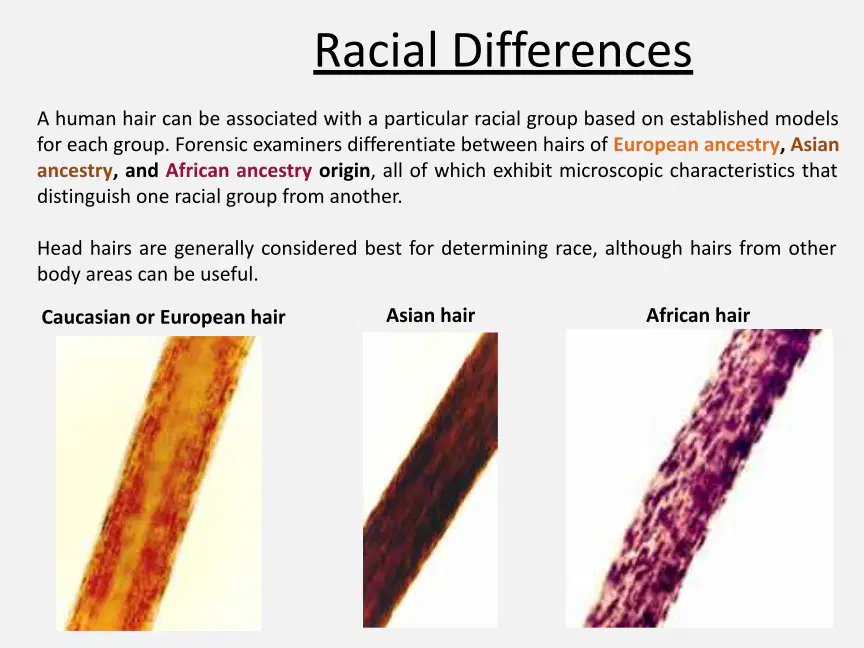
Which characteristic is most useful for distinguishing between European, Asian, and African hair?
Pigment granules
Cross section shape
Appearance (straight, wavy, or curly)
All of the above
43

44
Open Ended
Describe the process and significance of testing for substances in the hair shaft in forensic investigations.
45

46

47
Multiple Choice
Which of the following is NOT a recommended method for collecting hair as evidence at a crime scene?
Using tweezers to pick up visible strands
Using tape lift to collect hairs
Placing hair in paper bindles
Washing the hair before storing
48
49
50
Open Ended
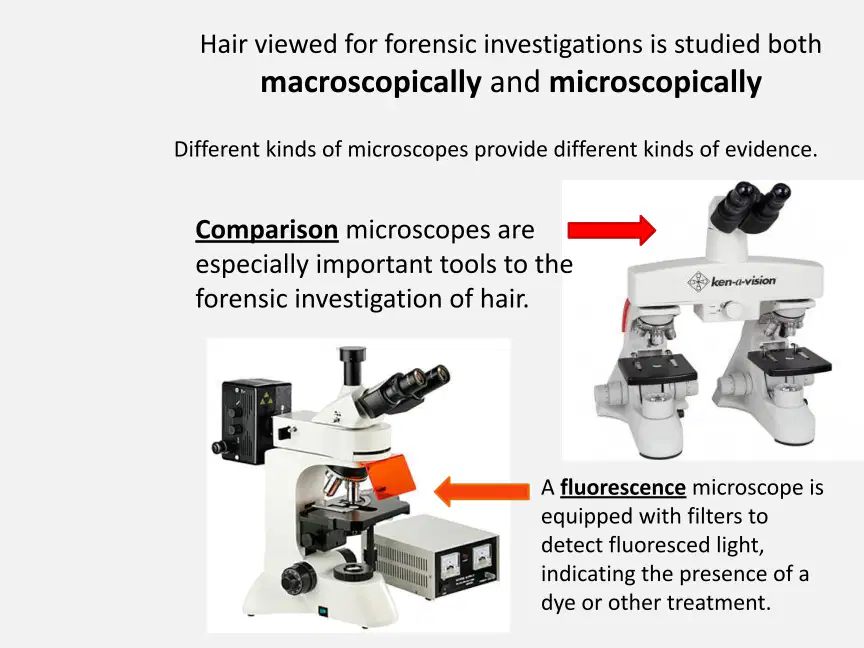
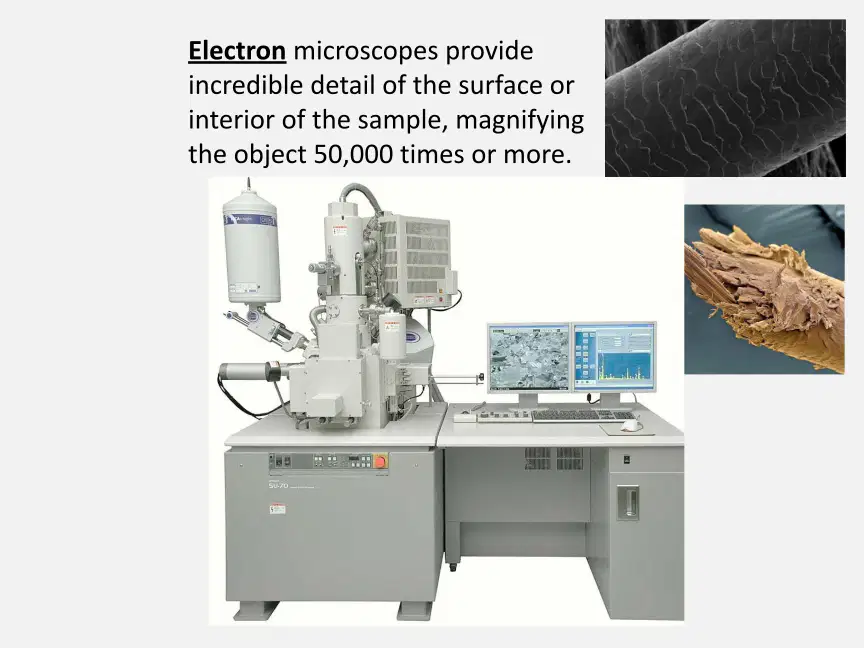
Explain how the use of different types of microscopes can contribute to the forensic analysis of hair evidence.
51

52
Fill in the Blanks
Neutron Activation Analysis (NAA) can identify up to
Type answer...
53
Open Ended
How can microscopic analysis of hair structure help forensic scientists in criminal investigations?
Show answer
Auto Play
Slide 1 / 53
SLIDE
Similar Resources on Wayground

50 questions
Bonding and Chemical Reactions
Presentation
•
9th Grade
50 questions
Chemical Bond Formation
Presentation
•
9th Grade
50 questions
Chemistry Bonding
Presentation
•
9th Grade
49 questions
Meiosis
Presentation
•
9th Grade
49 questions
Semester Exam Review: Revising and Editing
Presentation
•
9th Grade
46 questions
ELECTRON CONFIGURATION
Presentation
•
9th Grade
48 questions
Review for Chapter 1 Test
Presentation
•
9th Grade
50 questions
Lessons on Chemical Bonds
Presentation
•
9th Grade
Popular Resources on Wayground
10 questions
Safety Day 2026 – Student Review

Quiz
•
9th Grade
21 questions
Continents and Oceans
Quiz
•
6th Grade
20 questions
Parts of Speech
Quiz
•
5th Grade
16 questions
Subject & Predicate
Quiz
•
5th Grade
25 questions
Multiplication Facts
Quiz
•
5th Grade
12 questions
Map Skills
Quiz
•
3rd Grade
22 questions
Continents and Oceans
Quiz
•
5th Grade
15 questions
Rounding Decimals
Quiz
•
5th Grade
Discover more resources for Chemistry
20 questions
electron configurations and orbital notation
Quiz
•
9th - 12th Grade
20 questions
Physical or Chemical Change/Phases
Quiz
•
8th Grade - University
15 questions
Periodicity Module Exam Practice Quiz
Quiz
•
9th - 12th Grade
44 questions
C1 Atomic Structure Review
Quiz
•
9th Grade
19 questions
Isotopes & Ions
Quiz
•
9th Grade
8 questions
Label Energy Diagram
Quiz
•
9th - 12th Grade
10 questions
Endothermic/Exothermic
Quiz
•
9th - 12th Grade
6 questions
Energy Change
Quiz
•
9th - 12th Grade