

ATP PPT

Presentation
•
Biology
•
9th - 12th Grade
•
Easy
+2
Standards-aligned

Yeidy Vargas
Used 7+ times
FREE Resource
7 Slides • 19 Questions
1

2

3
Open Ended
Describe the process by which the energy in the food you eat becomes usable for your body's cells.
4
Multiple Choice
Why is ATP often referred to as the "energy currency" of the cell?
Because it stores and releases energy needed for cellular functions
Because it is a type of sugar used for energy
Because it is the only molecule found in cells
Because it is a waste product of metabolism
5
6
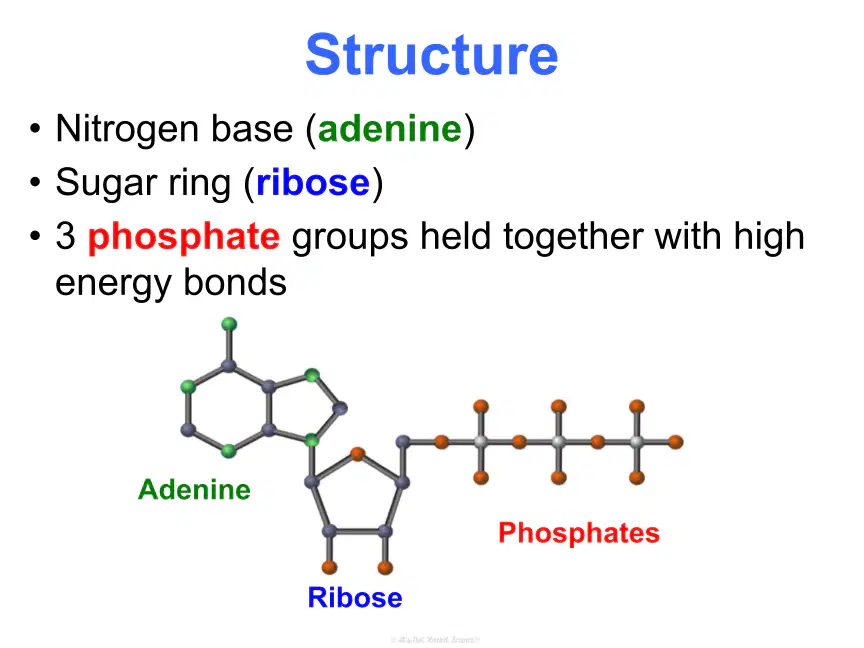
Labeling
Label the following Picture of ATP
Phosphate Groups
Adenine
Ribose Sugar
7
Multiple Choice
Which of the following is NOT a component of ATP?
Adenine
Ribose
Phosphate
Glucose
8

9

10
Hotspot
Where is the phosphate group in ATP?
11
Multiple Choice

12
Fill in the Blanks
The process of adding a phosphate group to ADP to form ATP is called
13
Open Ended
Explain how energy is released and stored during the ATP-ADP cycle.
14

15
Multiple Choice
Where is energy stored in the molecule of ATP?
Between the first and second phosphate group
Between the second and the third phosphate group
In the phosphate group
In the 5-carbon sugar
16
Multiple Choice
How many phosphates does a molecule of ATP contain?
10
2
3
17
Multiple Choice
Within ATP, the energy is stored in the three highly negative phosphate bonds and the Phosphorus atom as well.
True
False
18
Multiple Choice
What does ATP stand for?
Adenosine tetraphosphate
Adenosine triphosphate
Adenosine diphosphate
Adenine triphosphorus
19
Multiple Select
Which of the following statements about ATP and ADP are correct?
ATP contains three phosphate groups.
ADP is formed when a phosphate is removed from ATP.
Energy is released when ATP becomes ADP.
ADP contains more energy than ATP.
20

21
Multiple Choice
ATP components
1. nitrogen
2. sugar
3. phosphate
1. lysosomes
2. energy
1. triphosphate
2. chromosomes
3. energy
22
Multiple Choice
23
Multiple Choice
What is the role of ATP in cellular reactions?
It is a molecule that stores and releases energy when the cell needs it.
It is the ultimate source of energy for all living things.
It is a product of photosynthesis.
It is a type of cell membrane.
24
Multiple Choice
Which macromolecule provides the most energy per gram when broken down for ATP production?
Carbohydrates
Lipids
Proteins
Nucleic acids
25
Multiple Choice
ATP is often referred to as the cell's main energy currency. What is the primary reason for this?
It stores energy in its chemical bonds for cell functions.
It is the only molecule found in cells.
It is made from food directly.
It is used only in muscle cells.
26
Open Ended
Summarize how ATP is important for cellular functions based on what you learned in this lesson.
Show answer
Auto Play
Slide 1 / 26
SLIDE
Similar Resources on Wayground

20 questions
Physical Education
Presentation
•
9th - 12th Grade
20 questions
Theme
Presentation
•
9th - 12th Grade
20 questions
Cell Division
Presentation
•
9th - 12th Grade
20 questions
Atomic Structure Review
Presentation
•
9th - 12th Grade
20 questions
Por & para
Presentation
•
9th - 12th Grade
19 questions
Trophic Levels EOC Review
Presentation
•
8th - 11th Grade
24 questions
Protein Synthesis
Presentation
•
9th - 12th Grade
20 questions
Electromagnetic vs. Mechanical Waves Review Lesson
Presentation
•
9th - 12th Grade
Popular Resources on Wayground
10 questions
Safety Day 2026 – Student Review

Quiz
•
9th Grade
21 questions
Continents and Oceans
Quiz
•
6th Grade
20 questions
Parts of Speech
Quiz
•
5th Grade
16 questions
Subject & Predicate
Quiz
•
5th Grade
25 questions
Multiplication Facts
Quiz
•
5th Grade
12 questions
Map Skills
Quiz
•
3rd Grade
22 questions
Continents and Oceans
Quiz
•
5th Grade
15 questions
Rounding Decimals
Quiz
•
5th Grade
Discover more resources for Biology
20 questions
Cell organelles and functions
Quiz
•
10th Grade
20 questions
Cell Transport
Quiz
•
9th - 12th Grade
25 questions
photosynthesis and cellular respiration
Quiz
•
9th Grade
20 questions
Cell Cycle
Quiz
•
9th Grade
8 questions
DNA vs. RNA
Presentation
•
9th - 12th Grade
14 questions
Ecological Succession: Primary and Secondary
Quiz
•
9th Grade
20 questions
Macromolecules
Quiz
•
10th Grade
20 questions
Characteristics of Life
Quiz
•
9th - 10th Grade