
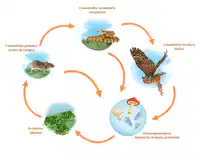
Cadenas alimenticias y Relaciones ecológicas

Presentation
•
Science
•
11th Grade
•
Practice Problem
•
Hard

LUIS RUIZ
Used 1+ times
FREE Resource
9 Slides • 11 Questions
1

2
Open Ended
Why is understanding food chains and energy flow important for maintaining healthy ecosystems?
3

4
Multiple Choice
Which of the following organisms is considered a primary consumer in a food chain?
Rabbit
Grass
Lion
Fungus
5

6
Multiple Choice
According to the 'Regla del Diez por Ciento', what happens to most of the energy when one organism consumes another?
It is stored in the consumer's biomass
It is lost as metabolic heat and waste
It is converted directly into new organisms
It is completely recycled by decomposers
7

8
Open Ended
Explain the role of decomposers in nutrient cycling and why they are considered essential for ecosystem sustainability.
9

10
Multiple Choice
Which of the following best describes the difference between a food chain and a food web, as illustrated in the images?
A food chain shows only one path of energy flow, while a food web shows multiple interconnected paths.
A food chain includes decomposers, while a food web does not.
A food web is less complex than a food chain.
A food chain is only found in aquatic environments.
11

12

13
Fill in the Blanks
Fill in the blank: Ecological relationships can be classified as positive (+), negative (-), or
Type answer...
14

15
Open Ended
How do predation and competition contribute to the regulation and evolution of populations in ecosystems?
16
Multiple Select
Select all that apply: Which of the following are examples of negative interactions in ecological relationships?
Competition
Mutualism
Predation
Commensalism
17

18
Multiple Choice
Which of the following best describes the function of primary consumers in a food chain?
They produce energy through photosynthesis.
They feed directly on producers and transfer energy to animal biomass.
They decompose organic matter.
They feed on secondary and tertiary consumers.
19
Open Ended
Explain the role of producers, primary consumers, and secondary/tertiary consumers in a food chain. How do they contribute to the flow of energy in an ecosystem?
20
Multiple Choice
What is the main difference between mutualism and commensalism as described in the image?
In mutualism, both species benefit, while in commensalism, only one benefits and the other is unaffected.
In mutualism, one species benefits and the other is harmed, while in commensalism, both benefit.
In mutualism, both species are harmed, while in commensalism, only one is harmed.
In mutualism, only one species benefits, while in commensalism, both are unaffected.
Show answer
Auto Play
Slide 1 / 20
SLIDE
Similar Resources on Wayground

14 questions
Ecology
Presentation
•
10th Grade
16 questions
Bohr Model/Lewis Structure
Presentation
•
10th Grade
13 questions
Groundwater
Presentation
•
10th - 12th Grade
15 questions
SI Units
Presentation
•
11th Grade
14 questions
Electron Math
Presentation
•
9th - 12th Grade
16 questions
Trigonometric functions
Presentation
•
11th Grade
16 questions
Proteins
Presentation
•
10th - 11th Grade
12 questions
What is Science?
Presentation
•
KG - 12th Grade
Popular Resources on Wayground
10 questions
Safety Day 2026 – Student Review

Quiz
•
9th Grade
21 questions
Continents and Oceans
Quiz
•
6th Grade
20 questions
Parts of Speech
Quiz
•
5th Grade
16 questions
Subject & Predicate
Quiz
•
5th Grade
25 questions
Multiplication Facts
Quiz
•
5th Grade
12 questions
Map Skills
Quiz
•
3rd Grade
22 questions
Continents and Oceans
Quiz
•
5th Grade
15 questions
Rounding Decimals
Quiz
•
5th Grade
Discover more resources for Science
14 questions
Periodic Trends

Interactive video
•
11th Grade
7 questions
Newton's Laws Video Quiz
Interactive video
•
9th - 12th Grade
35 questions
Cell Transport/Enzyme/Cell/Macro Review
Quiz
•
9th - 12th Grade
13 questions
Explore Enzyme Functions and Interactions
Quiz
•
9th - 12th Grade
10 questions
Fact or Fiction: Microbes
Quiz
•
9th - 12th Grade
10 questions
Understand Cell Functions and Organelles
Quiz
•
9th - 12th Grade
20 questions
BIOGEOCHEMICAL CYCLES
Quiz
•
10th - 11th Grade
19 questions
Explore Macromolecules in Living Organisms
Quiz
•
9th - 12th Grade