
Cell Transport Notes

Presentation
•
Other
•
9th - 12th Grade
•
Practice Problem
•
Easy

Teresa Schlueter
Used 6+ times
FREE Resource
22 Slides • 22 Questions
1

2

3
Multiple Choice
Which of the following is an example of a stimulus that could disrupt homeostasis in the human body?
A sudden drop in external temperature
Stable blood sugar levels
Constant internal pH
Consistent body temperature
4
Multiple Choice
Why is maintaining homeostasis important for living organisms?
Homeostasis allows organisms to maintain stable internal conditions.
5

6
Multiple Choice
Which of the following best describes the main function of feedback mechanisms in organisms?
To help maintain homeostasis by responding to stimuli
To help maintain homeostasis by increasing the rate of cell division
To help maintain homeostasis by producing energy for cellular processes
To help maintain homeostasis by transporting materials across the cell membrane
7

8

9
Multiple Select
Which of the following are examples of negative feedback mechanisms?
Human child birth
Fruit ripening
Thermoregulation
Blood sugar regulation
10
Multiple Select
Which of the following are examples of positive feedback mechanisms?
fruit ripening
shivering
blood clotting
Childbirth
11

12
Fill in the Blanks
The cell membrane helps maintain homeostasis by controlling the movement of things ___ and ___ of the cell.
13

14
Multiple Choice
Which of the following molecules can pass easily through the cell membrane?
Small nonpolar molecules
Large polar molecules
Ions
Proteins
15

16
Multiple Choice
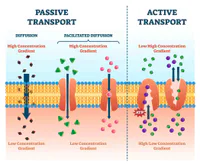
What is the difference between passive and active transport in terms of energy requirement.
17
Multiple Select
What is the difference between passive and active transport in terms of the direction of movement relative to the concentration gradient.
Active transport moves with the concentration gradient.
Passive transport moves against the concentration gradient.
Active transport moves against the concentration gradient.
Passive transport moves with the concentration gradient.
18

19
Multiple Choice
Which of the following best describes the role of a solvent in a solution?
It gets dissolved in another substance.
It does the dissolving in a solution.
It is always a solid.
It increases the concentration gradient.
20

21

22
Multiple Choice
Which of the following molecules would most likely require a transport protein to cross the cell membrane?
Oxygen (O2)
Carbon dioxide (CO2)
Glucose
Nitrogen (N2)
23
Open Ended
Explain how molecules move during simple diffusion and facilitated diffusion. What is similar and what is different about these two processes?
24

25
Fill in the Blanks
Osmosis is the diffusion of
26

27

28
Match
Match the type of solution to its effect on a cell:
Cell swells
Cell shrivels
Cell stays the same
Hypotonic
Hypertonic
Isotonic
Hypotonic
Hypertonic
Isotonic
29

30

31

32
Multiple Choice

33
Multiple Choice

34
Multiple Choice
A cell has 80% water 20% solute, the surrounding solution has 60% water and 40% solute. What type of solution is this?
Hypertonic
Isotonic
Hypotonic
Equilibrium
35
Multiple Choice

36

37
Multiple Choice
Which of the following statements about active transport using molecular pumps is correct?
It requires energy to move molecules against the gradient
It moves molecules with the gradient without energy
It only transports water molecules
It does not use protein channels
38

39

40
Multiple Choice
Which type of endocytosis involves the cell engulfing liquids?
Phagocytosis
Pinocytosis
Exocytosis
Osmosis
41
Multiple Choice
What is the term for a change in the environment that causes an organism to respond?
Stimulus
Response
Homeostasis
Equilibrium
42

43
Active
Passive
Osmosis
Water
Active
Molecular Pumps
Simple Diffusion
Exocytosis
large molecules and polar molecules
controls levels O2 and CO2 in the body
helps fight infections and diseases
gets rid of waste and regulates nerve impulses
44
Multiple Choice
Which type of transport is responsible for regulating blood sugar, and is it passive or active?
Facilitated Diffusion, Passive
Endocytosis, Active
Facilitated Diffusion, Active
Osmosis, Passive
Show answer
Auto Play
Slide 1 / 44
SLIDE
Similar Resources on Wayground

40 questions
Balancing and 5 Types of Chemical Reactions
Presentation
•
9th - 12th Grade
39 questions
4A Economics (Theory of Price Determination)
Presentation
•
9th - 12th Grade
41 questions
Nuclear Chemistry
Presentation
•
9th - 12th Grade
41 questions
Las Excusas (Pre-song Story)
Presentation
•
9th - 12th Grade
37 questions
ServSafe - Food Handler 4b - TCS Foods
Presentation
•
9th - 12th Grade
39 questions
Media Bias
Presentation
•
9th - 12th Grade
42 questions
ANS2L- 4.02- Livestock Digestion
Presentation
•
10th - 12th Grade
38 questions
Newton's Third law
Presentation
•
9th - 12th Grade
Popular Resources on Wayground
10 questions
Safety Day 2026 – Student Review

Quiz
•
9th Grade
21 questions
Continents and Oceans
Quiz
•
6th Grade
20 questions
Parts of Speech
Quiz
•
5th Grade
16 questions
Subject & Predicate
Quiz
•
5th Grade
25 questions
Multiplication Facts
Quiz
•
5th Grade
12 questions
Map Skills
Quiz
•
3rd Grade
22 questions
Continents and Oceans
Quiz
•
5th Grade
15 questions
Rounding Decimals
Quiz
•
5th Grade
Discover more resources for Other
10 questions
Safety Day 2026 – Student Review
Quiz
•
9th Grade
20 questions
REGULAR Present tense verbs
Quiz
•
8th - 9th Grade
26 questions
SLIME!!!!!
Quiz
•
KG - 12th Grade
20 questions
Cell organelles and functions
Quiz
•
10th Grade
10 questions
Test Your Knowledge on Bullying
Quiz
•
9th Grade
12 questions
Absolute Value Equations
Quiz
•
9th Grade
20 questions
Position vs. Time Graphs
Quiz
•
9th Grade
20 questions
Function or Not a Function
Quiz
•
8th - 9th Grade