

4. Homeostasis

Presentation
•
Other
•
12th Grade
•
Easy

Marvin Hong
Used 2+ times
FREE Resource
18 Slides • 18 Questions
1
2

3
Open Ended
How might an understanding of homeostasis benefit someone working in health or social care?
4
Multiple Choice
Why is maintaining homeostasis important for the human body?
It ensures optimal conditions for cells and bodily functions
It helps the body grow taller
It increases the speed of digestion
It makes bones stronger
5

6
Multiple Choice
Which of the following best describes the role of homeostasis in the body?
Maintaining a stable internal environment for optimal cell function
Increasing the rate of cell division
Producing energy for movement
Regulating external environmental changes
7

8
Multiple Select
Which of the following are examples of conditions regulated by the internal environment in the body?
Temperature
pH
Fluid balance
Blood pressure
9
Open Ended
Explain why maintaining a stable internal environment is important for enzyme function and overall health.
10

11
Multiple Choice
What is the main function of negative feedback in homeostasis?
To sense changes and trigger responses to restore stability
To amplify changes in the internal environment
To stop all biological processes
To increase body temperature continuously
12

13
Fill in the Blanks
The process by which the body produces heat through digestion and absorption of food is called
Type answer...
14

15
Multiple Choice
Which mechanism is primarily responsible for cooling the body when it overheats?
Evaporation
Radiation
Conduction
Convection
16

17

18
Multiple Choice
Which of the following best describes how arterioles and sweat glands contribute to temperature regulation in the body?
Arterioles release sweat and sweat glands control blood flow.
Arterioles control blood flow and sweat glands release sweat to cool the body.
Both arterioles and sweat glands only conserve heat.
Sweat glands and arterioles are not regulated by the nervous system.
19

20
Open Ended
Explain how shivering helps maintain thermal homeostasis in the body.
21

22
Multiple Select
Which of the following statements about surface area to volume ratios and heat exchange are correct?
Smaller organisms lose heat faster due to a larger surface area relative to their volume.
Larger organisms lose heat faster than smaller organisms.
Surface area to volume ratio does not affect heat exchange.
Larger organisms retain heat more effectively due to a smaller surface area relative to their volume.
23

24
Fill in the Blanks
Fever is a sign that the body's temperature regulation is
Type answer...
25

26
Open Ended
Describe the role of the pancreas in maintaining blood glucose levels and how it responds to changes in glucose concentration.
27

28
Multiple Choice
Which hormones work antagonistically to maintain glucose homeostasis, and what are their primary effects on blood glucose levels?
Insulin and glucagon; insulin lowers blood glucose and glucagon raises it.
Insulin and adrenaline; both lower blood glucose.
Glucagon and cortisol; both raise blood glucose.
Insulin and thyroxine; both lower blood glucose.
29

30
Multiple Choice
Which of the following processes contribute to water output in the human body?
Urination, sweating, and respiration
Only urination
Only sweating
Only respiration
31

32
Open Ended
Explain how the kidneys help maintain fluid balance in the body.
33

34
Fill in the Blanks
Hypothermia occurs when the body loses heat faster than it can produce it, leading to a dangerously low body
Type answer...
35
36
Multiple Select
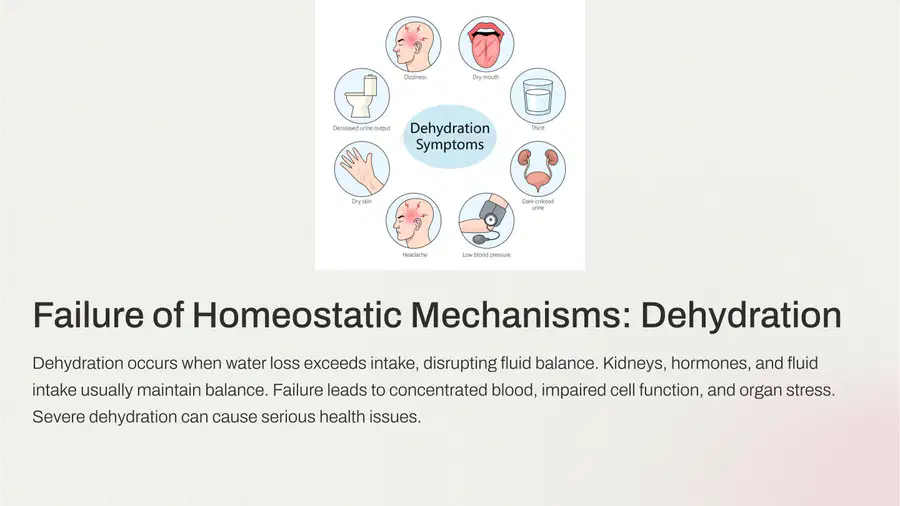
Which of the following are symptoms of dehydration?
Dizziness
Dry mouth
Headache
Increased urine output
Show answer
Auto Play
Slide 1 / 36
SLIDE
Similar Resources on Wayground

26 questions
Milady Haircoloring
Presentation
•
11th - 12th Grade
27 questions
Economia azul
Presentation
•
KG
30 questions
Senderos 1 Estructura 2.1 Present tense of -ar verbs
Presentation
•
12th Grade
34 questions
Identifying the Inquiry and Stating the Problem
Presentation
•
12th Grade
31 questions
Physical activity & disease prevention
Presentation
•
12th Grade
27 questions
Grammar Review- 3rd Grade, Unit 3, Lesson 12
Presentation
•
KG
30 questions
06 Knife Skills - On Cooking
Presentation
•
12th Grade
33 questions
ECONOMICS TOPIC 3 LESSON 3
Presentation
•
12th Grade
Popular Resources on Wayground
10 questions
Safety Day 2026 – Student Review

Quiz
•
9th Grade
21 questions
Continents and Oceans
Quiz
•
6th Grade
20 questions
Parts of Speech
Quiz
•
5th Grade
16 questions
Subject & Predicate
Quiz
•
5th Grade
25 questions
Multiplication Facts
Quiz
•
5th Grade
12 questions
Map Skills
Quiz
•
3rd Grade
22 questions
Continents and Oceans
Quiz
•
5th Grade
15 questions
Rounding Decimals
Quiz
•
5th Grade
Discover more resources for Other
26 questions
SLIME!!!!!
Quiz
•
KG - 12th Grade
21 questions
Los paises hispanohablantes y sus capitales
Quiz
•
12th Grade
20 questions
Cell Transport
Quiz
•
9th - 12th Grade
20 questions
Budgeting
Quiz
•
9th - 12th Grade
20 questions
Investing
Quiz
•
9th - 12th Grade
8 questions
DNA vs. RNA
Presentation
•
9th - 12th Grade
12 questions
Identify Rigid Transformations
Quiz
•
8th - 12th Grade
10 questions
Complementary, Supplementary, Vertical, and Linear Pairs
Quiz
•
9th - 12th Grade