

Unit 2 Lesson 2 Cnidarians

Presentation
•
Science
•
10th Grade
•
Easy
+1
Standards-aligned

Kimberlea Scott
Used 2+ times
FREE Resource
14 Slides • 5 Questions
1
2
Cnidaria
By Kimberlea Scott
Domian Eukarya
Kingdom Animalia
Ex: Jellyfish, Anemones, Corals

3
General Characteristics
Radial Symmetry
Have true tissues!
Diploblastic (“2 tissues”)
Endoderm = (“inside skin”) innermost tissue layer, develops into gut
Ectoderm = (“outside skin”) outermost tissue layer, develops into epidermis and nerve tissue
No coelom
Dimorphic (“two forms”)
Display 2 different body forms in a lifetime

4

5
Systems Breakdown
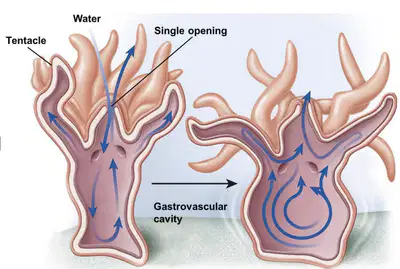
Digestion:
Gastrovascular Cavity (GVC) – large cavity that is connected to an opening that serves as the mouth and anus. Allows for direct digestion
“Mouth” → GVC → “Anus”
Carnivorous
Obtain food using cnidocytes
(stinging cells) on the tentacles

6
Systems Breakdown
Nervous:
Contain Nerve Net – no brain, but basic abilities to send and receive signals throughout body.
Specialized cells – Cnidocytes
Stinging cells found along the exterior of the tentacles
Produced by ectoderm cells
Used in food getting, defense & attachment
Cnidocyte Structure
Cnidocil – “trigger”
Operculum – covering
Nematocyst – barb and thread containing toxin


7
8
Human Impact
Most cnidarian toxins are paralytic to their prey.
These toxins do not generally cause permanent damage to humans apart from pain and irritation. This can be relieved by removing the barbs with tape or by scraping, then soaking in vinegar or hot water to dilute the toxin.
Some cnidarian species have powerful toxins that can cause immediate cardiovascular and respiratory failure in humans.
Portuguese Man O’ War, Irukandji, Sea Wasp Box Jelly (1)

9


10
Systems Breakdown
Skeletal:
Hydrostatic Skeleton – Keep body shape using water pressure inside the body.
Can change pressure levels to move and help ingest food.
Calcium carbonate “skeletons” form reef foundations
Muscular:
True muscle cells that allow for controlled movement
Gliding, somersaulting, propulsion
Circulation:
GVC circulates water and dissolved gasses through the body.
11
Systems Breakdown
Reproduction:
Dimorphism - 2 forms
Polyp Stage
Asexual and sessile
Aboral end attaches to substrate, oral
end (“mouth”) surrounded by tentacles
Medusa Stage
Sexual and mobile
Dioecious (separate sexes)
Sperm and egg released externally to create a zygote which grows into a free-swimming planula larva
One body form will always be dominant
Shows “alternation of generations”
2 body forms alternate between sexual and asexual

12
Multiple Choice
Explain the process of asexual reproduction in cnidarians.
Cnidarians reproduce asexually through spores.
Cnidarians reproduce asexually through mating.
Cnidarians reproduce asexually through fragmentation.
Cnidarians reproduce asexually through budding.
13
Multiple Choice
What term describes a life cycle that alternates between two forms, such as the medusa and polyp?
generational life cycle
alternation of life cycle
alternation of generations
changing life forms
14
Multiple Choice
How do cnidarians reproduce?
Reproducing through photosynthesis
By laying eggs in nests
Sexually by releasing eggs and sperm into the water, and asexually through budding
Using spores for reproduction
15
Multiple Choice
Term for an animal that is attached and not free-swimming.
planted
sessile
motile
amorphous
16

17

18
Ecology
Eaten by sea slugs, some starfish, butterfly and parrotfish and sea turtles.
Sea slugs have the ability to incorporate the cnidarian nematocysts into their own body for protection.
Make up coral reefs, which support more species per unit area than any other ecosystem on Earth, but cover less than 1% of the Earth’s surface.
Coral reefs are threatened due to human actions, mainly coral bleaching.
Caused by pollution and increased water temperature (global warming). “Bleached corals” are not dead yet, but in a very vulnerable state. They can be revived if water temperatures cool.
Coral reefs have a high impact on tourism economies. The Florida Keys reefs alone have an estimated asset value of $7.6 billion.
19
Open Ended
What questions do you have about Cnidarian anatomy, body processes or ecology?
Show answer
Auto Play
Slide 1 / 19
SLIDE
Similar Resources on Wayground

14 questions
Biodiversity
Presentation
•
9th - 10th Grade
17 questions
Rockets Part 2: How Rockets Move
Presentation
•
10th Grade
13 questions
Stress Management
Presentation
•
10th Grade
13 questions
Pharmacology + Medication Types
Presentation
•
10th Grade
16 questions
Topic Sentences
Presentation
•
9th - 10th Grade
12 questions
Stay Hydrated
Presentation
•
10th - 11th Grade
12 questions
Immune System
Presentation
•
9th - 10th Grade
20 questions
Air Masses
Presentation
•
10th Grade
Popular Resources on Wayground
10 questions
Safety Day 2026 – Student Review

Quiz
•
9th Grade
21 questions
Continents and Oceans
Quiz
•
6th Grade
20 questions
Parts of Speech
Quiz
•
5th Grade
16 questions
Subject & Predicate
Quiz
•
5th Grade
25 questions
Multiplication Facts
Quiz
•
5th Grade
12 questions
Map Skills
Quiz
•
3rd Grade
22 questions
Continents and Oceans
Quiz
•
5th Grade
15 questions
Rounding Decimals
Quiz
•
5th Grade
Discover more resources for Science
10 questions
Exploring Chemical and Physical Changes

Interactive video
•
6th - 10th Grade
10 questions
Exploring the Electromagnetic Spectrum for Middle School Science
Interactive video
•
6th - 10th Grade
10 questions
Exploring Force and Motion Concepts
Interactive video
•
6th - 10th Grade
10 questions
Exploring Air Masses and Weather Fronts
Interactive video
•
6th - 10th Grade
10 questions
Exploring the States of Matter
Interactive video
•
6th - 10th Grade
10 questions
Exploring Forces: Net Force, Normal Force, Gravity, and Friction
Interactive video
•
6th - 10th Grade
10 questions
Differentiating Thermal Energy and Temperature
Interactive video
•
6th - 10th Grade
10 questions
Exploring the States of Matter and Thermal Energy
Interactive video
•
6th - 10th Grade