

The Western Frontier 1

Presentation
•
Social Studies
•
12th Grade
•
Practice Problem
•
Hard

Jake Johnson
FREE Resource
31 Slides • 28 Questions
1

2
Open Ended
What were some of the major changes that occurred on the Western Frontier in the late 1800s, and why do you think these changes were significant for both settlers and the Plains Indians?
3

4
Multiple Choice
Which of the following best describes the impact of the cattle industry boom in the late 1800s on the Plains Indians?
It led to the preservation of Plains Indian culture.
It caused a decline in the culture of the Plains Indians.
It resulted in increased cooperation between settlers and Plains Indians.
It had no effect on the Plains Indians.
5

6
Multiple Choice
What was one major impact of the Transcontinental Railroad on the West by 1900?
It forced Native Americans off their lands and opened the West for settlement.
It prevented settlers from moving westward.
It led to the immediate end of mining activities.
It caused the Mississippi River to dry up.
7

8
Multiple Select
Which of the following statements about mining in the West are correct?
Gold was found in the Rocky Mountains in 1858.
Lode mining produced large amounts of gold and silver.
All miners became wealthy from their discoveries.
A lode is a deposit of valuable minerals buried between layers of rock.
9

10
Open Ended
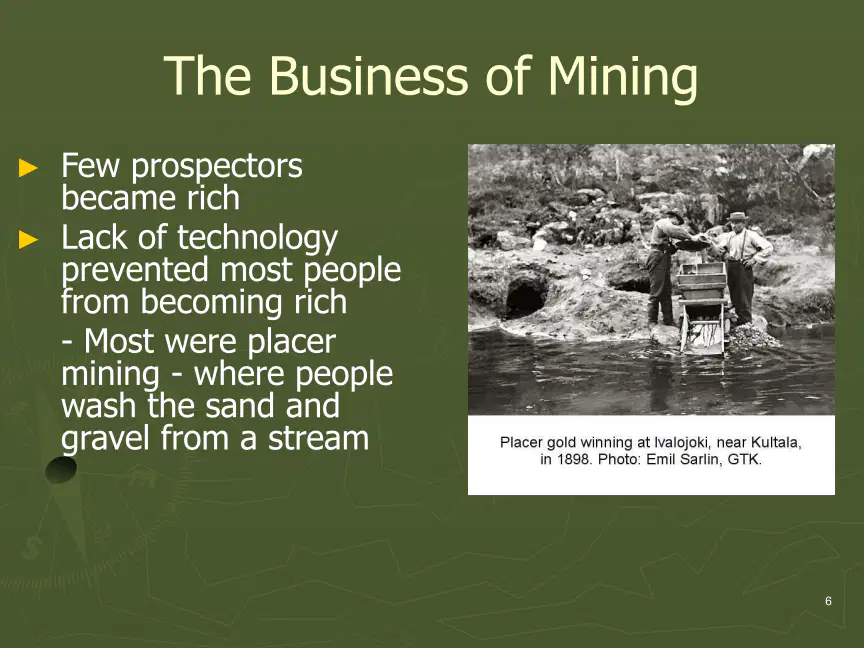
How did the roles of women contribute to the development of mining towns during the mining boom?
11
12
Fill in the Blanks
Most prospectors did not become
13

14
Multiple Choice
What was one negative consequence of using water cannons in mining during the 1870s?
It was very harmful to the environment.
It made mining safer for workers.
It reduced the amount of gold found.
It allowed everyone to afford mining equipment.
15

16
Open Ended
In what ways did the gold rush change the geography and settlement patterns of the United States?
17
18

19
Multiple Choice
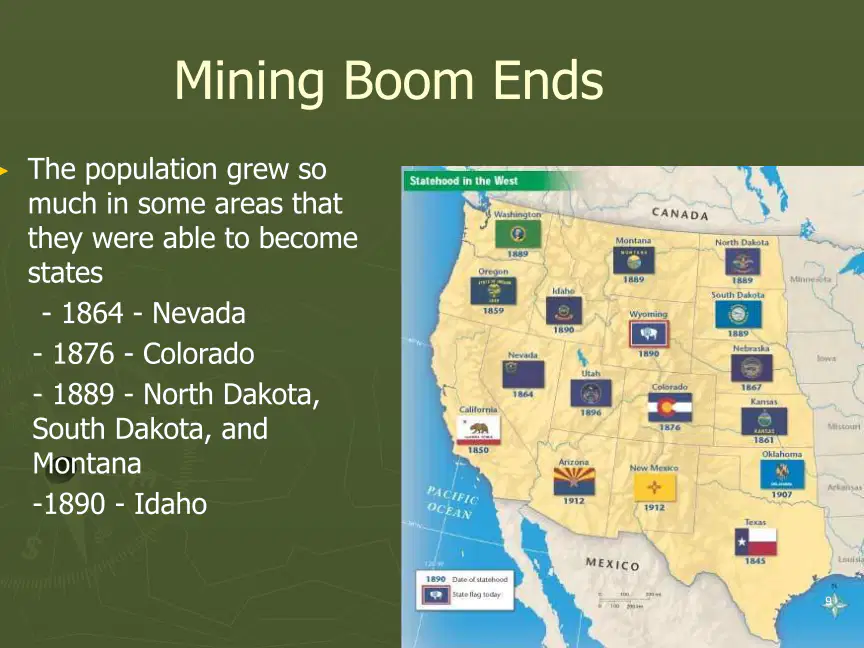
Which states became states as a result of population growth during the mining boom, and in what years did they achieve statehood?
Nevada (1864), Colorado (1876), North Dakota (1889), South Dakota (1889), Montana (1889), Idaho (1890)
California (1850), Oregon (1859), Texas (1845), Utah (1896)
Arizona (1912), New Mexico (1912), Oklahoma (1907)
Nebraska (1867), Kansas (1861), Wyoming (1890)
20

21
Multiple Select
Which territories were acquired by the United States through the Louisiana Purchase and the annexation of Texas? Select all that apply.
Nebraska
California
Texas
Kansas
22
23
Fill in the Blanks
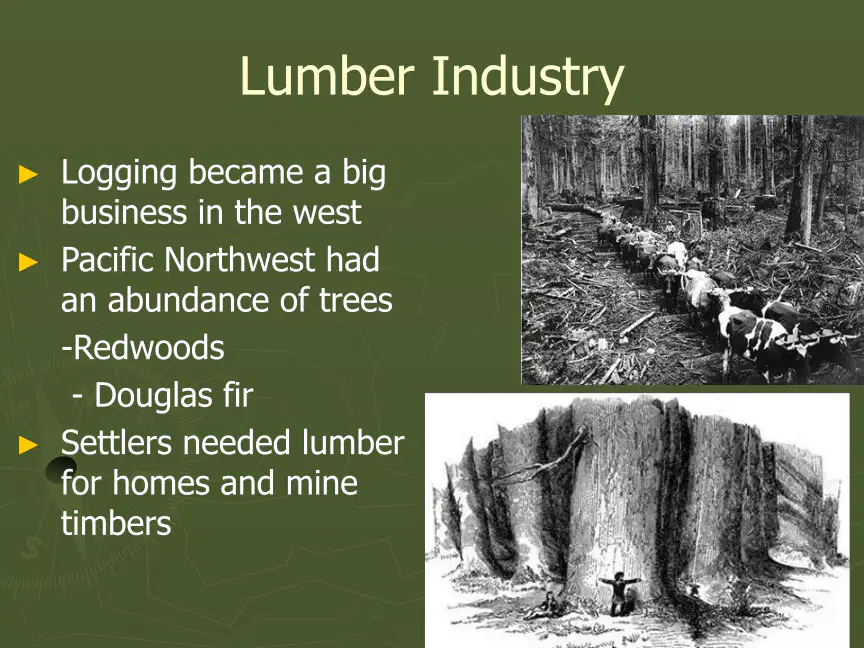
Logging became a big business in the west because the Pacific Northwest had an abundance of trees such as
24

25
Multiple Choice
Which of the following natural resources was NOT mentioned as being abundant in Alaska after its purchase?
Gold
Copper
Coal
Oil
26
Multiple Choice
How did the acquisition of Alaska benefit the United States, and what resources were found there?
It provided new farmland and increased cotton production.
It gave the U.S. access to the Pacific Ocean for trade.
It was rich in natural resources such as gold, copper, oil, and timber.
It allowed the U.S. to expand slavery into new territories.
27

28
Open Ended
Explain how government policy toward Plains Indians changed from the early 1800s to the mid-1800s.
29
30

31
Multiple Choice
What was one major difference between how Plains Indians and settlers viewed the use of natural resources?
Plains Indians used only what they needed, while settlers used resources for large scale activities.
Settlers used only what they needed, while Plains Indians used resources for large scale activities.
Both groups used resources only for their actual needs.
Plains Indians believed in mining and farming on a large scale.
32

33
Open Ended
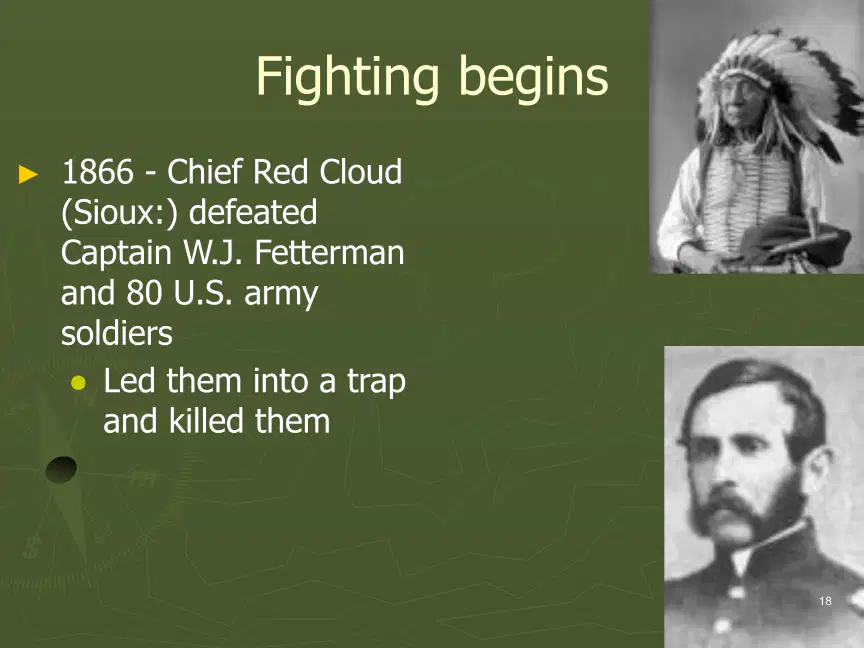
Explain the causes and consequences of the Sand Creek Massacre in 1864.
34
35

36
Multiple Select
Which of the following were outcomes of the Treaty of Fort Laramie?
The Bozeman Trail was closed by the government.
The Sioux agreed to live on a reservation along the Missouri River.
Sitting Bull signed and enforced the treaty.
The treaty was only a temporary fix for conflicts.
37
Fill in the Blanks
The Treaty of Fort Laramie was signed after the
38

39
Open Ended
How did the discovery of gold in the Black Hills impact relations between the U.S. government and the Sioux?
40
Multiple Choice
Who were the two Sioux chiefs that led the united Sioux warriors during the battles of 1875 and 1876?
Sitting Bull and Crazy Horse
Red Cloud and Sitting Bull
Crazy Horse and Geronimo
Red Cloud and Crazy Horse
41

42

43
Multiple Choice
What was the significance of the Battle of Little Bighorn for both the U.S. Army and the Sioux?
It was a major victory for the U.S. Army and ended the Indian Wars
It was a significant defeat for the U.S. Army and a temporary victory for the Sioux
It led to immediate peace between the U.S. Army and the Sioux
It resulted in the capture of Sitting Bull
44

45
Open Ended
Explain how the destruction of the buffalo impacted the way of life for the Plains Indians.
46

47
Multiple Choice
Which of the following statements about the Wounded Knee Massacre is correct?
It marked the beginning of the Indian Wars
It resulted in the death of 300 Sioux men, women, and children
It was a peaceful negotiation between the U.S. Army and the Sioux
It led to the immediate restoration of Sioux land
48
49
Fill in the Blanks
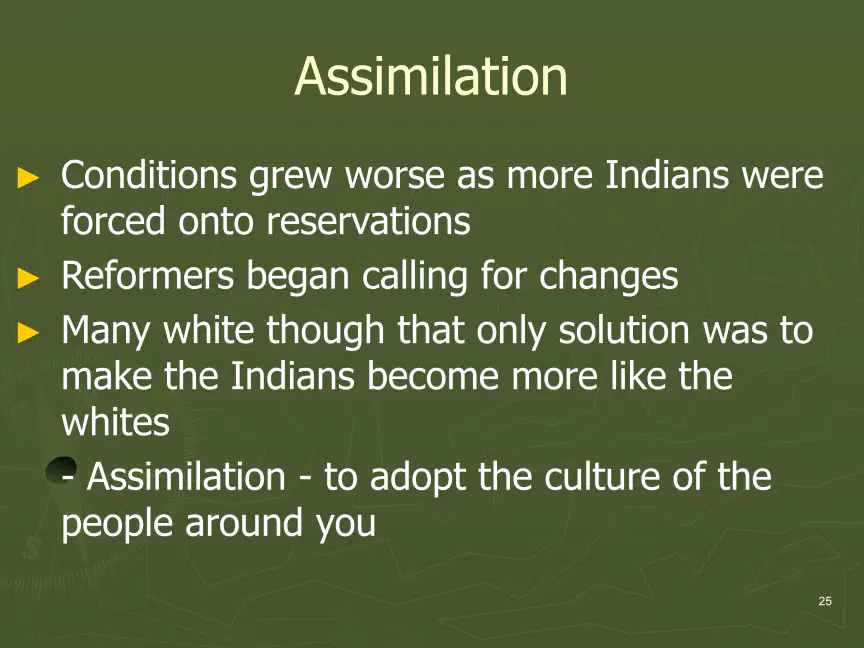
The process by which Native Americans were encouraged to adopt the culture of white Americans was called
50

51
Open Ended
How did the U.S. government’s policies toward Native Americans change from the late 1800s to the 20th century?
52
Multiple Select
Select all the outcomes of the Dawes Act (1887) as described in the slides.
Reservation lands were divided into farm plots for Indian families and individuals
Any remaining land was sold to white settlers
Indians who accepted plots could become citizens for the first time
The Dawes Act was immediately successful in helping Indians settle as farmers
53

54

55

56

57

58
Multiple Choice
What were some of the major changes that occurred on the prairie in the late 1800s?
The cattle industry declined and the Plains Indians' culture flourished
The cattle industry boomed and the culture of the Plains Indians declined
The cattle industry remained the same and the Plains Indians' culture was unaffected
The cattle industry disappeared and the Plains Indians' culture became dominant
59
Open Ended
How did the arrival of white settlers impact the culture of the Plains Indians and the economic concerns of farmers on the Western Frontier?
Show answer
Auto Play
Slide 1 / 59
SLIDE
Similar Resources on Wayground

55 questions
Civil Rights Achievements - Day 2
Presentation
•
11th Grade
54 questions
Cyber EOP - Types of Threats By Mr. B
Presentation
•
12th Grade
52 questions
SPANISH EXPLORATION LESSON AND ASSIGNMENT
Presentation
•
KG - University
54 questions
Political Philosophy Test Review
Presentation
•
12th Grade
54 questions
Unit 6: Progressives Part 3 & 4
Presentation
•
11th Grade
58 questions
Soc Sci American Revolution Part 2
Presentation
•
12th Grade
51 questions
L21 Inflation and the Federal Reserve
Presentation
•
University
52 questions
Colonization and The British Colonies
Presentation
•
11th Grade
Popular Resources on Wayground
10 questions
Safety Day 2026 – Student Review

Quiz
•
9th Grade
21 questions
Continents and Oceans
Quiz
•
6th Grade
20 questions
Parts of Speech
Quiz
•
5th Grade
16 questions
Subject & Predicate
Quiz
•
5th Grade
25 questions
Multiplication Facts
Quiz
•
5th Grade
12 questions
Map Skills
Quiz
•
3rd Grade
22 questions
Continents and Oceans
Quiz
•
5th Grade
15 questions
Rounding Decimals
Quiz
•
5th Grade
Discover more resources for Social Studies
20 questions
Chapter 8 Test "Types of Business Organizations"
Quiz
•
12th Grade
39 questions
Unit 7 Key Terms
Quiz
•
11th Grade - University
38 questions
Unit 6 Key Terms
Quiz
•
11th Grade - University
25 questions
Gilded Age Gallery Walk
Presentation
•
9th - 12th Grade
4 questions
3.3A Expressed v. Implied Powers Quiz
Quiz
•
12th Grade
23 questions
USHC 6 FDR and The New Deal Programs
Quiz
•
9th - 12th Grade
19 questions
Spanish American War
Presentation
•
8th - 12th Grade
62 questions
Midterm Review 2026
Quiz
•
12th Grade