

Summary Writing

Presentation
•
English
•
6th - 8th Grade
•
Medium
+14
Standards-aligned

Juen Li Choong
Used 15+ times
FREE Resource
12 Slides • 20 Questions
1

2

3
Open Ended
Why do you think it is important to focus on the central ideas when summarizing a text?
4
Multiple Select
Which of the followings should NOT be included in a summary?
Opinions
Central ideas
Personal information
Background knowledge
5

6
Multiple Choice
Which of the following is NOT a requirement for a good summary answer according to the guidelines?
It should be a complete sentence or two.
It should cover main point and key ideas.
It should be in your own words.
It should include every detail from the text.
7

8
Multiple Choice
What question should you ask yourself to decide if information belongs in your summary?
Is this information interesting?
Do you need this information to understand the text?
Does this information have big words?
Is this information repeated?
9

10
Open Ended
Explain the difference between key points and supporting details when writing a summary.
11
Fill in the Blanks
Fill in the blank: The main idea is what the text is
Type answer...
12
13
Multiple Choice
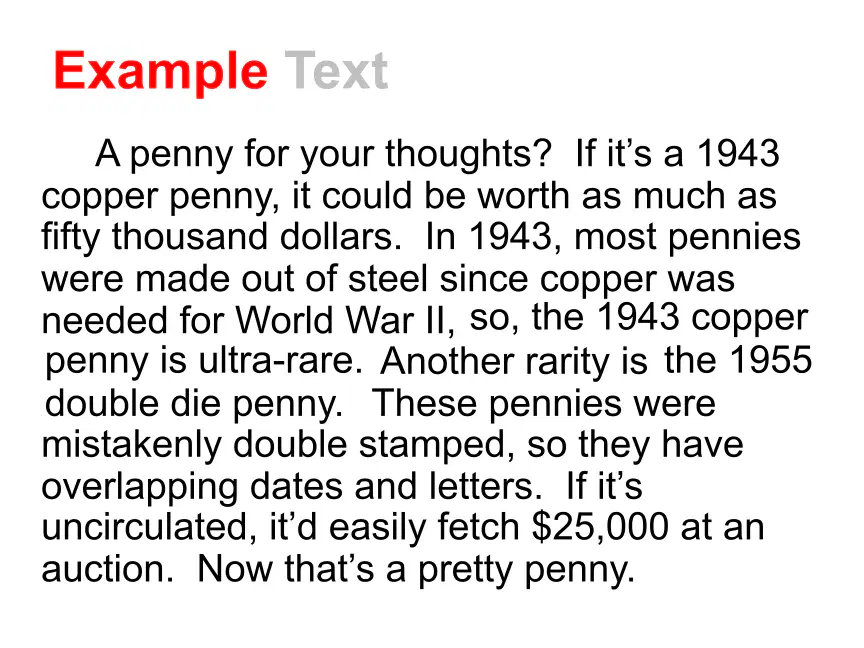
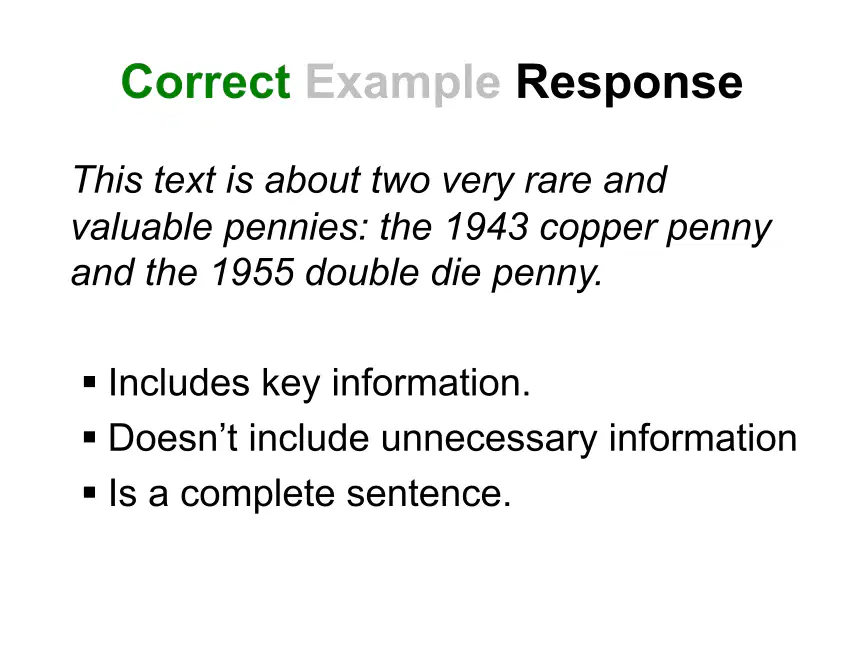
Based on the example text, what are the two rare and valuable pennies mentioned?
The 1943 copper penny and the 1955 double die penny
The 1943 steel penny and the 1955 copper penny
The 1943 silver penny and the 1955 double die penny
The 1943 copper penny and the 1956 double die penny
14
15
Multiple Choice
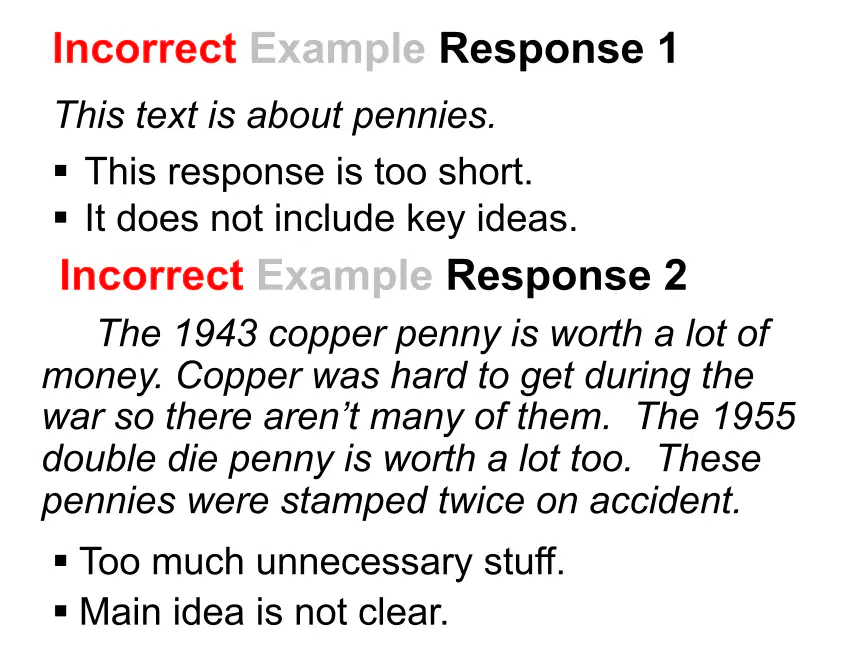
Which of the following best describes why the first incorrect example response is not a good summary?
It is too long and detailed.
It is too short and does not include key ideas.
It uses too many big words.
It is written in someone else's words.
16
17
Open Ended
How can you apply the concept of summarizing to other subjects or areas in your life?
18
Multiple Choice
What should a summary mainly focus on?
Central ideas of a text
Personal opinions
Background knowledge
Personal information
19
Multiple Choice
20
Multiple Choice
21
Multiple Choice
When you write the events you'll want to paraphrase them. What does paraphrase mean?
to list chronologically
to list objectively
to reduce to five sentences or less
to change the wording to your own words
22
Multiple Choice
23
Multiple Choice
24
Multiple Choice
You should only include the main events or ideas from the passage when writing a summary.
True
False
25
Open Ended
Picture this: a herd of elephants flies past you at sixty miles per hour, followed by a streak of tigers, a pride of lions, and a bunch of clowns. What do you see? It must be a circus train! One of the first uses of the circus train is credited to W.C. Coup. He partnered with P.T. Barnum in 1871 to expand the reach of their newly combined shows using locomotives. That's another word for train. You see, before trains, moving the circus was hard. They had to lug around all their animals, performers, and equipment with a team of more than 600 horses. Since there were no highways, these voyages were rough and took a long time. Circuses would stop at many small towns between the large venues. Performing at many of these small towns was not very profitable. Because of these limitations, circuses could not grow as large as the imaginations of the operators. After they began using circus trains, Barnum and Coup only brought their show to large cities. These performances were much more profitable and the profits went toward creating an even bigger and better circus. More stages or 'rings' were added and the show went on. Ringling Bros. and Barnum and Bailey Circus relied on the train to transport their astounding show until they went defunct in 2017.
26
Summary
Circuses used to have a difficult time travelling and had to stop at many small towns along the way. Trains allowed circuses to travel easily from large city to large city.
27
Open Ended
How do you say “'Holy cow”' in French? The fastest thing in France may just be the fastest ground transportation in the world. The TGV (Train à Grande Vitesse: French for very high speed) is France’s national high-speed rail service. On April 3rd, 2007, a TGV test train set a record for the fastest wheeled train, reaching 357.2 miles per hour. In mid 2011, TGV trains operated at the highest speed in passenger train service in the world, regularly reaching 200 miles per hour. But what you may find most shocking is that TGV trains run on electric power not petrol. Now if you’ll excuse me; I have a record to catch.
28
Summary
The TGV is a French train that set a record for the fastest wheeled train and the fastest passenger train service.
29
Open Ended
Electric trolley cars or trams were once the chief mode of public transportation in the United States. Though they required tracks and electric cables to run, these trolley cars were clean and comfortable. In 1922, auto manufacturer General Motors created a special unit to replace electric trolleys with cars, trucks, and buses. Over the next decade, they lobbied for laws and regulations that made operating trams more difficult and less profitable. In 1936 General Motors created several front companies to purchase and dismantle the trolley car system. They received big investments from Firestone Tire, Standard Oil of California, Phillips Petroleum, and others in the automotive industry. Some people suspect that these parties wanted to replace trolley cars with buses to make public transportation less desirable. This would then increase automobile sales. The decline of the tram system in North America could be blamed on many things—labor strikes, the Great Depression, regulations that were unfavorable to operators. Yet, perhaps the primary cause was having a group of powerful men from rival sectors of the auto industry working together to ensure its destruction. Fill it up, please.
30
Summary
Cows were not worth a lot of money until they could be easily transported to the East after the invention of the train. Many people then became cowboys despite the dangers they faced.
31
Open Ended
Giddy-up, cowboys and girls! In the Southwest during early half of the 1800s, cows were only worth 2 or 3 dollars apiece. They roamed wild, grazed off of the open range, and were abundant. Midway through the century though, railroads were built and the nation was connected. People in the Southwest could suddenly ship cows in freight trains to the Northeast. The Yankees there had a growing taste for beef and were willing to pay for it. Out of the blue, the same cows that were once worth a couple of bucks were now worth between twenty and forty dollars each. The only problem was that they had to get these cows to the train station. A new profession emerged from this. It became pretty lucrative to wrangle up a drove of cattle and herd them to the nearest train town. Of course it was dangerous too. Cowboys were threatened at every turn. They faced cattle rustlers, stampedes and extreme weather. But they kept pushing those steers to the train station. By the turn of the century, barbed wire killed the open range. Some may say the cowboy, too, was killed by barbed wire. Maybe, but it was the train that birthed them.
32
Summary
This passage is about how many large companies that served the automotive market conspired to dismantle the electric trolley car system and replace them with less desirable buses.
Show answer
Auto Play
Slide 1 / 32
SLIDE
Similar Resources on Wayground

22 questions
Argumentative Text Review
Presentation
•
6th - 8th Grade
22 questions
Understanding Ethos, Pathos, and Logos
Presentation
•
6th - 8th Grade
24 questions
Characterization Notes
Presentation
•
6th - 8th Grade
25 questions
Types of Conflict
Presentation
•
6th - 8th Grade
25 questions
Essay Writing
Presentation
•
6th - 8th Grade
24 questions
Drawing Conclusion 8th grade STAAR Reading Camp
Presentation
•
6th - 8th Grade
23 questions
Elements of a Story
Presentation
•
6th - 8th Grade
25 questions
Revision Unit 1 Vol.2: Present Simple vs Present Continuous
Presentation
•
6th - 7th Grade
Popular Resources on Wayground
10 questions
Safety Day 2026 – Student Review

Quiz
•
9th Grade
21 questions
Continents and Oceans
Quiz
•
6th Grade
20 questions
Parts of Speech
Quiz
•
5th Grade
16 questions
Subject & Predicate
Quiz
•
5th Grade
25 questions
Multiplication Facts
Quiz
•
5th Grade
12 questions
Map Skills
Quiz
•
3rd Grade
22 questions
Continents and Oceans
Quiz
•
5th Grade
15 questions
Rounding Decimals
Quiz
•
5th Grade
Discover more resources for English
20 questions
Context Clues
Quiz
•
6th Grade
10 questions
Inference and Textual Evidence
Quiz
•
7th Grade
25 questions
Making Inferences
Quiz
•
6th - 8th Grade
20 questions
Figurative Language Review
Quiz
•
6th Grade
15 questions
Plot Elements
Quiz
•
6th Grade
10 questions
Figurative Language
Quiz
•
7th Grade
20 questions
Figurative Language Review
Quiz
•
8th Grade
10 questions
Main Idea and Supporting Details
Quiz
•
3rd - 6th Grade