
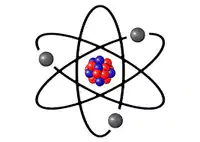
Parts of the Atom (Notes 1/5)

Presentation
•
Science
•
9th Grade
•
Practice Problem
•
Medium
+1
Standards-aligned

Mr. Baudendistel
Used 5+ times
FREE Resource
18 Slides • 17 Questions
1

2

3

4
Multiple Choice
Where is most of the mass of an atom located?
In the nucleus
In the electron cloud
Evenly distributed throughout the atom
In the empty space
5

6
Multiple Choice
Which subatomic particle is found outside the nucleus?
Electron
Proton
Neutron
Both proton and neutron
7

8
Multiple Choice
If an atom has more electrons than protons, what is the charge of the resulting ion?
Positive
Negative
Neutral
It depends on the number of neutrons
9
Multiple Select
Which of the following statements about subatomic particles are correct?
Protons have a positive charge.
Neutrons are electrically neutral.
Electrons have a negative charge.
Protons have a negative charge.
10

11
Fill in the Blanks
The
12

13

14
Multiple Choice
What is the atomic number of lithium as shown in the diagram?
3
7
6
12
15
Open Ended
Explain the difference between atomic number and mass number using examples from the periodic table.
16

17
Open Ended
Describe how you would use the periodic table to determine whether an element is a metal, nonmetal, or semimetal.
18

19
Fill in the Blanks
The number of neutrons in an atom can be calculated by subtracting the atomic number from the
20

21
Multiple Choice
Which of the following statements best explains why the atomic weight of an element is not always a whole number?
Because atomic weight is the sum of protons and electrons.
Because elements can have isotopes with different numbers of neutrons.
Because atomic weight is the same as atomic number.
Because elements can lose or gain electrons.
22

23
Multiple Select
Which of the following are true about isotopes?
They have the same number of protons.
They have different numbers of neutrons.
They have different atomic numbers.
They have the same chemical properties.
24

25

26
Open Ended
Explain how changing the number of protons in an atom affects the identity of the element. Provide an example using the periodic table.
27

28
Open Ended
Explain why only electrons can be gained or lost when an atom becomes an ion.
29

30
Multiple Choice
What determines the chemical properties of an atom?
The number of valence electrons
The number of protons
The number of neutrons
The atomic mass
31

32
Multiple Select
Which of the following statements about valence electrons and electron shells are correct?
Valence electrons are found in the outermost shell.
A full shell makes an atom stable.
Shell 2 can hold up to 8 electrons.
All electrons in an atom are valence electrons.
33

34
Fill in the Blanks
If an atom gains an electron, it becomes a(n)
35
Multiple Choice
Which of the following statements best describes the relationship between matter and atoms?
Atoms are made up of matter.
Matter is composed of atoms.
Atoms and matter are unrelated.
Matter is smaller than atoms.
Show answer
Auto Play
Slide 1 / 35
SLIDE
Similar Resources on Wayground

28 questions
Electromagnetic Spectrum
Presentation
•
8th Grade
27 questions
Types of Galaxies
Presentation
•
8th Grade
27 questions
Valence and Lewis Dot Diagrams
Presentation
•
9th Grade
29 questions
Review BIODIVERSITY
Presentation
•
9th Grade
25 questions
The CARBON CYCLE
Presentation
•
9th Grade
25 questions
Physical and Chemical Changes Review
Presentation
•
8th Grade
33 questions
DNA and Protein Synthesis Day 3
Presentation
•
9th Grade
27 questions
Periodic Table Build
Presentation
•
9th Grade
Popular Resources on Wayground
10 questions
Safety Day 2026 – Student Review

Quiz
•
9th Grade
21 questions
Continents and Oceans
Quiz
•
6th Grade
20 questions
Parts of Speech
Quiz
•
5th Grade
16 questions
Subject & Predicate
Quiz
•
5th Grade
25 questions
Multiplication Facts
Quiz
•
5th Grade
12 questions
Map Skills
Quiz
•
3rd Grade
22 questions
Continents and Oceans
Quiz
•
5th Grade
15 questions
Rounding Decimals
Quiz
•
5th Grade
Discover more resources for Science
10 questions
Exploring Chemical and Physical Changes

Interactive video
•
6th - 10th Grade
20 questions
Atomic Structure
Quiz
•
9th Grade
10 questions
Exploring the Electromagnetic Spectrum for Middle School Science
Interactive video
•
6th - 10th Grade
10 questions
Exploring Force and Motion Concepts
Interactive video
•
6th - 10th Grade
10 questions
Exploring Air Masses and Weather Fronts
Interactive video
•
6th - 10th Grade
10 questions
Exploring the States of Matter
Interactive video
•
6th - 10th Grade
10 questions
Exploring Forces: Net Force, Normal Force, Gravity, and Friction
Interactive video
•
6th - 10th Grade
10 questions
Differentiating Thermal Energy and Temperature
Interactive video
•
6th - 10th Grade