

VARIATION

Presentation
•
Science
•
6th - 8th Grade
•
Medium

Kaylee Franz
Used 10+ times
FREE Resource
8 Slides • 11 Questions
1

2

3
Multiple Choice
Which of the following best describes a behavioral variation?
A difference in the way individuals act within a species
A difference in the body structures of individuals
A difference in the color of flowers in a field
A difference in the number of individuals in a population
4
5

6

7

8
Multiple Select
In which situations might the moth’s white variation be a disadvantage?
In a burnt forest
In a dirty environment
In a beach ecosystem
In a deep cave
9
10
Multiple Choice
Which of the following statements best explains how variations can impact populations when the environment changes?
Some variations help a population survive environmental changes better than others.
All variations are always beneficial for survival.
Variations do not affect survival during environmental changes.
Populations with no variations survive best.
11

12
Fill in the Blanks
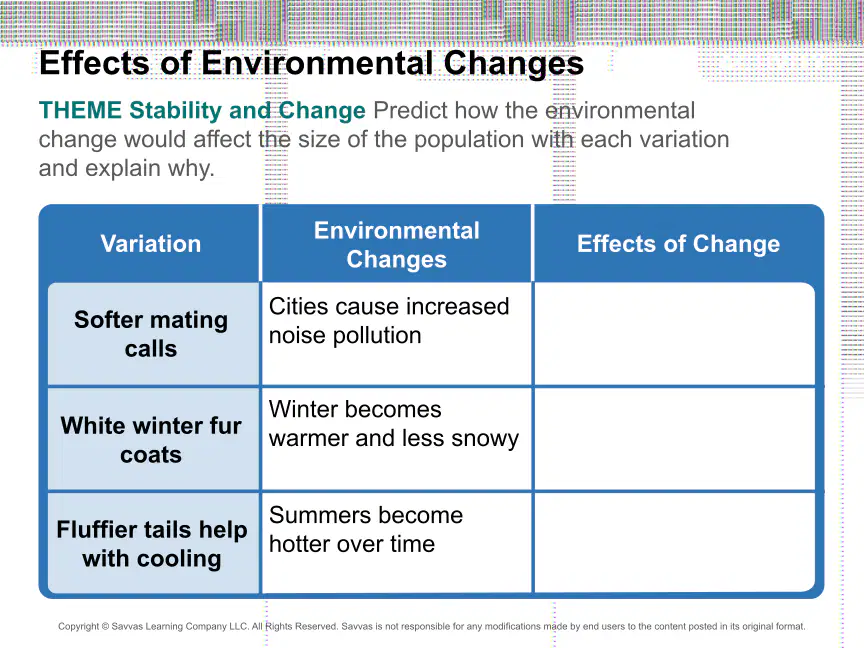
Cities cause increased noise pollution. As a result, populations with
Type answer...
13
Multiple Choice
What is the difference between behavioral variations and physical variations in a population?
Behavioral variations are differences in how individuals act, while physical variations are differences in body structures.
Behavioral variations are differences in body structures, while physical variations are differences in how individuals act.
Both refer to differences in body structures.
Both refer to differences in how individuals act.
14
Multiple Choice
Polar bears, snow, and sunlight are all parts of an ecosystem in the Arctic. Which of the following correctly classifies these factors in an ecosystem as biotic or abiotic?
Biotic: polar bears and sunlight; Abiotic: snow
Biotic: snow and sunlight; Abiotic: polar bears
Biotic: polar bears and snow; Abiotic: sunlight
Biotic: polar bears; Abiotic: snow and sunlight
15
Multiple Choice
Which of the following accurately describes an ecosystem from the highest level to the lowest level of organization? 6.12A
A) Communities - organisms - populations - ecosystem
B) Ecosystem - organisms - populations - communities
C) Organisms - populations - communities - ecosystem
D) Ecosystem - communities - populations - organisms
16
Multiple Choice

Which of these observations describe competition between the organisms or populations? 6.12B
A) 1, 3, 4
B) 1, 2, 4
C) 2, 3, 4
D) 1, 2, 3
17
Multiple Select
Which sentences describe competitive relationships between animals? Choose two correct answers. 6.12A Check all that apply.
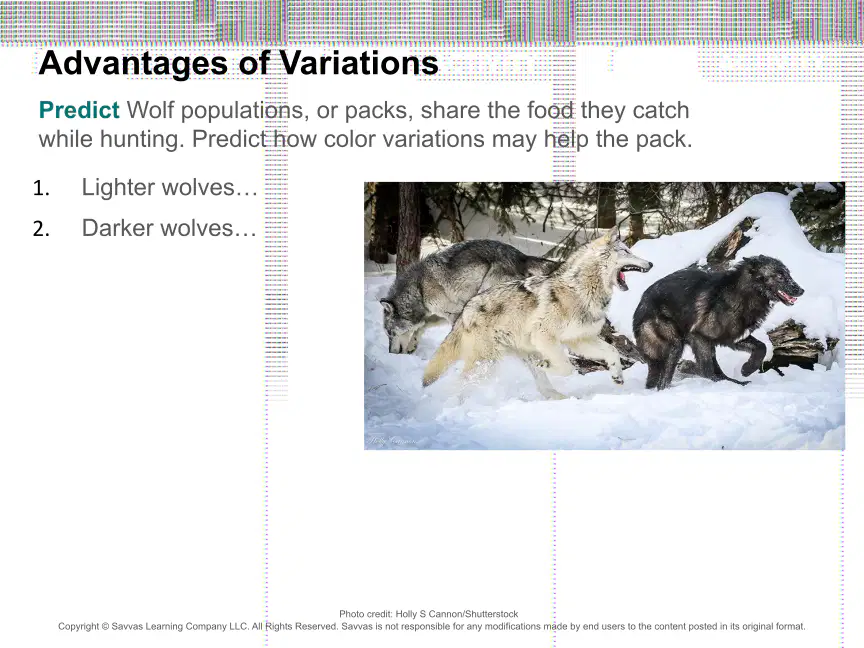
Wolves hunt in a group or pack to capture their prey.
Leafcutter ants bring leaves back to their nest to make food.
Several mosquitos lay eggs in a small body of water.
Two birds eat the berries on the same vine.
18
Multiple Choice
A certain plant needs light, carbon dioxide, oxygen, water, and minerals to survive. What are these factors classified as?
Biotic factors
Abiotic and biotic factors
Abiotic factors
None of the above
19
Multiple Choice
Carl has a pet worm named Pete. After 8 weeks of living with Pete, Carl notices that Pete has doubled in size. What characteristic of living things did Carl observe?
Living things grow and develop.
Living things respond to stimuli.
Living things reproduce.
Living things use energy.
Show answer
Auto Play
Slide 1 / 19
SLIDE
Similar Resources on Wayground

15 questions
THERMAL ENERGY
Presentation
•
6th - 8th Grade
14 questions
Earth's energy budget and the greenhouse effect
Presentation
•
6th - 8th Grade
14 questions
Severe Weather
Presentation
•
6th - 8th Grade
15 questions
Natural Selection
Presentation
•
6th - 8th Grade
15 questions
Respiratory System
Presentation
•
6th - 8th Grade
13 questions
5.1: Forms of Energy
Presentation
•
6th - 8th Grade
16 questions
Mars
Presentation
•
KG - 8th Grade
16 questions
The Theory of Evolution
Presentation
•
8th Grade
Popular Resources on Wayground
10 questions
Safety Day 2026 – Student Review

Quiz
•
9th Grade
21 questions
Continents and Oceans
Quiz
•
6th Grade
20 questions
Parts of Speech
Quiz
•
5th Grade
16 questions
Subject & Predicate
Quiz
•
5th Grade
25 questions
Multiplication Facts
Quiz
•
5th Grade
12 questions
Map Skills
Quiz
•
3rd Grade
22 questions
Continents and Oceans
Quiz
•
5th Grade
15 questions
Rounding Decimals
Quiz
•
5th Grade
Discover more resources for Science
20 questions
Newton's Laws of Motion
Quiz
•
8th Grade
20 questions
Elements, compounds, and mixtures
Quiz
•
6th Grade
10 questions
6.6D - Relative Density Review
Quiz
•
6th Grade
15 questions
potential and kinetic energy
Quiz
•
8th Grade
21 questions
Newton's Laws of Motion
Quiz
•
8th Grade
20 questions
Elements, Compounds and Mixtures
Quiz
•
8th Grade
10 questions
Exploring Chemical and Physical Changes

Interactive video
•
6th - 10th Grade
20 questions
CONDUCTION,CONVECTION AND RADIATION
Quiz
•
6th Grade