Revision (Current Electricity, DC Circuits, Practical)
Presentation
•
Science
•
9th - 12th Grade
•
Medium
Syed Ali
Used 8+ times
FREE Resource
1 Slide • 29 Questions
1
Revision (Current Electricity,
DC Circuits, Practical Electricity)
By Syed Ali
2
Multiple Choice
Which statement correctly defines current?
the amount of electric charge flowing
the amount of energy flowing
the rate of flow of electric charge
the rate of flow of energy
3
Multiple Choice
Which term is a unit of current?
ampere
ohm
volt
watt
4
Multiple Choice
What is the formula of current?
I = Q x t
I = Q / t
Q = I / t
5
Multiple Choice
What is electromotive force?
The work done in driving a unit charge around a complete circuit.
The work done in driving a unit charge through the component.
6
Multiple Choice
What is potential difference?
The work done in driving a unit charge around a complete circuit.
The work done in driving a unit charge through the component.
7
Multiple Choice
Which term is a unit of potential difference?
ampere
ohm
volt
watt
8
Multiple Choice
What is the formula of voltage?
V = W x Q
V = W / Q
W = V / Q
9
Multiple Choice
What unit is used to measure resistance?
Ohms
Omega
Volts
Amps
10
Multiple Choice
A circuit has 1250 C flowing through it for 25 s.
What is the current in the circuit?
25 A
50 A
1250 A
6250 A
11
Multiple Choice
What is the time taken when 1500 C of charge flows through a fixed point to give a current of 10 A?
1.5 min
2.0 min
2.5 min
3.0 min
12
Multiple Choice
13
Multiple Choice
In a complete circuit, the work done by an electrical energy source in moving an electric charge of 5.0 C from terminal X to terminal Y is 3.5 J.
Determine the e.m.f. of the electrical energy source.
0.70 V
1.43 V
17.5 V
14
Multiple Choice
What is the current in a circuit with 6 ohms of resistance and a battery containing 24 Volts?
1/4 A
144 A
4 A
0.4 A
15
Multiple Choice
A series circuit is shown.
When 2 C of charge passes round the circuit, 6 J of work drives the charge through component S and 6 J through component T.
What is the electromotive force (e.m.f) of the cell?
3 V
6 V
12 V
24 V
16
Multiple Choice
The diagram shows a circuit containing a lamp and three resistors.
What is the total resistance in this circuit?
less than 2 Ω
5 Ω
9 Ω
14 Ω
17
Multiple Choice
The diagram shows four circuits using resistors of the same value.
Which circuit has the least effective resistance?
A
B
C
D
18
Multiple Choice
Four lamps and four switches are connected to a power supply as shown in the circuit diagram.
When all the switches are closed, all the lamps are lit.
When one of the switches is then opened, only one lamp goes out.
Which switch is opened?
A
B
C
D
19
Multiple Choice
The diagram shows a circuit with a 3.0 ohm resistor and a 2.0 ohm resistor connected in parallel.
The switch is open and the ammeter reads 2.0 A.
When the switch is closed, the ammeter reads the total current through both resistors.
What is the ammeter reading when the switch is closed?
1.2 A
3.0 A
4.0 A
5.0 A
20
Multiple Choice
Two 10 Ω resistors are connected in parallel, their equivalent resistance is
5 Ω
10 Ω
15 Ω
0.5 Ω
21
Multiple Choice
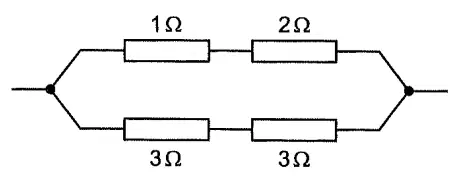
Four resistors are connected as shown. What is the total resistance of this arrangement?
0.5 Ω
2 Ω
3 Ω
9 Ω
22
Multiple Choice
A wire of length 2.0 m and cross-sectional area 0.50 x 10⁻⁶ m2 has a resistance of 1.2 Ω.
Another wire of the same material has a length of 0.50 m and a cross-sectional area of
1.0 X 10⁻⁶m2.
What is the resistance of the shorter wire?
0.15 Ω
0.60 Ω
2.4 Ω
9.6 Ω
23
Multiple Choice
What is the equation for calculating the electrical power produced in a resistor?
power = voltage x current
power = voltage/current
power = voltage x current x time
power = (voltage x current)/time
24
Multiple Choice
25
Fill in the Blanks
26
Fill in the Blanks
27
Multiple Choice
A student draws a circuit, shown below, to show how an appliance should be connected to a fuse and the household mains.
Identify the error in the circuit.
The fuse rating is too high.
The fuse rating is too low.
The fuse is connected wrongly.
The switch is connected wrongly.
28
Multiple Choice
In a household electrical circuit, why are fuses and switches always placed in the live wire?
A break in the live wire cuts off the appliance from the voltage supply.
A break in the neutral wire would not stop current in the circuit.
The live wire carries a greater current.
The neutral wire carries no current.
29
Multiple Choice
Where should a fuse always be connected?
in a separate circuit
in the earth wire
in the live wire
in the neutral wire
30
Multiple Choice
how does earth wire work to protect the users?
When the live wire touches the metal casing of the appliance,
large current flows through the earth wire.
This causes the fuse to blow
and the appliance is isolated from high voltage.
This protects the users from getting an electric shock.
When there is excessive current flow,
the earth wire will melt and break the circuit.
Revision (Current Electricity,
DC Circuits, Practical Electricity)
By Syed Ali
Show answer
Auto Play
Slide 1 / 30
SLIDE

Similar Resources on Wayground
23 questions
The NITROGEN CYCLE
Presentation
•
9th - 12th Grade
22 questions
Accuracy v. Precision, Sig Figs, and Scientific Notation
Presentation
•
9th - 12th Grade
21 questions
Introduction to the Integumentary System
Presentation
•
9th - 12th Grade
23 questions
Potential (GPE) and Kinetic (KE) Energy practice
Presentation
•
9th - 11th Grade
24 questions
Work And Energy
Presentation
•
9th - 12th Grade
22 questions
How big is a mole?
Presentation
•
9th - 12th Grade
20 questions
Photosynthesis
Presentation
•
9th - 11th Grade
Popular Resources on Wayground
10 questions
HCS SCI 03 Summer School Review 4
Quiz
•
3rd Grade
11 questions
HSMS - Standard Response Protocol
Quiz
•
6th - 8th Grade
16 questions
1.1-1.2 Quiz Review
Quiz
•
9th - 12th Grade
12 questions
Exponent Expressions
Quiz
•
6th Grade
20 questions
Adding and Subtracting Integers
Quiz
•
6th - 7th Grade
11 questions
Northeast States
Quiz
•
3rd - 4th Grade
10 questions
Characterization
Quiz
•
3rd - 7th Grade
10 questions
Common Denominators
Quiz
•
5th Grade