Unit 8 Energy
Presentation
•
Chemistry
•
10th Grade
•
Hard

Joseph Anderson
FREE Resource
18 Slides • 12 Questions
1
Monday 1/23 : Heating Curves
•Pick up a packet on side table
•Thurs 1/26- Quiz 1- states of matter, heating curves, heat calculations
• Tues 1/31- Quiz 2- gas laws
Thurs 2/2 Unit 8 test
• Fri 2/3- PLD day
• announcements • Unit 7 shout outs
• PPT- Heating Curves, heat
calculations
Announcements/Reminders:
Agenda:
Bellwork:
Learning check on GC
HW:
1. packet page 4
2
3
STUDENTSTHATEARNED A
100% ONTHEUNIT 7 TEST HONORABLEMENTIONS (97%)
★ 1am
○ Alyssa
○ Avelyn
○ Kailen K
★ 2am
○ Carson
○ Parker
○ Joey
★ 1pm:
○ Sarah Booker
○ Jenny
○ Kaitlyn
○ Ty K
○ William W
○ Virgilio
★ 1am
○ Charlie
○ Jo
★ 2am
○ Tye
○ Logan
○ Noah
★ 1pm:
○ JM Jenkins
○ Miranda
4
liquid
water
ice&water
water&
steam
ice
steam
5
The first horizontal line is the constant temperature for change of solid to liquid. This the the melting point e.g. mp water = 0oC
6
Copyright © Cengage Learning.
All rights reserved
24
Heating/Cooling Curve
7
8
Multiple Choice
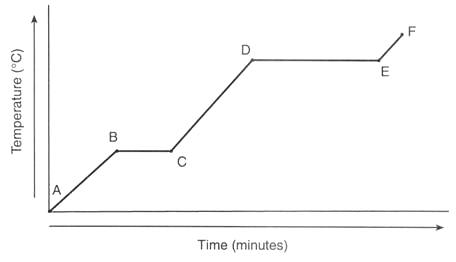
Between which points is the temperature of the substance remaining constant?
A-B only
A-B, C-D, and E-F
B-C only
B-C and D-E
9
Multiple Choice
The melting point of the sample is
-60 ºC
20 ºC
60 ºC
100 ºC
10
Multiple Choice
Which letter indicates where water is in both the solid and liquid phase at the same time?
A
B
C
D
E
11
Multiple Choice
A measure of the average kinetic energy of the particles in an object is called
Heat
Temperature
Kinetic energy
Enthalpy
12
Multiple Choice
In which region(s) does temperature increase?
Region C only
Regions B and D
Regions A, C, and E
Regions A and B
13
Multiple Choice
In which region(s) of the heating curve would water be a liquid and a gas at the same time?
A
B
C
D
E
14
Multiple Choice
The energy transferred between objects that are at different temperatures is called
Heat
Temperature
Energy
Friction
15
Multiple Choice
Describe the substance at letter A.
Solid
Liquid
Melting
Evaporating
16
Multiple Choice
In a heating curve, diagonal lines indicate temperature is __________, while flat lines indicate temperature is __________.
Constant, changing
Changing, constant
17
Multiple Choice
At which letter is the substance changing its state of matter?
A only
A, C, and E
D and E
B and D
18
Multiple Choice
NaCl was heated starting at an initial temperature of 0°C. The heating curve is shown in the picture. What is the melting point of this substance?
0°C
801°C
1000°C
1465°C
19
Multiple Choice
Describe the substance at letters D.
Gas
Liquid
Melting
Evaporating
20
HEAT – measure of the amount of energy transferred from one substance to another
- measured in units of joules (SI unit) or calories
- 4.184 J = 1 calorie
Calorimeter - device used to measure heat
21
22
How do we calculate heat?
specific heat ( C ) - amount of heat energy required to raise the temperature of 1 g of material 1C (or 1 K )
23
Heat of Vaporization ( Hv) - amount of energy
needed to vaporize 1 g of a liquid at its boiling point
Hv for water = 2260 J/g
Heat of Fusion ( Hf) - amount of energy needed to melt 1 g of a solid at its melting point
Hf for water = 334 J/g
24
Problem 1: How many joules are required to
vaporize 1000g of water?
q= 1000 g X 2260 J = 2260000 J = 2.26 X 10⁶ J
g
25
Problem 2: If we melted 70 g of ice to water, how
much energy would the ice need to absorb?
melting or freezing is
heat of fusion
Q = 70 g X 334 J = 23,380 J
g
26
Some text here about the topic of discussion
27
28
Answer the following questions using the chart above.
1. What is the freezing point of the substance?
2. What is the
boiling point of the
substance?
3. What is the
melting point
of the substance?
B
B
D
29
4. What letter represents the range
where the solid is being warmed?
A
5. What letter represents
the range where the
liquid is being warmed?
C
6. What letter represents
the range where the
vapor is being warmed?
E
7. What letter represents
the melting of the solid?
B
30
8. What letter represents the
vaporization of the liquid?
D
9. What letter(s) shows a
change in potential energy?
B and D
10. What letters(s) shows a
change in kinetic energy?
A, C, and E
Monday 1/23 : Heating Curves
•Pick up a packet on side table
•Thurs 1/26- Quiz 1- states of matter, heating curves, heat calculations
• Tues 1/31- Quiz 2- gas laws
Thurs 2/2 Unit 8 test
• Fri 2/3- PLD day
• announcements • Unit 7 shout outs
• PPT- Heating Curves, heat
calculations
Announcements/Reminders:
Agenda:
Bellwork:
Learning check on GC
HW:
1. packet page 4
Show answer
Auto Play
Slide 1 / 30
SLIDE

Similar Resources on Wayground
23 questions
The Mole Concept
Presentation
•
10th Grade
22 questions
OBJ 6.3 Polar versus Non-polar Bonds
Presentation
•
10th Grade
21 questions
Oxidation States
Presentation
•
10th Grade
22 questions
Oxidation and Reduction
Presentation
•
10th Grade
22 questions
Introduction to Naming IONIC Chemical Compounds
Presentation
•
10th Grade
20 questions
Atomic Structure
Presentation
•
10th Grade
23 questions
C6 Le Chatelier's Principle and Equilibrium
Presentation
•
10th Grade
21 questions
dimensional analysis shrontz lesson2
Presentation
•
9th - 10th Grade
Popular Resources on Wayground
10 questions
Safety Day 2026 – Student Review
Quiz
•
9th Grade
21 questions
Continents and Oceans
Quiz
•
6th Grade
20 questions
Parts of Speech
Quiz
•
5th Grade
16 questions
Subject & Predicate
Quiz
•
5th Grade
25 questions
Multiplication Facts
Quiz
•
5th Grade
12 questions
Map Skills
Quiz
•
3rd Grade
22 questions
Continents and Oceans
Quiz
•
5th Grade
15 questions
Rounding Decimals
Quiz
•
5th Grade
Discover more resources for Chemistry
20 questions
electron configurations and orbital notation
Quiz
•
9th - 12th Grade
25 questions
Writing and Naming Binary Ionic compounds
Quiz
•
10th Grade
20 questions
COUNTING ATOMS
Quiz
•
10th Grade
20 questions
Physical or Chemical Change/Phases
Quiz
•
8th Grade - University
15 questions
Periodicity Module Exam Practice Quiz
Quiz
•
9th - 12th Grade
20 questions
Naming Ionic Compounds
Quiz
•
10th Grade
45 questions
Chem Unit 3 Review
Quiz
•
10th Grade
16 questions
History of the Atomic Theory
Quiz
•
10th Grade