

Sandstone

Presentation
•
Science
•
9th Grade
•
Hard

Joseph Anderson
FREE Resource
8 Slides • 1 Question
1
2
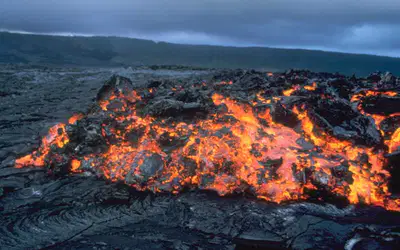
Principles of uniformitarianism
What does "The present is the key to the past" mean?
The process that happens today happened in the past.
This idea is called Uniformitarianism.
Introduced by James Hutton in the late 1700s.
Modern geological processes help us understand ancient ones.
3
How modern observations inform the past
By studying lava cooling today, we know that certain rocks formed from ancient lava.
Observations of sand dunes today explain ancient sandstone formations.
Geologists apply current knowledge to unravel ancient mysteries.
4
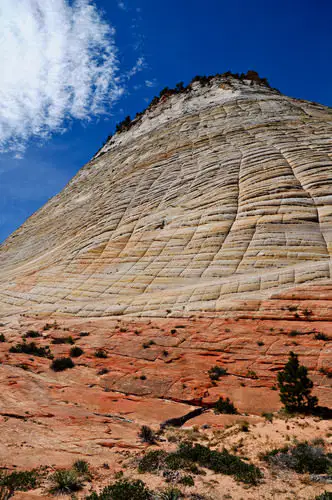
Checkerboard Mesa
This rock formation is the Navajo Sandstone.
Checkerboard Mesa in Zion National Park has unique patterns.
The rock is sandstone, limiting the formation possibilities.
We use present observations to hypothesize how it formed.
5
Understanding Cross-bedding in sandstone
Cross-bedding occurs due to changes in wind direction.
Observing modern sand dunes reveals similar patterns.
The Navajo sandstone likely formed from ancient sand dunes.

6
Applying uniformitarianism to Geology
The process that forms rocks today likely operated the same way in the past.
This principle helps geologists make sense of the rock record.
From volcanoes to rivers, modern processes explain ancient formations.
7
Applying uniformitarianism to Geology
8
Multiple Choice
What is a principal that states that geologic processes that occurred in the past can be explained by current geologic processes.
Catastrophism
Unconformity
Uniformitarianism
Angular Unconformity
9
Summary
Uniformitarianism helps us apply current knowledge to past events.
Modern geological processes provide insights into ancient formations.
Understanding the present helps unlock the secrets of Earth’s history.
Show answer
Auto Play
Slide 1 / 9
SLIDE
Similar Resources on Wayground

8 questions
Descriptions
Presentation
•
9th Grade
7 questions
DESALINATION LESSONS 7 and 8
Presentation
•
9th Grade
6 questions
Heredity
Presentation
•
9th Grade
6 questions
Classification of Sedimentary Rocks 11A(2) 1st qt 22/23
Presentation
•
9th Grade
10 questions
Earths Interior
Presentation
•
9th - 10th Grade
10 questions
Erosion by Wind & Waves
Presentation
•
9th Grade
6 questions
4B: Passive & Active Transport
Presentation
•
9th Grade
6 questions
4A: Prokaryotes vs. Eukaryotes
Presentation
•
9th Grade
Popular Resources on Wayground
10 questions
Safety Day 2026 – Student Review

Quiz
•
9th Grade
21 questions
Continents and Oceans
Quiz
•
6th Grade
20 questions
Parts of Speech
Quiz
•
5th Grade
16 questions
Subject & Predicate
Quiz
•
5th Grade
25 questions
Multiplication Facts
Quiz
•
5th Grade
12 questions
Map Skills
Quiz
•
3rd Grade
22 questions
Continents and Oceans
Quiz
•
5th Grade
15 questions
Rounding Decimals
Quiz
•
5th Grade
Discover more resources for Science
10 questions
Exploring Chemical and Physical Changes

Interactive video
•
6th - 10th Grade
20 questions
Atomic Structure
Quiz
•
9th Grade
10 questions
Exploring the Electromagnetic Spectrum for Middle School Science
Interactive video
•
6th - 10th Grade
10 questions
Exploring Force and Motion Concepts
Interactive video
•
6th - 10th Grade
10 questions
Exploring Air Masses and Weather Fronts
Interactive video
•
6th - 10th Grade
10 questions
Exploring the States of Matter
Interactive video
•
6th - 10th Grade
10 questions
Exploring Forces: Net Force, Normal Force, Gravity, and Friction
Interactive video
•
6th - 10th Grade
10 questions
Differentiating Thermal Energy and Temperature
Interactive video
•
6th - 10th Grade