Open SciEd Lesson 12
Presentation
•
Science
•
9th Grade
•
Hard
Standards-aligned

Joseph Anderson
FREE Resource
43 Slides • 52 Questions
1
Unit 1: Biomolecules and Cell Structure/Function
2
Open Ended
DO NOW: When is your Biology MOCK Exam?
3
Multiple Choice
DO NOW: What is the function of carbohydrates?
Perform cell's functions/tasks
Fast energy
Energy storage
Alter other biomolecules
Store information for cells
4
Multiple Choice
DO NOW: What is the function of nucleic acids?
Perform cell's functions/tasks
Fast energy
Energy storage
Alter other biomolecules
Store information for cells
5
6
Multiple Choice
What is the smallest unit of a macromolecule?
polymer
monomer
dimer
trimer
7
8
Open Ended
What are the 4 biomolecules?
9
10
Fill in the Blanks
Type answer...
11
Multiple Choice
Which of the following elements are present in Carbohydrates?
C, H, O, N, P
C, H, O
C, H, O, S
C, H, O, P
12
Insulation (warmth)
13
Multiple Select
Which of the following are lipids?
Butter
Sugar
Oil
Protein shake
14
Multiple Choice
Which of the following elements are present in Lipids?
C, H, O, N, P
C, H, O
C, H, O, S
C, H, O, P
15
Carbohydrates have a 1:2:1 C: H: O Ratio
Carbohydrates
Lipids have a hydrocarbon chain (only hydrogens and carbons)
Lipids
If both Carbs and Lipids contain CHO, how do we tell them apart?
16
17
Fill in the Blanks
18
Fill in the Blanks
19
Multiple Choice
What elements are present in Nucleic Acids?
C, H, O
C, H, O, N, P
C, H, O, N
C, H, O, P
20
Multiple Choice
What is the function of nucleic acids?
Quick energy
Increase muscle mass
Store genetic information
Insulation and cell membrane composition
21
22
Fill in the Blanks
23
Multiple Select
Which of the following are functions of proteins? (select all that apply)
Fight disease
Help form muscle and bones
Long term energy storage
Enzymes
Act as transporting molecules
24
Multiple Choice
Which elements are present in proteins?
C, H, O
C, H, O, N, P
C, H, O, N
C, H, O, P
25
26
Multiple Choice
What is the main function of a carbohydrate?
Provide the body a source of quick energy
Store energy for the body
Form bones and muscles
Help create genetic material
27
Fill in the Blanks
28
Multiple Choice
Nucleic acids provide the genetic code which creates which other biomolecule group?
Carbohydrates
Lipids
Proteins
They don't create any other group.
29
Multiple Choice
Which figure identifies the monomer that is used for short term energy in the cell?
30
Multiple Choice
Which group of biomolecules is important in the composition of the cell membrane?
Protein
Carbohydrate
Lipid
Nucleic acid
31
Multiple Choice
Which of the following is a characteristic of protein?
Made up of amino acids and regulate cellular processes
Fats, oils, and waxes
Complex carbohydrates known as starches
DNA and RNA
32
Multiple Choice
The function of the nucleic acid is --
to store and transmit genetic information inherited from your parents
to maintain our body temperature
to build up muscles bones and other body parts
to regulate sugar in your blood and give your cells energy
33
34
Multiple Choice
Enzymes are
Lipids
Protein
Carbohydrates
Nucleic Acids
35
Multiple Choice
Enzymes are responsible for-
Speeding up reactions
Giving the body energy
Slowing down reactions
36
Multiple Choice
Which of these is most likely an enzyme?
Sucrose
Galactose
Fructose
Amylase
37
38
Multiple Choice
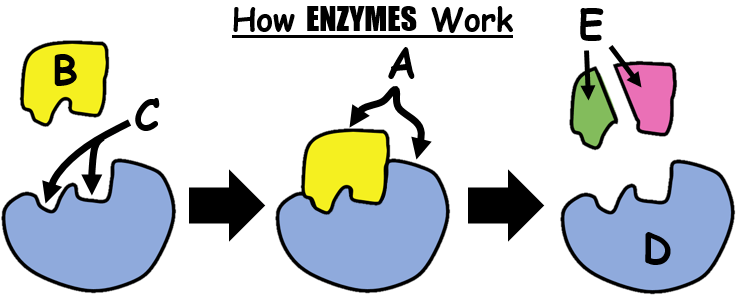
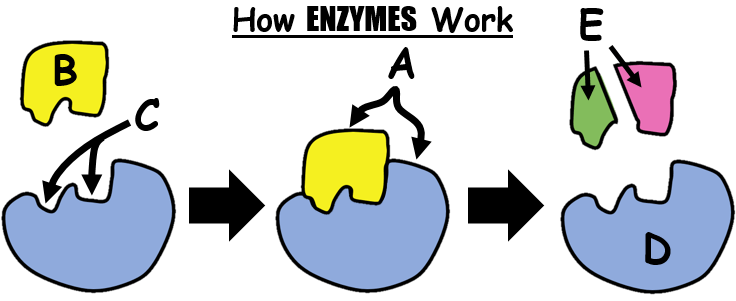
Letter D...
active site
enzyme
substrate
products
39
Multiple Choice
Letter B...
active site
enzyme
substrate
products
40
Multiple Choice
Letter c...
active site
enzyme
substrate
products
41
Multiple Choice
Each enzyme only has 1 substrate that will fit its active site. What is this called?
reusablility
denaturation
specificity
fragility
42
43
44
Multiple Choice
What is a substance called if it speeds up a chemical reaction?
reusable
catalyst
specific
fragile
45
46
Multiple Choice
An enzyme speeds up a chemical reaction in the cell but can only be used once. True or False?
true
false
47
48
Multiple Choice
49
50
Multiple Choice
What happens when enzymes are heated to a high temperature?
The enzymes die.
The shapes of the enzyme are altered denature
The enzymes' amino acid sequence changes.
The enzymes remain the same
51
52
There are 2 basic cell types
Prokaryotic (does not contain a nucleus)
Eukaryotic (contains a true nucleus)
53
Prokaryotic Cells
Very simple; found in single celled organisms
Do not contain "membrane-bound" organelles
Smallest versions of the cell
Contains DNA in the nucleoid region
Example: bacteria
54
Eukaryotic Cells
Found in multicellular, complex organisms
Contains membrane-bound organelles
Much larger than prokaryotic cells
Contains a true nucleus that contains DNA
Example: plant and animal cells
55
Multiple Select
Which of the following structures are found in both prokaryotic and eukaryotic cells?
DNA/RNA
Cell Membrane
Flagellum
Nucleus
Ribosomes
56
Multiple Choice
How does the size of prokaryotic cells compare to eukaryotic cells?
Prokaryotic cells are much smaller than eukaryotic cells.
Eukaryotic cells are typically smaller than prokaryotic cells.
Prokaryotic cells can be the same size as eukaryotic cells, if they grow under the right conditions.
Prokaryotic and eukaryotic cells are the same size.
57
Multiple Select
Which of the following word parts means "no" or "without"?
eu-
pro-
-karyotic
nu-
58
59
60
61
Poll
What can we compare the cell membrane to?
Wall/Border
Building
62
63
Multiple Choice
This organelle controls what goes in and out of plant and animal cells.
Cell Wall
Cell Membrane
Chloroplasts
Cytoplasm
64
Multiple Choice
65
66
Poll
What can we compare the nucleus to?
City hall
Roads
67
68
Multiple Choice
What is the structure that contains DNA and directs the cell?
endoplasmic reticulum
central vacuole
cell wall
nucleus
69
Multiple Choice
In what organelle is the genetic material found inside?
cell membrane
chloroplast
nucleus
ribosome
70
71
Poll
What can we compare DNA to?
The City Mayor
Recycling trucks
72
73
74
75
Multiple Choice
76
77
78
Multiple Choice
I make proteins for the cell. What am I?
ribosome
cell membrane
nucleus
chloroplast
79
80
Open Ended
What can I compare the Mitochondria to in a city scale?
81
82
Multiple Choice
What organelle is called the "powerhouse" of a cell?
mitochondria
nucleus
cell wall
cell membrane
83
84
85
Multiple Choice
The _____________ stores food, water, wastes, and other materials in both plant and animal cells.
Vacuole
Mitochondria
Cytoplasm
Nucleus
86
87
88
Multiple Choice
89
90
91
Multiple Choice
92
Multiple Choice
The arrow is showing the fluid inside the cell that surrounds the cell organelles. What is the arrow pointing to in the cell?
cytoplasm
mitochondria
ribosomes
nucleus
93
Wednesday- Unit 2: Mitosis and Cell Cycle
94
Thursday- Unit 3: Cellular Energetics
95
Friday-Unit 4: Animal and Plant Systems
Unit 1: Biomolecules and Cell Structure/Function
Show answer
Auto Play
Slide 1 / 95
SLIDE

Similar Resources on Wayground
91 questions
ELA 8 24-25 Catch Up Plan
Presentation
•
8th Grade
92 questions
Unit 11- Linear Equations
Presentation
•
8th Grade
86 questions
Geologic Time Scale
Presentation
•
9th Grade
93 questions
Monohybrid Cross
Presentation
•
9th Grade
88 questions
Introduction to Waves
Presentation
•
8th Grade
87 questions
EXPLORING SPACE
Presentation
•
8th Grade
88 questions
Nubia 1b: The Kushites & Meroë Study Guide
Presentation
•
8th Grade
93 questions
Industrial Revolution (Lesson Slides)
Presentation
•
8th Grade
Popular Resources on Wayground
10 questions
HCS SCI 03 Summer School Review 4
Quiz
•
3rd Grade
11 questions
HSMS - Standard Response Protocol
Quiz
•
6th - 8th Grade
16 questions
1.1-1.2 Quiz Review
Quiz
•
9th - 12th Grade
12 questions
Exponent Expressions
Quiz
•
6th Grade
20 questions
Adding and Subtracting Integers
Quiz
•
6th - 7th Grade
11 questions
Northeast States
Quiz
•
3rd - 4th Grade
10 questions
Characterization
Quiz
•
3rd - 7th Grade
10 questions
Common Denominators
Quiz
•
5th Grade