

Matter and Their Particles

Presentation
•
Science
•
6th Grade
•
Hard

Joseph Anderson
FREE Resource
11 Slides • 7 Questions
1
Science : Particles in States of Matter
Particles in states of matter may be in the form of molecules or ions. Molecules are particles that are made up of atoms of one or more elements. They can be made up of single atoms, for example helium and argon, or many atoms like sulfur or carbon. Most molecules contain atoms of different elements.
2

What is a particle?
A particle is an extremely tiny piece of matter, and scientists believe that everything in the universe is made up of particles. Particles can range in size, from larger subatomic particles, like electrons, or much smaller microscopic particles like atoms or molecules.
Particles
3
4
A solid has a fixed shape and a fixed volume because the particles can move only a little. The particles vibrate back and forth but remain in their fixed positions. As a solid is heated, the particles vibrate faster and faster until they have enough energy to break away from their fixed positions.
How fast do the particles in a solid move?
Point out the following about solids: The particles (atoms or molecules) are attracted to each other. The particles (atoms or molecules) vibrate but do not move past one another. The solid retains its shape.
Particles in a solid.
Particles in a solid
5
Multiple Choice
How do the particles in a solid move?
they vibrate
they zoom past
they slide past
they fly past
they bounce past
6
Fill in the Blanks
what is a particle?
7

The particles of a liquid are close together, always moving, and can slide past one another. In a gas, the particles have very little attraction to each other. They are very far apart compared to the particles in a solid or liquid, and are constantly moving.
Particles of a liquid.
8
A liquid can flow and does not have a specific shape like a solid. Instead, a liquid conforms to the shape of the container in which it is held. Although this is similar to a gas, a liquid does not expand to fill up the container like a gas.
How does a liquid fill its container
Liquid In a liquid, particles will flow or glide over one another, but stay toward the bottom of the container. The attractive forces between particles are strong enough to hold a specific volume but not strong enough to keep the molecules sliding over each other.
About liquids particles
Liquid facts and questions
9
Multiple Choice
Do liquids have specific shapes like solids
10
Multiple Choice
How does a liquid fill its container
11
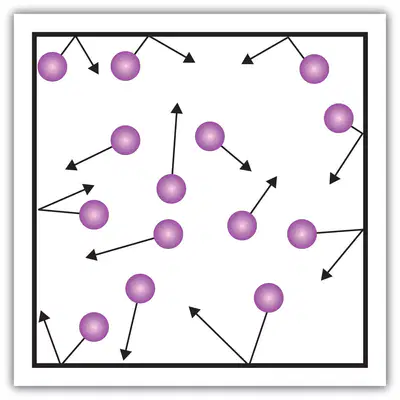
In a gas, the particles have very little attraction to each other. They are very far apart compared to the particles in a solid or liquid, and are constantly moving. The particles don't interact with one another but just hit and bounce off of each other when they collide.
Particles in a gas
12
Why are gases different from liquids and solids?
Solids have a definite shape and volume. Liquids have a definite volume, but take the shape of the container. Gases have no definite shape or volume.
13
It's a mixture of different gases. The air in Earth's atmosphere is made up of approximately 78 percent nitrogen and 21 percent oxygen. Air also has small amounts of other gases, too, such as carbon dioxide, neon, and hydrogen. Individual atoms can combine with other atoms to form molecules. In particular, oxygen and nitrogen, which are the major components of air, occur in nature as diatomic (2 atom) molecules. Under normal conditions, matter exists as either a solid, a liquid, or a gas. Air is a gas.
Is air a gas or liquid
A gas is a substance that is in a gaseous, or vaporous, state of matter. The term gas is also used in reference to the state itself when applied to matter that has the properties of a gaseous substance. Gas is one of four natural states of matter, along with liquid, solid and plasma. A gas has no fixed shape or volume.
Explination on Gases
14

Gas Properties Definitions
You can open this webpage in a new tab.
15
Why do solids require more energy compared to liquids and gases for the movement of particles?
There are three states of matter.
They are solids, liquids, and gases.
In solids, the particles are closely packed and there is a strong force of attraction between the particles which holds them in a fixed position. The particles have very limited freedom.
In liquids, the particles are close together but are not so close as in solids. The intermolecular force of attraction is less than that of solids. So, the particles in liquids have more freedom than those in solids.
In gases, the particles are much farther apart from one another as compared to solids and liquids. The space between them is very large. The force of attraction between them is negligible. So, particles of gas are free to move in any direction.
Thus, a solid requires more energy for the movement of particles since the particles are closely packed and have a strong force of attraction between them.
16
Multiple Choice
Why do solids require more energy compared to liquids and gases for the movement of particles?
17
Multiple Choice
Does a gas have more energy than a solid? why?
18
Multiple Choice
which has more energy: solid, liquid, or gas? why? and how?
Science : Particles in States of Matter
Particles in states of matter may be in the form of molecules or ions. Molecules are particles that are made up of atoms of one or more elements. They can be made up of single atoms, for example helium and argon, or many atoms like sulfur or carbon. Most molecules contain atoms of different elements.
Show answer
Auto Play
Slide 1 / 18
SLIDE
Similar Resources on Wayground

13 questions
Electromagnetic Spectrum
Presentation
•
6th - 7th Grade
16 questions
Unbalanced and Balanced Forces/Net Force
Presentation
•
6th Grade
16 questions
Respiratory System
Presentation
•
6th Grade
16 questions
Lesson 1 Earth's Moving Surface
Presentation
•
6th Grade
15 questions
The Urinary System
Presentation
•
6th - 7th Grade
13 questions
Stimuli and Response
Presentation
•
6th Grade
14 questions
Photosynthesis
Presentation
•
6th Grade
11 questions
Law of conservation of energy
Presentation
•
6th Grade
Popular Resources on Wayground
10 questions
Safety Day 2026 – Student Review

Quiz
•
9th Grade
21 questions
Continents and Oceans
Quiz
•
6th Grade
20 questions
Parts of Speech
Quiz
•
5th Grade
16 questions
Subject & Predicate
Quiz
•
5th Grade
25 questions
Multiplication Facts
Quiz
•
5th Grade
12 questions
Map Skills
Quiz
•
3rd Grade
22 questions
Continents and Oceans
Quiz
•
5th Grade
15 questions
Rounding Decimals
Quiz
•
5th Grade
Discover more resources for Science
20 questions
Elements, compounds, and mixtures
Quiz
•
6th Grade
10 questions
6.6D - Relative Density Review
Quiz
•
6th Grade
10 questions
Exploring Chemical and Physical Changes

Interactive video
•
6th - 10th Grade
20 questions
CONDUCTION,CONVECTION AND RADIATION
Quiz
•
6th Grade
20 questions
Rocks and The Rock Cycle
Quiz
•
6th Grade
19 questions
Describing and Classifying Matter
Presentation
•
6th Grade
21 questions
Waves and Wave Properties
Quiz
•
6th - 8th Grade
20 questions
Phases of the Moon
Quiz
•
6th Grade