Measuring Waves
Presentation
•
Physics
•
8th - 12th Grade
•
Hard

Joseph Anderson
FREE Resource
14 Slides • 12 Questions
1
By Ms Sims
2
The peak is like the top of the hill, while the trough is like the bottom of the hill.
Waves also have amplitudes, which is a measure of how tall a wave is above the center line.
Parts of a wave
3
Multiple Choice
4
Multiple Choice
5
Multiple Choice
6
The last identifiable feature of a wave is its wavelength, or the length of the wave from left to right. You calculate it by measuring from one peak to the next peak, one trough to the next trough, as well as from any point until one complete cycle has finished.
Wavelength
7
Wavelength can be measured from crest to crest
Or wavelength can be measured from trough to trough
8
Multiple Choice
9
Multiple Choice
10
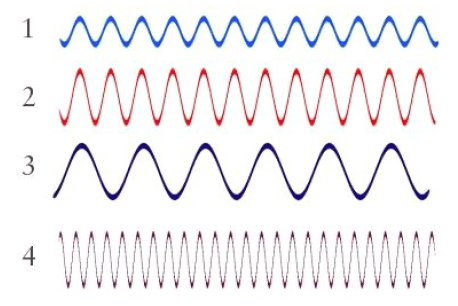
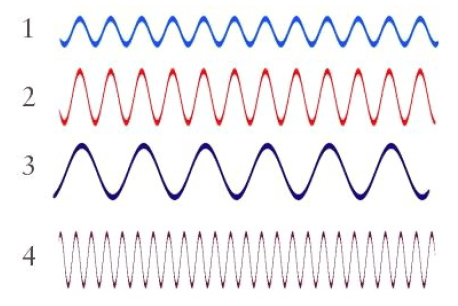
Imagine the red box is one second. The top wave has greater frequency than the bottom because more waves pass in that second.
Frequency is the number of waves that pass by each second.
11
Multiple Choice
12
When one increases, the other decreases.
Wavelength increases= Frequency decreases
Wavelength decreases = Frequency increases
13
Multiple Choice
14
Multiple Choice
15
Multiple Choice
16
17
Taller waves have more energy.
18
Multiple Choice
19
Sound waves with more amplitude are louder
Light waves with more amplitude are more intense
20
for light, it determines the color
for sound, it determines the pitch
(how low or high the sound is)
21
22
23
Mechanical waves need a medium
like gas, liquids, or solids
Electromagnetic waves do not need a medium
They can travel through a vacuum
24
Radio
Wi-fi
Gravity
light
microwaves
magnetic fields
electrical fields
25
Multiple Choice
26
Multiple Choice
True or false: electromagnetic all travel at the speed of light
True
False
By Ms Sims
Show answer
Auto Play
Slide 1 / 26
SLIDE

Similar Resources on Wayground
22 questions
The Moon
Presentation
•
8th - 12th Grade
20 questions
Indirect Object Pronouns Lesson
Presentation
•
8th - 12th Grade
17 questions
Conservation of Energy
Presentation
•
9th - 12th Grade
21 questions
Lesson 3: Describing Circuits
Presentation
•
7th - 12th Grade
21 questions
Parent Functions & Transformations
Presentation
•
8th - 12th Grade
19 questions
Homophone Review
Presentation
•
8th - 12th Grade
19 questions
Comparative Anatomy
Presentation
•
8th - 12th Grade
Popular Resources on Wayground
10 questions
Safety Day 2026 – Student Review
Quiz
•
9th Grade
21 questions
Continents and Oceans
Quiz
•
6th Grade
20 questions
Parts of Speech
Quiz
•
5th Grade
16 questions
Subject & Predicate
Quiz
•
5th Grade
25 questions
Multiplication Facts
Quiz
•
5th Grade
12 questions
Map Skills
Quiz
•
3rd Grade
22 questions
Continents and Oceans
Quiz
•
5th Grade
15 questions
Rounding Decimals
Quiz
•
5th Grade
Discover more resources for Physics
20 questions
Position vs. Time Graphs
Quiz
•
9th Grade
22 questions
Physical Properties of Matter
Quiz
•
8th Grade
10 questions
Exit Check 5.1 - Forms of Energy
Quiz
•
9th Grade
11 questions
Electricity Explained
Interactive video
•
9th - 12th Grade
87 questions
25-26 Unit 1.2 Review - Radioactivity & Earth's Age
Quiz
•
8th - 10th Grade
15 questions
Position vs. Time and Velocity vs. Time Graphs
Quiz
•
10th - 12th Grade
21 questions
Calculating Speed Distance and Time
Quiz
•
6th - 8th Grade
18 questions
Quiz #8 Practice: Forces on an Incline
Quiz
•
9th Grade