

High School Biology Review Lesson on Ecology

Presentation
•
Science
•
9th - 10th Grade
•
Hard

Joseph Anderson
FREE Resource
22 Slides • 8 Questions
1
By Derek Hathaway
2
Ecology is the study of relationships between living things and their environment
Environment is made up of biotic and abiotic things
Biotic: living
Abiotic: nonliving
Ecosystem= Level of ecology that includes
the biotic and abiotic factors

3

4

5
Multiple Choice
Which of the following is an abiotic factor?
Grass
Fungi
Bacteria
Water
6
Multiple Choice
Which of the following is a behavioral adaptation?
Migrating south for the winter
Large Claws
Camouflage
Toxic chemicals for defense
7
Energy flows through an ecosystems in one direction
Starting with the sun or chemical compounds
Then to autotrophs(producers)
Then to various heterotrophs(consumers)

8
Models that show all possible feeding relationships at each trophic level in a community; links all food chains in an ecosystem together.

9
Energy is passed up a food chain or food web from lower to higher trophic levels.
Generally only about 10% of the energy at one level is available to the next level and stored as energy
The rest of the energy is used for metabolic process or given off as heat to the environment.

10
Multiple Choice
What is always on the bottom level of energy pyramid?
primary consumers
secondary consumers
autotrophs (producers)
heterotrophs (consumers)
11
Multiple Choice
What do fungi do to dead plants and animals?
Leave them there
Decompose them
Wait for other animals to eat them
Move away
12
An ecosystem survives by a combination of energy flow and matter recycling
Biogeochemical cycles move all nutrients through air, water, soil, rock and living organisms

13
The circulation of carbon between the living organisms and the non-living components of ecosystems.
Plants and other organisms that can perform photosynthesis help to remove carbon dioxide from the atmosphere and release oxygen.

14

15
~ 78% of the atmosphere is nitrogen gas, but it is not in a usable form
Bacteria are the only organisms that can use nitrogen directly from the environment

16

17

18

19
Multiple Choice
The highest population an environment can support is called
a limiting factor
exponential growth
carrying capacity
20
Multiple Choice

When a population grows past the ecosystem's carrying capacity, what eventually happens to the population?
Continues to grow
The population starts to die off, due to limited resources
The population grows then finds a new carrying capacity
21

22

23

24

25
Multiple Choice

The picture shows what type of succession?
primary
secondary
tertiary
quadanary
26

27

28

29

30
Multiple Choice
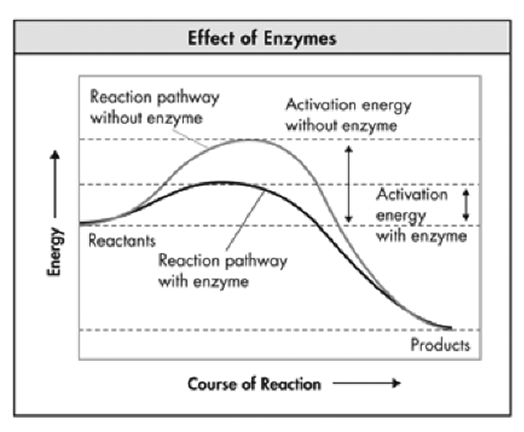
Enzymes decrease the activation energy of the reaction.
By Derek Hathaway
Show answer
Auto Play
Slide 1 / 30
SLIDE
Similar Resources on Wayground

25 questions
16.1 Mining & resources
Presentation
•
9th - 10th Grade
23 questions
Introduction to Biomolecules
Presentation
•
9th Grade
23 questions
Prokaryotic V Eukaryotic Cells
Presentation
•
9th Grade
23 questions
Feedback loops and Homeostasis
Presentation
•
10th Grade
22 questions
Carbohydrates
Presentation
•
9th - 11th Grade
21 questions
Motion- Speed and Velocity
Presentation
•
10th Grade
21 questions
Biology EOC Review
Presentation
•
10th Grade
21 questions
Wave Equation
Presentation
•
9th - 11th Grade
Popular Resources on Wayground
10 questions
Safety Day 2026 – Student Review

Quiz
•
9th Grade
21 questions
Continents and Oceans
Quiz
•
6th Grade
20 questions
Parts of Speech
Quiz
•
5th Grade
16 questions
Subject & Predicate
Quiz
•
5th Grade
25 questions
Multiplication Facts
Quiz
•
5th Grade
12 questions
Map Skills
Quiz
•
3rd Grade
22 questions
Continents and Oceans
Quiz
•
5th Grade
15 questions
Rounding Decimals
Quiz
•
5th Grade
Discover more resources for Science
10 questions
Exploring Chemical and Physical Changes

Interactive video
•
6th - 10th Grade
20 questions
Atomic Structure
Quiz
•
9th Grade
10 questions
Exploring the Electromagnetic Spectrum for Middle School Science
Interactive video
•
6th - 10th Grade
10 questions
Exploring Force and Motion Concepts
Interactive video
•
6th - 10th Grade
10 questions
Exploring Air Masses and Weather Fronts
Interactive video
•
6th - 10th Grade
10 questions
Exploring the States of Matter
Interactive video
•
6th - 10th Grade
10 questions
Exploring Forces: Net Force, Normal Force, Gravity, and Friction
Interactive video
•
6th - 10th Grade
10 questions
Differentiating Thermal Energy and Temperature
Interactive video
•
6th - 10th Grade