
Food Webs, Symbiosis, Limiting Factors and Cells

Presentation
•
Science
•
8th Grade
•
Hard

Joseph Anderson
FREE Resource
7 Slides • 6 Questions
1
An ecosystem Includes all living and non-living parts of the environment as well as the interactions among them.
Biotic factors are living parts of an ecosystem which includes remains and wastes.
Non-living parts of an ecosystem which includes light, temperature, weather, soil and water
Important Information
2



If there's not enough food or water, individuals will die through starvation, desiccation (the removal of moisture from something) and stress, or they will fail to produce offspring.
Food and water
Competition would increase. Lack of resources would affect the local population and the carrying capacity of the area would suffer.
Space
Exposure to the elements or predators is a major factor.
Shelter
Limiting Factors to take into consideration
3
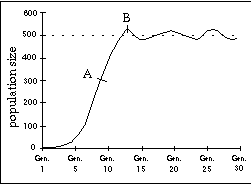
Limiting Factors are conditions of the environment that limit the growth of a species.
Because of these limiting factors, each ecosystem has a finite capacity for growth connected to its carrying capacity.
Limiting Factors

4
Multiple Choice

In the graph to the right, what is the population of deer at the carrying capacity of the environment?
3
7
70
40
5
Multiple Choice
around 500
more than 500
less than 500
around 600
6
Multiple Choice
What will happen if all of the frogs in a population die?
The frogs' predators will decrease and the frogs' prey will increase
The frogs' predators will increase and the frogs' prey will decrease
We better all pray because there isn't anymore frogs.
7
Multiple Choice
limiting factors
wet
messy
found in rocks
8
First-order consumers feed directly on producers
Second-order consumer feed on first-order consumers
Third-order consumer feeds on second-order consumers
Food Chains and Food Webs

9
Decomposers are organisms that gets energy by breaking down the remains of dead organisms and the wastes of living things.
Producers make their own food through photosynthesis.
Ecosystems get all energy from the sun!
Food Chains and Food Webs

10
Multiple Choice

Which of the following is not shown as a primary consumer
black bear
beaver
pine vole
bobcat
11
Animals coexist when they live in the same habitat but rely on different resources
Mutualism is a relationship in which both species benefit
Animal Relationships

12
Commensalism is a relationship where one species benefits without benefiting or harming the other species
Parasitism is a relationship between a parasite and its host where one species benefits and the other is harmed.
Animal Relationships

13
Multiple Choice
Arrows in a food web represent...
eating
sunlight
energy
matter
An ecosystem Includes all living and non-living parts of the environment as well as the interactions among them.
Biotic factors are living parts of an ecosystem which includes remains and wastes.
Non-living parts of an ecosystem which includes light, temperature, weather, soil and water
Important Information
Show answer
Auto Play
Slide 1 / 13
SLIDE
Similar Resources on Wayground

10 questions
1.2 Metric Conversions
Presentation
•
8th Grade
10 questions
Density Practice Live Lesson
Presentation
•
8th Grade
9 questions
Formation of Fossil Fuel
Presentation
•
9th Grade
13 questions
Class Activity - Convection Currents
Presentation
•
8th Grade
13 questions
SSA Review: Earth Spheres
Presentation
•
8th Grade
13 questions
Tides
Presentation
•
8th Grade
8 questions
The Chesapeake Bay Resources Review
Presentation
•
8th Grade
11 questions
Moon Phases
Presentation
•
8th Grade
Popular Resources on Wayground
24 questions
PBIS-HGMS Day 10

Quiz
•
6th - 8th Grade
10 questions
HCS SCI 03 Summer School Review 3
Quiz
•
3rd Grade
11 questions
Home Scope
Quiz
•
7th - 8th Grade
15 questions
HCS SCI 05 Summer School Assessment 3 Review
Quiz
•
5th Grade
35 questions
Lufkin Road Middle School Student Handbook & Policies Assessment
Quiz
•
7th Grade
18 questions
Geo 11.3 Area of Circles and Sectors
Quiz
•
9th - 11th Grade