
Electron Cloud

Presentation
•
Chemistry
•
11th Grade
•
Hard

Joseph Anderson
FREE Resource
9 Slides • 5 Questions
1
2
The Atom's Structure (Quick Review)
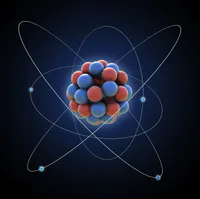
The atom consists of a nucleus and an electron cloud.
The nucleus contains protons and neutrons.
The electron cloud holds electrons.

3
MASS OF THE ATOM = NUCLEUS
Just about all of the mass of an atom comes from the protons & neutrons found in the nucleus.
Think of electrons as dust on your shoulder.
4
VOLUME (SPACE IT TAKES UP ) OF THE ATOM = ELECTRON CLOUD
Nucleus: is extremely tiny. It hardly takes up any space.
Analogy: Nucleus = a marble on the 50 yard line in a stadium
5
Electron Cloud: The rest of the atom consists of space for the electrons to zip around in.
Analogy: Electrons = people in the stands.
Electron Cloud = All of the seats in
the stadium. Very few are
occupied. Most are empty.
Energy Levels = Specific rows within
the stadium (electron cloud).

6
MOST OF AN ATOM IS EMPTY SPACE!
Since electrons are so unbelievably tiny, most of the electron cloud is just empty space!
Analogy: 20 people in Giants Stadium.
Most of the seats are empty.
7
Multiple Choice
Where is most of the mass of an atom concentrated?
Nucleus
Electron Cloud
Both Nucleus and Electron Cloud
8
Multiple Choice
What determines the volume of an atom?
Nucleus
Electron Cloud
Both Nucleus and Electron Cloud
9
Multiple Choice
What is the main difference between the nucleus and the electron cloud in an atom?
The nucleus contains protons and neutrons, while the electron cloud holds electrons.
The nucleus is much larger than the electron cloud, occupying most of the atom's volume.
The electron cloud contains protons and neutrons, while the nucleus holds electrons.
The electron cloud is much smaller than the nucleus, occupying most of the atom's volume.
10
PROTONS PULL ELECTRONS CLOSE:
Protons: + Electrons: -
They have opposite charges so they are attracted to one another.
The more protons in the nucleus, the stronger the attraction between the nucleus and the electrons in the electron cloud.

11
STRONGER NUCLEUS = SMALLER ATOM:
More protons exert a stronger attraction for the electrons in the electron cloud. They get pulled in closer to the middle and atom gets smaller.

12
Multiple Choice
Which atom from row 4 on the periodic table will be smaller?
K
Ca
As
Br
13
Multiple Choice
Protons exert an ___ force on electrons in the electron cloud.
attractive
neutral
positive
repulsive
14
Complete your Take Away Ideas before you submit this lesson and move on to Part 8.
Show answer
Auto Play
Slide 1 / 14
SLIDE
Similar Resources on Wayground

12 questions
Anne Frank Character Change
Presentation
•
6th - 9th Grade
8 questions
Gay-Lussac Law
Presentation
•
12th Grade
12 questions
Electron Configuration
Presentation
•
11th - 12th Grade
10 questions
Periodic Trends
Presentation
•
11th - 12th Grade
10 questions
Solving Equations
Presentation
•
6th Grade
10 questions
Periodic Table and Elements
Presentation
•
10th - 12th Grade
9 questions
Limiting Reactant and Percent Yield
Presentation
•
10th Grade
12 questions
Unit 6 - Stoichiometry - Intro to Stoichiometry Notes
Presentation
•
10th - 12th Grade
Popular Resources on Wayground
10 questions
Safety Day 2026 – Student Review

Quiz
•
9th Grade
21 questions
Continents and Oceans
Quiz
•
6th Grade
20 questions
Parts of Speech
Quiz
•
5th Grade
16 questions
Subject & Predicate
Quiz
•
5th Grade
25 questions
Multiplication Facts
Quiz
•
5th Grade
12 questions
Map Skills
Quiz
•
3rd Grade
22 questions
Continents and Oceans
Quiz
•
5th Grade
15 questions
Rounding Decimals
Quiz
•
5th Grade
Discover more resources for Chemistry
20 questions
electron configurations and orbital notation
Quiz
•
9th - 12th Grade
20 questions
Periodic Table Trends
Quiz
•
11th Grade
50 questions
Unit 3: Atomic Assault Summative Review
Quiz
•
11th Grade
20 questions
Physical or Chemical Change/Phases
Quiz
•
8th Grade - University
15 questions
Periodicity Module Exam Practice Quiz
Quiz
•
9th - 12th Grade
15 questions
Electron Configurations and Orbital Notation
Quiz
•
11th Grade
8 questions
Label Energy Diagram
Quiz
•
9th - 12th Grade
20 questions
Naming Covalent Compounds
Quiz
•
11th Grade