

Layers of the Earth and Plate Tectonics

Presentation
•
Science
•
9th - 12th Grade
•
Hard

Joseph Anderson
FREE Resource
19 Slides • 12 Questions
1
Plate Tectonics
An Introduction

2
Practice with purpose games and word wall
3
There was once a time when you could take a stroll from North or South America to Africa no problem!

4
Plate tectonics theorizes that Earth's outer layer is made up of large, moving pieces called plates! These plates are in constant motion.

5
Assignment: EdPuzzle
Title:
What are Tectonic Plates? Our Earth and Its Movements
After video: class discussion:
What are the basic layers of the Earth?
What are the possible outcomes of plate movement?
How do fossils support the idea of Pangea, the super continent?
If the inner core is so hot why is it solid?
6
Multiple Choice

About how fast do you think the tectonic plates move?
As fast as students leave school at the end of the day
As fast as your nails grow
As fast as you can run
7
Tectonic plates move about as fast as your fingernails grow -
That's 1-6 inches a year!

8
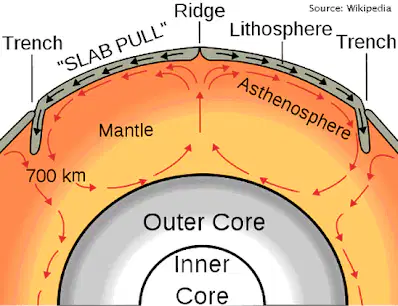
3 Theories of plate tectonics
Convection
Slab pull
Ridge Push.
What causes tectonic plates to move?
10
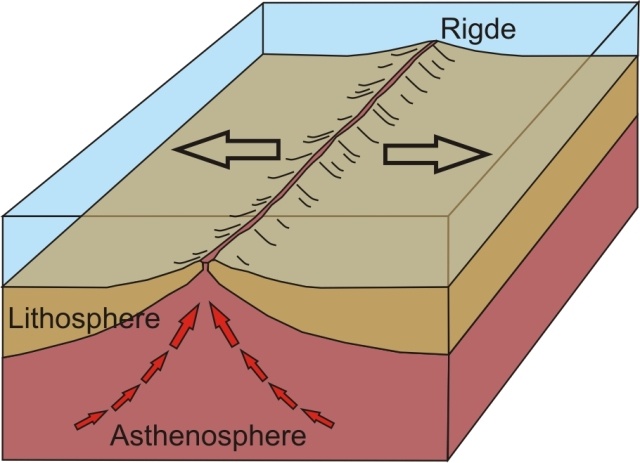
These plates move due to heat from Earth's core.
Heat rises at spreading centers, pushing plates apart
This process resulted in the breakup of Pangea, the formation of the Atlantic Ocean, and how Earth's surface appears today!

11
slab pull
This force is caused by the sinking of cold, dense mantle material at subduction zones. As the old mantle material sinks back into the Earth, it pulls the tectonic plates along with it.
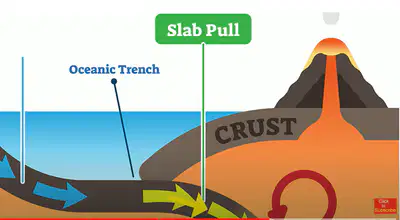
subduction zones are where the slabs are pulled underneath (because they cool and are more dense)
12
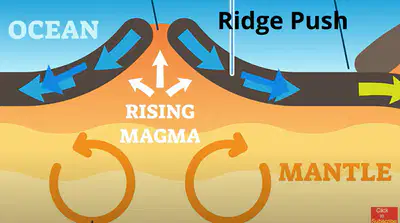
the upward movement of hot mantle material at mid-ocean ridges. As the new mantle material rises to the surface, it pushes the older, cooler mantle material away. This creates a ridge push force that moves the tectonic plates apart.
Ridge push
13
Multiple Choice
What do you think happens when two plates converge (collide)?
Mountains form
A trench forms
They change course and move somewhere else
14
Through collisions, plates can raise incredible mountain ranges!
The Himalayan mountains formed as the Indian plate crashed into the Eurasian plate.

15
Multiple Choice
What's the smartest mountain in the world?
Mount Cleverest
16
Multiple Choice
Which mountain range (hint: it is close to home!) also formed due to the collision of plates?
The Andes
The Appalachians
The Cascades
The Transantarctic Mountains
17
18
Types of Plate Boundaries
Describe the different types of plate boundaries
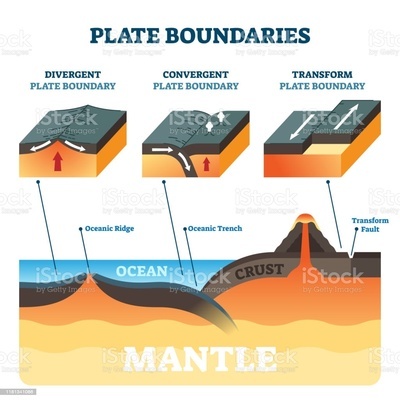
19
Divergent Boundary
- Place where 2 plates move apart
-Most occur in the ocean and form mid-ocean ridges
-When they occur on land, rift valleys form

20
Divergent Oceanic
-Example-Mid Atlantic Ridge

21
Multiple Choice
When a divergent boundary occurs on land, which landform does it create?
mid-ocean ridge
rift valley
new ocean floor
subduction zone
22
Multiple Choice
Which type of boundary involves the plates moving horizontally, side by side?
convergent
divergent
transform
23
Transform Boundary
-Place where two plates slip past each other side by side
- Crust is neither created nor destroyed
-Earthquakes frequently occur along these boundaries

24
Multiple Choice
What are transform boundaries known for?
earthquakes
volcanoes
mid-ocean ridges
rift vallies
25
Multiple Choice
26
Multiple Choice
The process when one crust goes under another is called
sea floor spreading
convergency
subduction
rifting
27
Multiple Choice
28
Multiple Choice

This type of Boundary results when plates separate
Divergent
Convergent
Transform
29
Multiple Choice
Type of Boundary where plates collide
Divergent
Convergent
Transform
30
That's right! Next time you hike in Shenandoah National Park, know that you are among mountains that started forming over 400 million years ago (that's before life even left the ocean!).

31
Thank you!

Plate Tectonics
An Introduction
Show answer
Auto Play
Slide 1 / 31
SLIDE
Similar Resources on Wayground

25 questions
Photosynthesis
Presentation
•
9th - 11th Grade
21 questions
7.3 Weather Patterns
Presentation
•
9th - 12th Grade
24 questions
1C Unit 9.1 - Distance and Displacement
Presentation
•
8th - 12th Grade
27 questions
Evidence of Evolution Notes
Presentation
•
9th - 12th Grade
26 questions
Gas Laws
Presentation
•
9th - 12th Grade
24 questions
Unit 5 - Gas Laws
Presentation
•
9th - 12th Grade
27 questions
DNA RNA
Presentation
•
9th - 12th Grade
24 questions
Free fall
Presentation
•
10th - 12th Grade
Popular Resources on Wayground
24 questions
PBIS-HGMS Day 10

Quiz
•
6th - 8th Grade
10 questions
HCS SCI 03 Summer School Review 3
Quiz
•
3rd Grade
11 questions
Home Scope
Quiz
•
7th - 8th Grade
15 questions
HCS SCI 05 Summer School Assessment 3 Review
Quiz
•
5th Grade
35 questions
Lufkin Road Middle School Student Handbook & Policies Assessment
Quiz
•
7th Grade
18 questions
Geo 11.3 Area of Circles and Sectors
Quiz
•
9th - 11th Grade