

12b plant systems

Presentation
•
Biology
•
9th - 12th Grade
•
Medium
+8
Standards-aligned

SARAN WARD
Used 4+ times
FREE Resource
37 Slides • 24 Questions
1


Plant
Systems:
Structures
and Transport
Functions
Exploring the Root and
Shoot Systems of Plants
This Photo by Unknown Author is licensed under CC BY
2

Lesson
Objective
- Understand how plant
structures facilitate the
transport of water,
minerals, and sugars.
- Learn the roles of
xylem and phloem in
plant transport.
3
Multiple Choice
Photosynthesis causes plants to
produce sugars and oxygen
collect water and waste
use up sugars
create carbon dioxide
4
Multiple Choice
How does water move through plants?
It goes out through the roots.
It enters through the stomata.
It gets trapped in the membrane.
It is carried through the xylem
5

Root System
•Key Features:
•- Functions:
•
- Anchors the plant.
•
- Absorbs water and minerals.
•
- Stores sugars.
•- Types of Roots:
•
- Taproot: Dominant central
root.
•
- Fibrous roots: Thin, branching
roots.
•
- Root hairs: Increase surface
area for absorption.
6
Multiple Choice
___________ plants have roots that helps them absorb water and anchor them to the soil.
vascular
non-vascular
mossy
7
Multiple Choice
Water enters the roots thanks to a PROCESS called ___________. Water enters THROUGH the ________________.
osmosis, cell wall
osmosis, cell membrane
active transport, cell membrane
active transport, cell wall
8

Xylem
•Xylem: type of vascular tissue in plants that is responsible for
transporting water and dissolved minerals from the roots to the
rest of the plant.
•Key Features of Xylem:
•Composition: Made up of specialized cells like tracheid and vessel
elements, which are dead at maturity and form hollow tubes.
•Direction of Flow: Transports water and minerals upward from
roots to leaves.
•Additional Role: Provides structural support due to the presence
of lignin, a rigid compound in its cell walls.
This Photo by Unknown Author is licensed under CC BY-SA-NC
9
Multiple Choice
The tubes that carry water and nutrients are called
xylem
phloem
stems
roots
10
Open Ended
What is Xylem?
11
Multiple Choice
Set of tubes that carry food throughout the plant
xylem
phloem
stems
roots
12
Multiple Choice
Photosynthesis happens in the leaves of plants and requires
sunlight, oxygen, and carbon dioxide
sunlight, water, and carbon dioxide
oxygen and carbon dioxide
oxygen and sunlight
13

Phloem
•Key Features of Phloem:
•Function: Transports sugars (mainly
sucrose) and other organic molecules
from the leaves (source) to other parts
of the plant (sink).
•Direction of Flow: Bidirectional,
depending on the plant's needs:
•From leaves to roots, flowers,
fruits, or storage organs.
•From storage organs to growing
parts during periods of low
photosynthesis.
Phloem: vascular tissue in plants responsible for transporting sugars, nutrients, and other organic compounds throughout the plant
14
Multiple Choice
Tiny openings in the leaves of plants where gases (oxygen and carbon dioxide) are exchanged.
xylems
phloems
stomata
junctions
15
Multiple Choice
What is phloem?
Storage for sugar and other nutrients
Transportation of nutrients and Sugars
IDK
Creates Antibodies
16
Multiple Choice
Stomata open and close to helps the plant lose water. This process is called
evaporation
transpiration
condensation
sublimation
17


Shoot
System
•Key Components:
•- Stems: Transport
water and sugars
through xylem and
phloem.
•- Leaves:
•
- Photosynthesis site.
•
- Gas exchange
through stomata.
18
Multiple Choice
Where are xylem and phloem found?
in the roots
in the stem
in the leaves
in the soil
19


Transport
in Plants
•Water Movement:
•- Pathway: Root → Stem
→ Leaf → Exit through
stomata.
•- Processes Involved:
•
- Osmosis: Water
enters roots.
•
- Transpiration: Water
vapor exits via stomata.
20

Turgor Pressure
•Definition: Pressure exerted by
water on cell walls.
•How Turgor Pressure Works:
1.Water Uptake:
1. Water enters plant cells by
osmosis due to higher solute
concentration inside the cell
compared to its surroundings.
2.Vacuole Role:
1. The central vacuole fills with
water, increasing its volume.
3.Pressure Against the Cell Wall:
1. As the vacuole expands, it
pushes the plasma membrane
outward against the rigid cell
wall, creating turgor pressure.
21
Multiple Choice
What is Turgor Pressure ?
Amino acids of the plant
Creates storage vessels for the plant to use for nutrients
Pressure exerted by the stroma
22
Explanation Slide...
Pressure exerted by water on cell walls
23

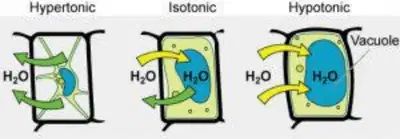
Importance of Turgor Pressure:
•Structural Support:
•High turgor pressure keeps plants upright and leaves firm.
•Low turgor pressure causes wilting.
•Cell Expansion:
•Drives cell elongation during growth.
•Stomatal Function:
•Turgor pressure in guard cells regulates the opening and
closing of stomata for gas exchange and transpiration.
•High pressure – plant erect
•Low pressure – plant wilts
This Photo by Unknown Author is
licensed under CC BY
24

Transpiration
•Definition: Water vapor diffuses
through stomata in leaves.
•Steps in Transpiration:
1.Water Absorption:
1. Water is absorbed by the
roots from the soil.
2.Water Movement:
1. Water travels upward through
the xylem to the leaves,
driven by transpiration pull,
cohesion, and adhesion.
3.Evaporation:
1. Water evaporates from the
surface of mesophyll cells
inside the leaf into the air
spaces.
4.Diffusion:
1. Water vapor diffuses out of
the leaf through the stomata
into the atmosphere.
25
Multiple Choice
What is Transcription?
Water Storage in the Roots
Dissolved water vaper
Water movement through out the plant
Guard Cells
26

Importance of Transpiration:
Creates a transpiration pull that draws water and nutrients from roots to
shoots.
Water
Transport:
Cools the plant by evaporative cooling, especially in hot environments.
Cooling
Mechanism:
Facilitates the exchange of gases needed for photosynthesis and respiration.
Gas Exchange:
Helps maintain cell structure and function.
Maintains
Turgor
Pressure:
27

Summary
of Day 1
•Key Takeaways:
•- Root system absorbs water and minerals.
•- Shoot system transports materials and
supports photosynthesis.
•- Xylem moves water; phloem moves
sugars.
•- Transpiration and turgor pressure
maintain plant health.
28

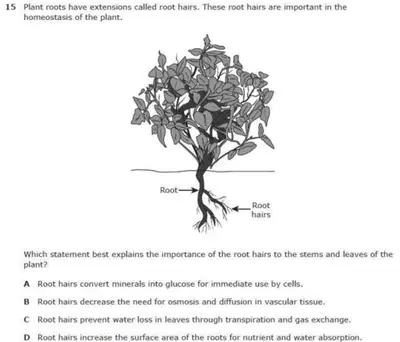
Exit Ticket
29
Multiple Choice
What is the answer to the exit ticket?
A
B
C
D
30
Plant Systems and Interactions

31
Overview of Plant Reproduction
Key Points:
Plants reproduce both sexually and asexually.
Sexual reproduction involves flowers and the fusion of gametes.
Asexual reproduction produces genetically identical offspring.
32

Plants reproduce sexually through flowers, which contain male and female reproductive organs.
Stamen (Anther + Filament).
Carpel (Stigma + Style + Ovary).
Seeds: Result of fertilized ovules.
Fruit: Ripened ovary aiding seed dispersal.
Sexual Reproduction
33

Produces and releases pollen grains, which contain male gametes (sperm).
Pollen grains have a tough coat to protect the sperm during transfer to the female structures.
Anther
A stalk that supports the anther, positioning it for effective pollen transfer by wind, insects, or animals.
Filament
Male Reproductive Parts
34
Fill in the Blanks
35

The sticky surface at the top of the carpel where pollen grains land during pollination.
Specialized to capture and germinate compatible pollen grains.
Stigma
A tube-like structure that connects the stigma to the ovary.
Guides the pollen tube to the ovule for fertilization.
Style
Contains ovules, which house the female gametes (eggs).
After fertilization, the ovary develops into a fruit.
Ovary
Female Reproductive Parts
36
Multiple Choice
What's the purpose of the Stigma?
A storage unit to hold all egg cells
Tube like structure that connects to the ovary
Capture pollen grains
Located inside the Ovary
37
Fill in the Blanks
38


Embryo: The young plant that will develop into the mature plant after germination.
Cotyledons: Store nutrients that support the embryo during germination.
Seed Coat: Protects the seed from physical damage and prevents water loss.
Seeds
Protects the developing seeds.
Facilitates seed dispersal through mechanisms like being eaten by animals, floating in water, or carried by the wind.
Fruits
39
Multiple Choice
What is a seed coat?
Protection from Harm
Water Repellant
Outer layer of an Ovary
Embryo Sac
40
Explanation Slide...
Protects the seed from physical damage and water damage
41

Seed Dispersal Methods:
Wind (e.g., dandelions).
Water (e.g., coconuts).
Animals (e.g., berries).
Explosions (e.g., peas).
Gravity (e.g., apples).
Seed Dispersal
42

Self-Pollination: Occurs when pollen from the same plant fertilizes its ovules.
Cross-Pollination: Involves pollen transfer between different plants, increasing genetic diversity.
Pollination
43

A pollen tube grows from the pollen grain down the style to the ovary.
Sperm cells travel through the tube to fertilize the ovule, forming a zygote.
Fertilization
44
Multiple Select
What Insects are Pollinators?
Butterflies
Bees
Beetles
Roaches
45
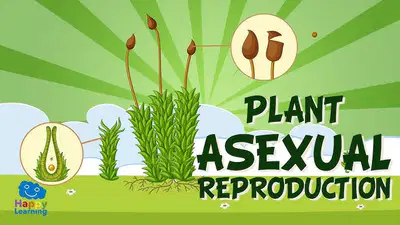
Key Points:
Asexual Reproduction: produces plants that are genetically identical to the parent plant
Methods:
Roots: Tuberous roots (e.g., sweet potatoes).
Stems: Stolons, runners, bulbs (e.g., strawberries, onions).
Leaves: Vegetative propagation (e.g., Bryophyllum).
Advantages: Faster reproduction; stable environments.
Disadvantages: No genetic variation.
Asexual Reproduction
46
Exit Ticket
What are the main differences between sexual and asexual reproduction in plants? Provide one example of each.
47

Tropisms and Plant Responses
48

What are Tropisms?
Tropisms: Directional growth responses of plants toward or away from environmental stimuli.
Significance: These responses enable plants to adapt to their surroundings, ensuring survival, reproduction, and resource acquisition.
Tropisms
49

Example: Roots grow downward into the soil.
Function: Helps anchor the plant and absorb water and nutrients from the soil.
Positive Geotropism
Example: Stems grow upward, away from gravity.
Function: Maximizes access to sunlight for photosynthesis.
Negative Geotropism
Plant cells detect gravity through organelles called statoliths.
Hormones like auxin redistribute in response to gravity, promoting growth in specific directions.
Mechanism
Geotropism (Gravitropism)
Geotropism: Growth response to gravity
50

Example: Stems and leaves bend toward light.
Function: Maximizes photosynthesis by exposing leaves to optimal light.
Positive Phototropism
Auxins accumulate on the shaded side of the plant.
Cells on the shaded side elongate, causing the plant to bend toward the light source.
Mechanism
Phototropism: Growth response to light
51
Open Ended
What is Geotropism?
52
Explanation Slide...
Growth response to gravity
53

Helps climbing plants secure themselves for better access to light.
Protects certain plants by allowing them to retract or curl when touched (e.g., tendrils).
Function
Contact with an object triggers rapid growth on the opposite side, causing the plant to bend or wrap around the object.
Mechanism
Vines wrapping around a trellis or support structure.
Sensitive plants reacting to physical touch.
Examples
Thigmotropism
Growth response to touch or physical contact.
54
Multiple Choice
What is phototropism?
Growth response to light
A mechanism of photosynthesis
Growth response to gravity
Growth response to touch
55
Fill in the Blanks
56

Example: Roots grow toward areas of higher moisture.
Function: Ensures plants access water, crucial for photosynthesis and nutrient transport.
Positive Hydrotropism
Root tips detect water gradients in the soil.
Cells on the side of the root facing less water elongate, bending the root toward the water source.
Mechanism
Hydrotropism
Growth response to water.
57


Function
Triggered by changes in turgor pressure within specialized cells.
Mechanism
Venus Flytrap: Closes rapidly when prey touches its sensitive hairs.
Mimosa Plant: Folds its leaves when touched or shaken.
Examples
Nastic Movements
Non-directional responses to stimuli, unlike tropisms, which are directional.
Protects plants from herbivores or environmental stress.
Helps trap prey (in carnivorous plants) for nutrient acquisition.
58
Real-World Applications of Tropisms
Phototropism: Greenhouses use light sources to optimize plant growth.
Geotropism: Ensures proper orientation of roots and stems during early growth.
Thigmotropism: Used in agriculture to grow climbing crops like beans and grapes efficiently.
Hydrotropism: Studied for improving drought-resistant crops.
59
Multiple Choice
Name the 4 types of tropism
Phototropism, Geotropism, Thigmotropism, Hydrotropism
Lysotropism, Geotropism,Thermotropism
Phototropism, Gigatropism,Hydrotropism,Geotropism
IDK
60
Exit Ticket
Explain one way phototropism and geotropism work together to ensure a plant's survival
61
Explanation Slide...
produces plants that are genetically identical to the parent plant
Plant
Systems:
Structures
and Transport
Functions
Exploring the Root and
Shoot Systems of Plants
This Photo by Unknown Author is licensed under CC BY
Show answer
Auto Play
Slide 1 / 61
SLIDE
Similar Resources on Wayground

57 questions
Mitosis vs Meiosis
Presentation
•
9th - 12th Grade
55 questions
Nutrition Facts Labels
Presentation
•
8th - 12th Grade
53 questions
Quizizz Slides: Genetics Part 2
Presentation
•
9th - 12th Grade
51 questions
photo & cell notes 25
Presentation
•
9th - 12th Grade
53 questions
Photosynthesis and Respiration Review
Presentation
•
9th - 12th Grade
56 questions
Past Simple vs Past continuous
Presentation
•
8th - 12th Grade
Popular Resources on Wayground
24 questions
PBIS-HGMS Day 10

Quiz
•
6th - 8th Grade
10 questions
HCS SCI 03 Summer School Review 3
Quiz
•
3rd Grade
11 questions
Home Scope
Quiz
•
7th - 8th Grade
15 questions
HCS SCI 05 Summer School Assessment 3 Review
Quiz
•
5th Grade
35 questions
Lufkin Road Middle School Student Handbook & Policies Assessment
Quiz
•
7th Grade
18 questions
Geo 11.3 Area of Circles and Sectors
Quiz
•
9th - 11th Grade