Potential vs Kinetic
Presentation
•
Science
•
8th Grade
•
Practice Problem
•
Medium
+1
Standards-aligned
Jordan Archible
Used 12+ times
FREE Resource
10 Slides • 18 Questions
1
Energy is never created or destroyed... only transferred between potential and kinetic energy.
by Mr. Arch
2
3
What is Kinetic Energy?
Kinetic Energy is energy of motion.
An object gets kinetic energy from its mass and velocity. An object with kinetic energy has energy stored in motion.
4
KE is the energy of motion
The amount of Kinetic energy is dependent on the mass and velocity of an object.
5
Multiple Choice
What is kinetic energy?
the energy an object has because its moving
the energy an object does not have because its moving
the energy an object sometimes has because its moving
the energy an object never has because its moving
6
Multiple Choice
Kinetic energy depends on
mass and height
height and speed
mass and speed
mass and force
7
Potential Energy
Potential Energy is energy of position.
An object gets potential energy from height, mass and gravity.
An object with potential energy has the potential to do work. This potential is only released when the object falls.
8
Stored energy
The energy of position
The amount of energy contained in an object at rest
9
Multiple Select
What variables determine the amount of PE an object has?
Energy/Force
Position/Height
Gravity
Mass
10
Multiple Select
What variables determine the amount of KE an object has?
Mass
Gravity
Speed
Potential Energy
11
Multiple Choice
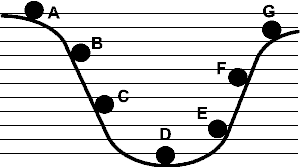
Which point has the most potential energy?
at point A
at point F
at point B
at point G
12
Multiple Choice
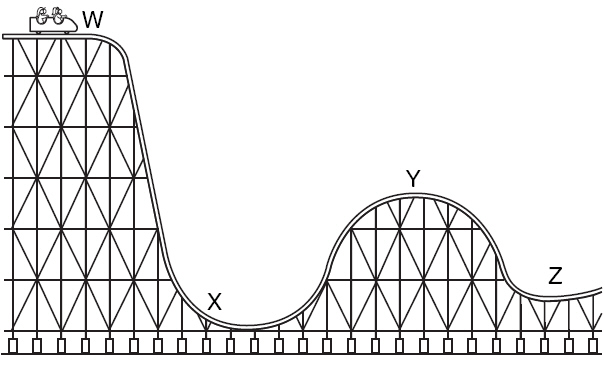
At which point is potential energy least?
Y
X
W
Z
13
Multiple Choice
Look at the picture. Which of these has the least potential energy.
A
B
C
D
14
Notice that as the kinetic energy increases the potential energy decrease.
When the coaster goes back up the hill the energy is converted back to potential energy.
15
16
Fill in the Blanks
As potential energy decrease Kinetic energy
Type answer...
17
Open Ended
If PE depends on the position and mass of an object, how can you increase the amount of potential energy an object has?
18
Multiple Choice
An object that is NOT moving has _________ energy.
kinetic
potential
19
Multiple Choice
An object that is moving has _________ energy.
kinetic
potential
20
Multiple Choice
Potential or Kinetic?
Potential
Kinetic
21
Multiple Choice
Potential or Kinetic?
Potential
Kinetic
22
Energy has a unit of Joules (J).
23
Multiple Choice
You serve a volleyball with a mass of 2 kg.
The ball leaves your hand with a speed of 30 m/s.
The ball has kinetic energy.
Calculate it.
60 J
1800 J
900 J
24
Multiple Choice
A car is traveling with a velocity of 20 m/s and has a weight (mass) of 1000 kg. What type of energy does the car have?
kinetic
potential
25
m is the mass, h is the height and g is acceleration of gravity (g)= 10
26
Multiple Choice
A baby carriage is sitting at the top of a hill that is 20 m high.
The carriage with the baby in it weighs 40 kg.
Calculate how much potential energy the carriage with baby has?
800 J
8000 J
80 J
27
Open Ended
What is the difference between kinetic energy and potential energy?
28
Open Ended
The Law of Conservation of Energy states, "Energy is never created or destroyed only change." How does the relationship between potential and kinetic energy illustrate this?
Energy is never created or destroyed... only transferred between potential and kinetic energy.
by Mr. Arch
Show answer
Auto Play
Slide 1 / 28
SLIDE

Similar Resources on Wayground
22 questions
Fluids, Viscosity and Flow Rate
Presentation
•
8th Grade
22 questions
2.18 Connecting Cellular Respiration and Photosynthesis
Presentation
•
8th Grade
20 questions
Science Tools
Presentation
•
8th Grade
20 questions
Cluster 4 Day 1-Symbiosis
Presentation
•
8th Grade
23 questions
Light as a Wave
Presentation
•
8th Grade
21 questions
Atoms and Elements
Presentation
•
8th Grade
24 questions
Water Unit Lesson
Presentation
•
8th Grade
21 questions
Earth Layers
Presentation
•
8th Grade
Popular Resources on Wayground
10 questions
Safety Day 2026 – Student Review
Quiz
•
9th Grade
21 questions
Continents and Oceans
Quiz
•
6th Grade
20 questions
Parts of Speech
Quiz
•
5th Grade
16 questions
Subject & Predicate
Quiz
•
5th Grade
25 questions
Multiplication Facts
Quiz
•
5th Grade
12 questions
Map Skills
Quiz
•
3rd Grade
22 questions
Continents and Oceans
Quiz
•
5th Grade
15 questions
Rounding Decimals
Quiz
•
5th Grade
Discover more resources for Science
20 questions
Newton's Laws of Motion
Quiz
•
8th Grade
15 questions
potential and kinetic energy
Quiz
•
8th Grade
21 questions
Newton's Laws of Motion
Quiz
•
8th Grade
20 questions
Elements, Compounds and Mixtures
Quiz
•
8th Grade
10 questions
Exploring Chemical and Physical Changes
Interactive video
•
6th - 10th Grade
20 questions
Physical vs Chemical Changes
Quiz
•
8th Grade
20 questions
Conduction, convection, and Radiation Practice
Quiz
•
8th Grade
21 questions
Waves and Wave Properties
Quiz
•
6th - 8th Grade