Atoms and Elements
Presentation
•
Science
•
10th Grade
•
Hard

James Gonzalez
FREE Resource
20 Slides • 35 Questions
1
Atomic Structure (subatomic particles)
2
3
4
5
6
7
8
9
10
11
12
13
14
Multiple Choice
All matter is made of what
energy
electrons
atoms
compounds
15
Multiple Choice
The central region of an atom where its neutrons and protons are is its
nucleus
core
energy shell
center
16
Fill in the Blanks
Type answer...
17
Multiple Choice
What are the 3 particles that make-up the atom?
protons, neutrons, and isotopes
positives, negatives, and electrons
neutrons, isotopes, and electrons
protons, neutrons, and electrons
18
Fill in the Blanks
Type answer...
19
Multiple Choice
Which subatomic particles have no charge (they are neutral)?
protons
electrons
neutrons
ions
20
Multiple Choice
The cloud-like space that electrons travel around:
nucleus
shell
neutrons
oort cloud
21
Multiple Choice
Which 2 particles are found in the nucleus of an atom?
proton and electron
neutron and proton
electron and neutron
22
Multiple Choice
Why do the electrons surround the nucleus?
the negative electrons are attracted to the neutral neutrons
the negative electrons are repelled by the neutral neutrons
the negative electrons are repelled by the positive protons
the negative electrons are attracted to the positive protons
23
Multiple Choice
What subatomic particle is represented by this symbol (+):
neutron
proton
electron
24
Multiple Choice
What is the definition of an atom?
The smallest unit of matter that retains the properties of an element
The total number of protons and neutrons in an atom
The number of protons in an atom determines its atomic number
Each element is characterized by the number of protons in its nucleus
25
Multiple Choice
What is the purpose of the Periodic Table?
To organize elements based on their properties and atomic numbers
To describe the behavior and interactions of elements
To break down elements into simpler substances
To explain the atomic structure of elements
26
27
28
Number of Protons = Atomic number (Z)
Number of Electrons = number of protons
Number of Nuetrons = Mass number (A) - Atomic number (Z)
29
Multiple Choice
What is atomic number?
proton number
electron number
30
Multiple Choice
The fluorine atom has an atomic number of
F
9
19
10
31
Multiple Choice
What is the mass number and atomic number ?
Mass number = 7, atomic number = 14
Mass number = 14.007, atomic number = 7
Mass number = 14, atomic number = 7
Mass number = 7, atomic number = 14.007
32
Multiple Choice
How many neutrons are there in one atom of magnesium?
12
24
6
24.305
33
Multiple Choice
Which element has an atomic number of 11?
Sodium
Lithium
Aluminum
Carbon
34
Multiple Choice
What is the atomic mass of Neon?
10
10.18
20.18
20
35
Multiple Choice
What is the mass number of Neon?
10
10.18
20.18
20
36
Multiple Choice
How many electrons does an Iodine atom have?
53
73
126
179
37
Multiple Choice
How many neutrons does an Oxygen atom have?
8
24
16
7.999
38
Multiple Choice
What is the atomic mass of Iron?
26
56
55.845
30
39
Multiple Choice
In an atom, what is the number of protons equal to?
The number of electrons.
The number of molecules.
The number of neutrons.
The number of nuclei.
40
Multiple Choice
Which of the following determines the type of element that an atom makes?
The size of the nucleus.
How much the atom weighs.
The number of protons.
The number of neutrons.
41
Multiple Choice
The number of neutrons equals...
atomic number - mass number
Electrons - protons
Protons - neutrons
mass number - atomic number
42
Isotopes
43
Always remember this:
Proton = Atomic number (Z)
Electron = number of protons
Nuetron = Mass number (A) - Atomic number (Z)
44
45
Isotopes of each other.
46
Multiple Choice
What is an isotope?
A charged atom
Two atoms of the same element with different amounts of neutrons
Two atoms of the same element with different amounts of protons
A neutral atom
47
Multiple Choice
What quantities vary between isotopes of an element?
Neutrons and mass number
Neutrons and electrons
Protons, electrons, and atomic number
Protons, electrons, and atomic mass
48
Multiple Choice
A neutral atom with atomic number 6 would have how many electrons?
3
6
1
49
Multiple Choice
Which two components of an atom contribute to the mass?
Neutrons and electrons
Protons and electrons
Protons and neutrons
50
Multiple Choice
How many neutrons are in carbon-14?
6
8
10
12
51
Multiple Choice
Different isotopes have...
different protons
different atomic numbers
different electrons
different masses
52
Multiple Choice
How many neutrons does a Sodium-24 isotope have?
13
12
11
10
53
Multiple Choice
How many neutrons does a Calcium48 isotope have?
28
16
12
20
54
Multiple Choice
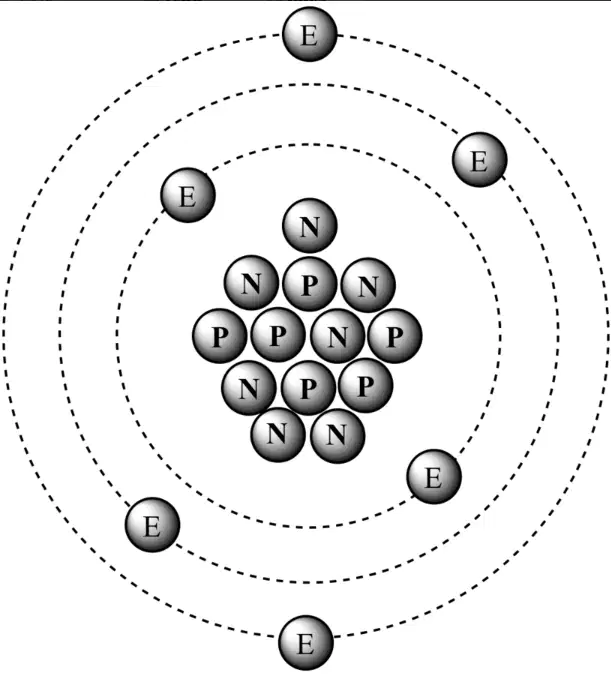
What is the name of the pictured isotope?
Carbon-15
Carbon-12
Carbon-14
Carbon-13
55
Multiple Choice
How many neutrons does a carbon-13 atom have?
6
5
7
8
Atomic Structure (subatomic particles)
Show answer
Auto Play
Slide 1 / 55
SLIDE

Similar Resources on Wayground
47 questions
🎯Describing Matter
Presentation
•
10th Grade
48 questions
Heating and Cooling Matter
Presentation
•
9th - 10th Grade
48 questions
Phys. Final Review
Presentation
•
9th Grade
49 questions
Biology 8.3
Presentation
•
9th Grade
46 questions
Electricity and Ohm's Law
Presentation
•
10th Grade
48 questions
Lesson: Electricity Introduction
Presentation
•
9th Grade
50 questions
Things to know about stars
Presentation
•
10th Grade
50 questions
G10 Lesson 4.1: The Covalent Bond
Presentation
•
10th Grade
Popular Resources on Wayground
24 questions
PBIS-HGMS Day 10
Quiz
•
6th - 8th Grade
10 questions
HCS SCI 03 Summer School Review 3
Quiz
•
3rd Grade
11 questions
Home Scope
Quiz
•
7th - 8th Grade
15 questions
HCS SCI 05 Summer School Assessment 3 Review
Quiz
•
5th Grade
35 questions
Lufkin Road Middle School Student Handbook & Policies Assessment
Quiz
•
7th Grade
18 questions
Geo 11.3 Area of Circles and Sectors
Quiz
•
9th - 11th Grade