Unit 5 Lesson adaptation and life cycles
Presentation
•
Science
•
5th Grade
•
Medium
+2
Standards-aligned
Harvey Jones
Used 2+ times
FREE Resource
72 Slides • 13 Questions
1
2
3
4
5
6
7
8
9
10
11
12
13
14
15
16
17
18
19
20
21
22
23
Multiple Choice
A
B
C
D
24
25
26
27
28
29
30
31
32
33
34
35
36
37
38
39
40
41
42
43
Multiple Choice
A
B
C
D
44
45
46
47
48
49
50
51
52
53
54
55
56
57
58

59
60
61
62
63
64
65
Multiple Choice
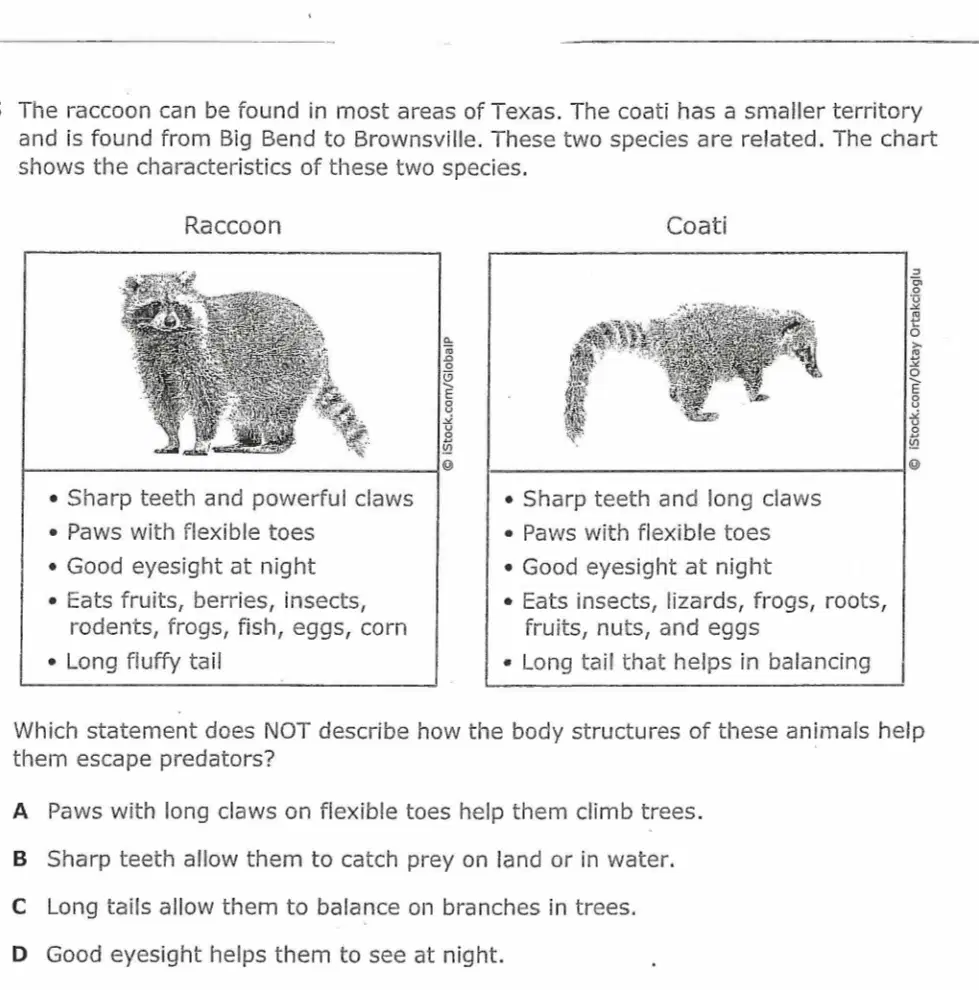
Which statement does NOT describe how the body structures of these animals help them escape predators?
A. Paws with long claws on flexible toes help them climb trees.
B. Sharp teeth allow them to catch prey on land or in water.
C. Long tails allow them to balance on branches in trees.
D. Good eyesight helps them to see at night.
66
Multiple Select
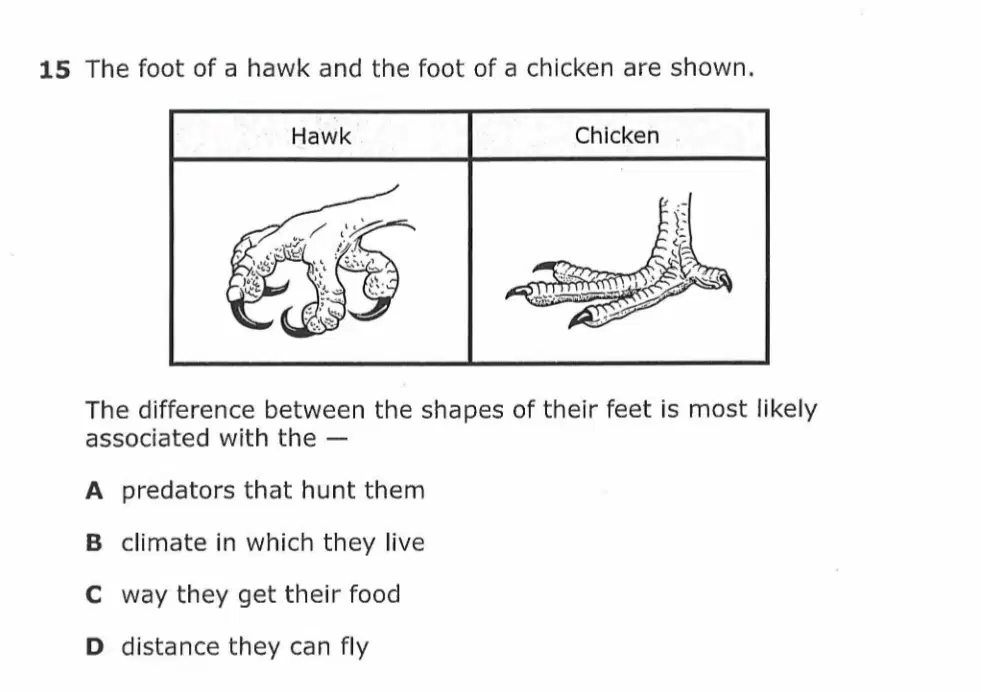
The foot of a hawk and the foot of a chicken are shown. The difference between the shapes of their feet is most likely associated with the —
A. predators that hunt them
B. climate in which they live
C. way they get their food
D. distance they can fly
67
Multiple Choice
Unlike humans, otters have special flaps that close off their nostrils and ears. These flaps help otters survive in an environment that is —
terrestrial
snowy
windy
aquatic
68
Multiple Choice
Based on these adaptations, which table best matches the bird species to its environment?
Species: Bird 1 - Prairie, Bird 2 - Forest, Bird 3 - Pond, Bird 4 - Marsh
Species: Bird 1 - Forest, Bird 2 - Pond, Bird 3 - Marsh, Bird 4 - Prairie
Species: Bird 1 - Prairie, Bird 2 - Marsh, Bird 3 - Pond, Bird 4 - Forest
Species: Bird 1 - Forest, Bird 2 - Marsh, Bird 3 - Prairie, Bird 4 - Pond
69
Multiple Choice
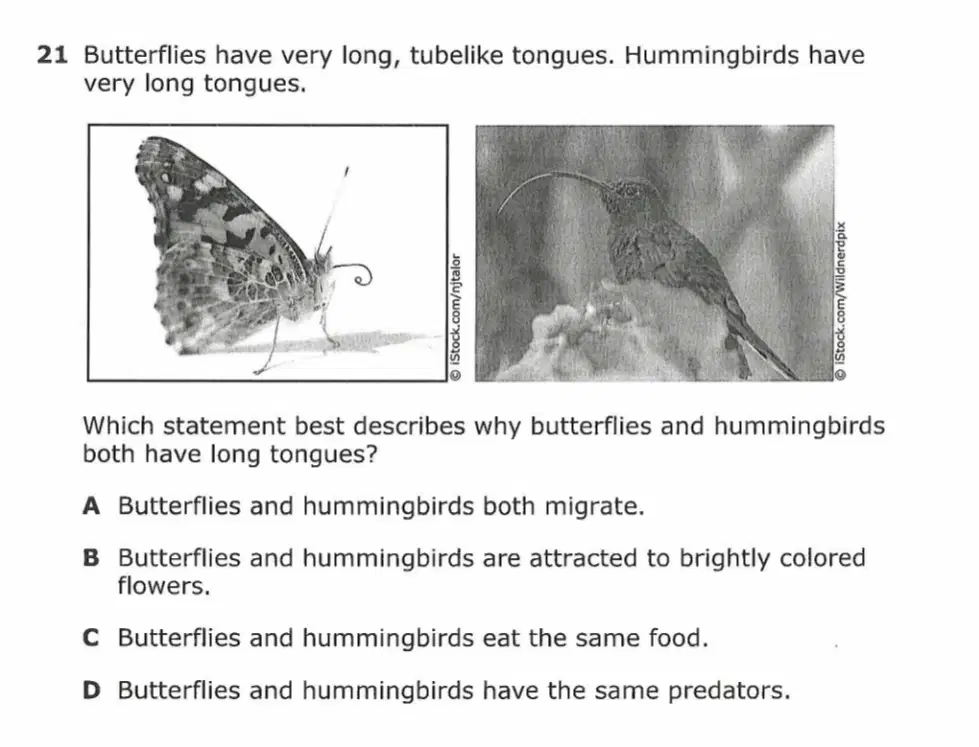
Which statement best describes why butterflies and hummingbirds both have long tongues?
A. Butterflies and hummingbirds both migrate.
B. Butterflies and hummingbirds are attracted to brightly colored flowers.
C. Butterflies and hummingbirds eat the same food.
D. Butterflies and hummingbirds have the same predators.
70
Multiple Select
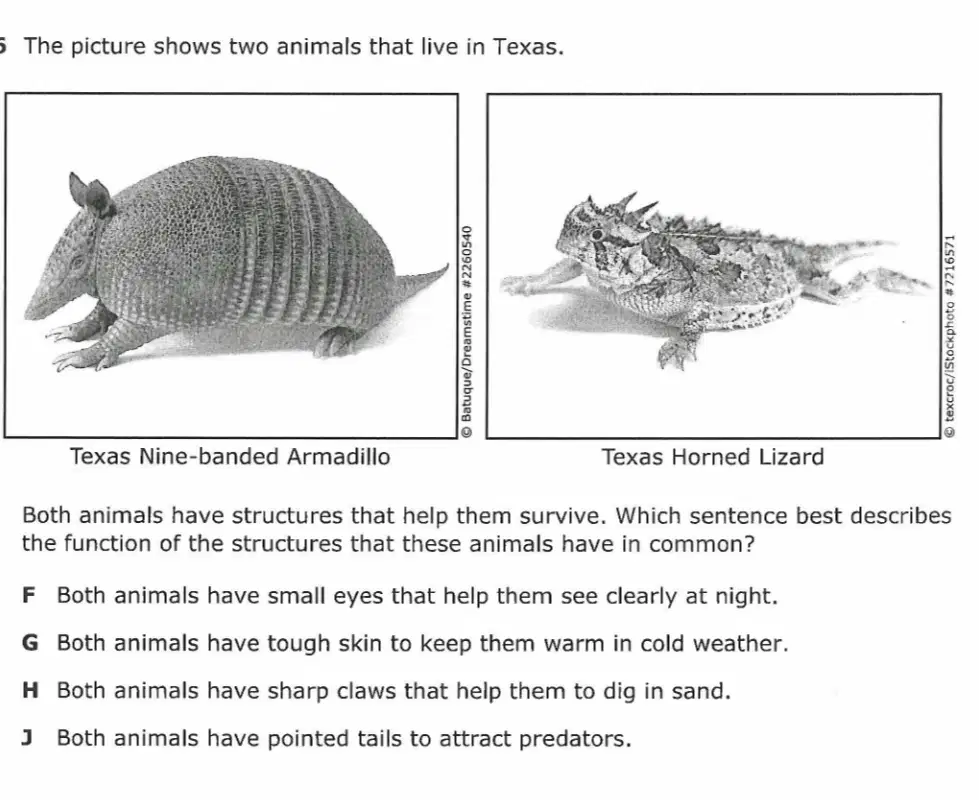
The picture shows two animals that live in Texas. Both animals have structures that help them survive. Which sentence best describes the function of the structures that these animals have in common?
F. Both animals have small eyes that help them see clearly at night.
G. Both animals have tough skin to keep them warm in cold weather.
H. Both animals have sharp claws that help them to dig in sand.
J. Both animals have pointed tails to attract predators.
71
Multiple Choice
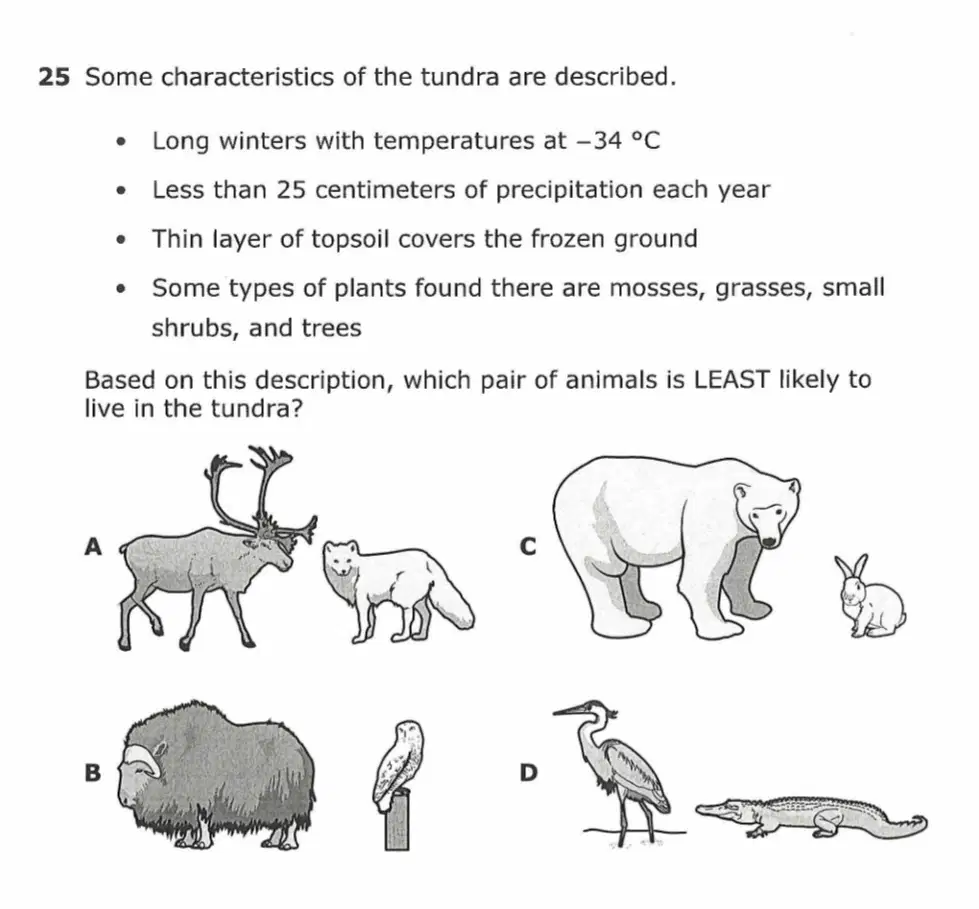
Some characteristics of the tundra are described: - Long winters with temperatures at -34 °C - Less than 25 centimeters of precipitation each year - Thin layer of topsoil covers the frozen ground - Some types of plants found there are mosses, grasses, small shrubs, and trees Based on this description, which pair of animals is LEAST likely to live in the tundra?
A) Reindeer and Arctic Fox
B) Musk Ox and Snowy Owl
C) Polar Bear and Arctic Hare
D) Heron and Alligator
72
73
74
75
76
77
78
79
80
81
82
Multiple Choice
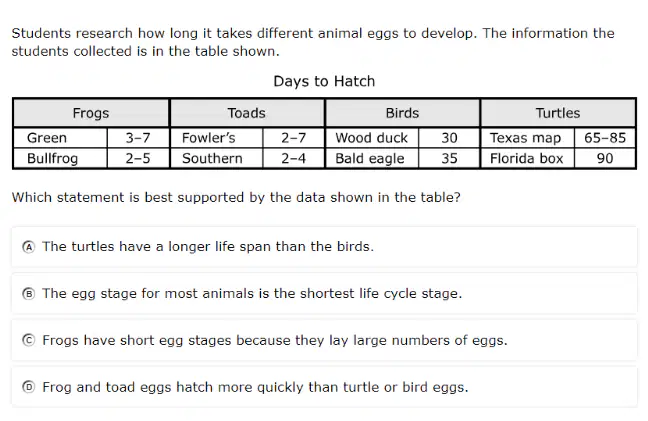
A
B
C
D
83
Multiple Choice
A
B
C
D
84
Multiple Choice
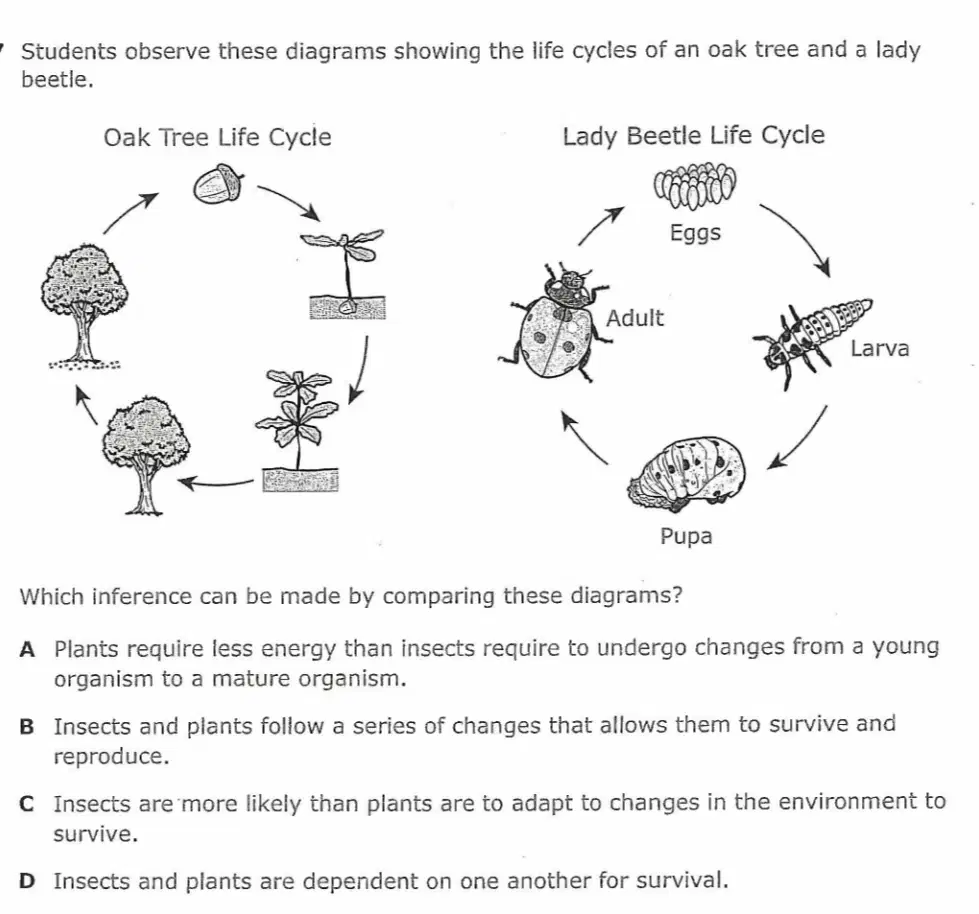
Which inference can be made by comparing these diagrams?
A. Plants require less energy than insects require to undergo changes from a young organism to a mature organism.
B. Insects and plants follow a series of changes that allows them to survive and reproduce.
C. Insects are more likely than plants are to adapt to changes in the environment to survive.
D. Insects and plants are dependent on one another for survival.
85
Multiple Select
Which of these correctly compares the lacewing life cycle with the frog life cycle?
Adult lacewings lay eggs, but adult frogs give birth to live larvae.
When they hatch, young lacewings and young frogs look different from their adult forms.
When they hatch, both lacewings and frogs have long legs for jumping.
Both adult lacewings and adult frogs have more legs than they had as larvae.
Show answer
Auto Play
Slide 1 / 85
SLIDE

Similar Resources on Wayground
78 questions
Apartheid in South Africa
Presentation
•
7th Grade
79 questions
SCIENCE FORM 2 CHAPTER 2 ECOSYSTEM
Presentation
•
6th - 8th Grade
80 questions
Ecosystems and Food Chains
Presentation
•
6th - 8th Grade
84 questions
Mexico
Presentation
•
6th Grade
85 questions
UNIT 4: Dividing Fractions
Presentation
•
6th Grade
74 questions
TLT Ch. 10
Presentation
•
6th Grade
82 questions
Plant Organs
Presentation
•
3rd - 5th Grade
72 questions
Decomposers and Cycles
Presentation
•
4th - 6th Grade
Popular Resources on Wayground
24 questions
PBIS-HGMS Day 10
Quiz
•
6th - 8th Grade
10 questions
HCS SCI 03 Summer School Review 3
Quiz
•
3rd Grade
11 questions
Home Scope
Quiz
•
7th - 8th Grade
15 questions
HCS SCI 05 Summer School Assessment 3 Review
Quiz
•
5th Grade
35 questions
Lufkin Road Middle School Student Handbook & Policies Assessment
Quiz
•
7th Grade
18 questions
Geo 11.3 Area of Circles and Sectors
Quiz
•
9th - 11th Grade