
Sound

Presentation
•
Science
•
9th Grade
•
Practice Problem
•
Hard

Ruth S.Pd
FREE Resource
13 Slides • 0 Questions
1
GRADE 8
2


Vibration or osillation is periodic motion in which an object moves back and fort repeatedly about the equilibrium position. The diagram above shows a pendulum. A complete cycle (one vibration) occurs when force is applied and the bob swings from point K-L-M-L-K. Point L is the equilibrium point for this pendulumm
Vibration
Periode = T (second or s)
Frekuensi = f (hertz or Hz)
Amplitudo = A (the maximum displacement of an object from its equilibrium positions)
n = number of vibration
t = time for n number of fibration (second or S)
Quantity of Vibration
T = t/n
f = n/t
T = 1/f
f = 1/T
3
Waves is disturbance of matter that transfers energy and propagates through a mediaum. There are two types of waves, electromagnetic waves and mechanical waves. Another way to categorise waves is based on the direction of vibration of the particles relative to the direction of propogation of the wave, is transverse waves and longitudinal waves. Speed or velocity waves is the measure of how fast the wave propagates through a medium.
v = λ/T = λf
4
Sound waves, types of longitudinal wave. Sound cannot travel through a vacuum (empty space) because no particle to transfer the energy.

5
Hearing Sound
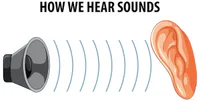
We hear sounds when the sound waves reach our ears.
pinna (daun telinga) is shaped to collect sound energy
eardrum (gendang telinga) is a thin layer of tissue that separates the outer from the internal parts
ossicles
cochlea
Ears are also important in our sense of balanced

6
7
The Speed of Sound
The speed of sound is the distance sound waves travel in one second . Equation
v = d/t
v = speed (m/s)
d = distance sound wave travel (m)
t = time (s)
The speed of sound in air is approximately 340 m/s at 20°.
The higher temperature of the air, the faster the sound travels.
In a liquid or a solid the particles are much closer together than in a gas.This means that the vibrations cen be passed onwards much faster. Sound waves travel the fastest in solids, then liquids and the slowest is in gas.
8
Describing Sound
Loudness
Amplitude
The rate at which sound energy passes through a unit area is called the sound intensity, measured W/m2.
intensity
Doppler effect is the change of frequency of sound waves due to the relative motion between the source and observer.
CRO (cathhode ray oscilloscope)
9
Natural frequency
Resonance
Ln = λ/4 (2n - 1) for n = 1,2,3,4,....
Echoes (gema)
Sonar
Resonansi


10
Sonar
The same principle is used in sound navigation and ranging or "sonar" to detect underwater objects or sea bed. A device sends out ultrasound waves from a ship. The waves are reflected by objects.
11
Human ears can only detect sound of frequencies between 20 Hz and 20 000 Hzz
Audible Sound
Is low frequency sound, less than 20 Hz. In nature, earthquakes, volcanoes, and avalanches are the sources of infrasound. Some animals such as elephants and giraffes.
Infrasound
Is sound wave of frequencies above 20 000 Hz. Dolphins and bats use ultrasound very effectively to communicate and for echolocation
Ultrasound
12
Other loud noises can cause damage to our hearing over longer periods of time. For example, the ossicles (small bones) can wear out and become less sensetive as they rub together.
We can measure loudness with a sound meter in a unit called decibel (dB). The best way to protect your ears is to reduce the loudness of the noise around you, we can use ears protectors.
13

GRADE 8
Show answer
Auto Play
Slide 1 / 13
SLIDE
Similar Resources on Wayground

10 questions
non- mendelian inheritance
Presentation
•
9th Grade
10 questions
Kinetic Energy
Presentation
•
9th - 10th Grade
12 questions
Electricity and Magnetism
Presentation
•
9th Grade
10 questions
Net Forces Practice
Presentation
•
8th Grade
9 questions
Components of the Universe
Presentation
•
8th Grade
13 questions
Ecosystems & Energy
Presentation
•
9th Grade
8 questions
Moon
Presentation
•
8th Grade
10 questions
Atomic Structure
Presentation
•
9th Grade
Popular Resources on Wayground
10 questions
Safety Day 2026 – Student Review

Quiz
•
9th Grade
21 questions
Continents and Oceans
Quiz
•
6th Grade
20 questions
Parts of Speech
Quiz
•
5th Grade
16 questions
Subject & Predicate
Quiz
•
5th Grade
25 questions
Multiplication Facts
Quiz
•
5th Grade
12 questions
Map Skills
Quiz
•
3rd Grade
22 questions
Continents and Oceans
Quiz
•
5th Grade
15 questions
Rounding Decimals
Quiz
•
5th Grade
Discover more resources for Science
10 questions
Exploring Chemical and Physical Changes

Interactive video
•
6th - 10th Grade
20 questions
Atomic Structure
Quiz
•
9th Grade
10 questions
Exploring the Electromagnetic Spectrum for Middle School Science
Interactive video
•
6th - 10th Grade
10 questions
Exploring Force and Motion Concepts
Interactive video
•
6th - 10th Grade
10 questions
Exploring Air Masses and Weather Fronts
Interactive video
•
6th - 10th Grade
10 questions
Exploring the States of Matter
Interactive video
•
6th - 10th Grade
10 questions
Exploring Forces: Net Force, Normal Force, Gravity, and Friction
Interactive video
•
6th - 10th Grade
10 questions
Differentiating Thermal Energy and Temperature
Interactive video
•
6th - 10th Grade