

Shoulder Injuries

Presentation
•
Health Sciences
•
12th Grade
•
Easy

Matthew Spiess
Used 4+ times
FREE Resource
23 Slides • 40 Questions
1

2

3

4
Multiple Choice
What is one of the most frequent fractures in sports?
Clavicular Fracture
Humerus Fracture
Scapula Fracture
Elbow Fracture
5
Multiple Choice
Which of the following is a mechanism of injury for a clavicular fracture?
Fall on the tip of the shoulder
Twisting the arm
Bending the elbow
Hitting the elbow
6

7

8
Multiple Choice
What is a common mechanism of injury for a shaft fracture of the humerus?
Dislocation
Direct blow or fall on the arm
Falling on an outstretched arm
Twisting motion
9
Multiple Choice
Where do most proximal humerus fractures occur?
At the elbow joint
At the wrist
At the surgical neck
At the shoulder blade
10
Multiple Choice
Which of the following is a sign of a humerus fracture?
Headache
Pain at the fracture site
Fever
Nausea
11
Multiple Choice
What is a symptom of a humerus fracture?
Inability to move the arm
Increased appetite
Sneezing
Blurred vision
12

13
14

15
Multiple Choice
What is the AC joint particularly vulnerable to, especially in collision sports?
Fractures
Sprains
Dislocations
Bruises
16
Multiple Choice
What is one mechanism of injury for an acromioclavicular sprain?
Twisting the arm
Direct impact to the tip of the shoulder
Falling on the back
Overstretching the shoulder
17
Multiple Choice
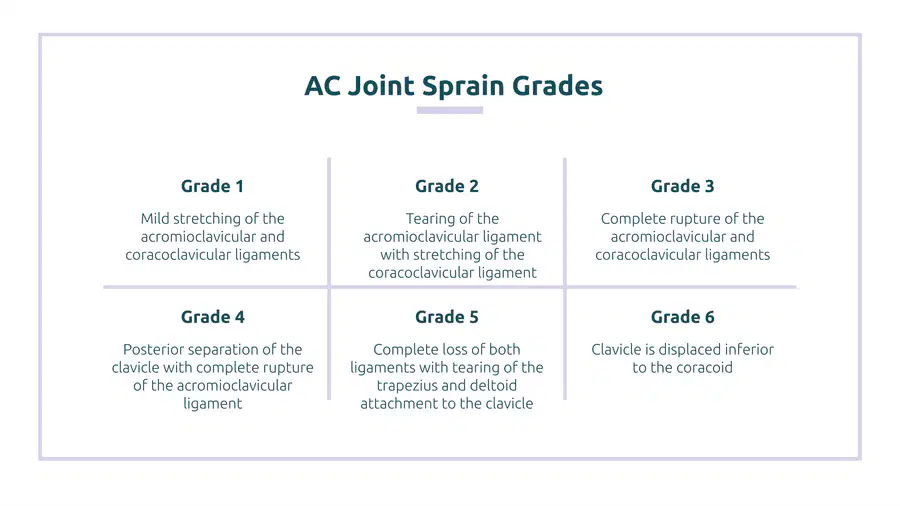
What is the characteristic of a Grade 3 AC joint sprain?
Mild stretching of the acromioclavicular and coracoclavicular ligaments
Tearing of the acromioclavicular ligament with stretching of the coracoclavicular ligament
Complete rupture of the acromioclavicular and coracoclavicular ligaments
Clavicle is displaced inferior to the coracoid
18
Multiple Choice
Which grade of AC joint sprain involves the clavicle being displaced inferior to the coracoid?
Grade 1
Grade 4
Grade 5
Grade 6
19
Multiple Choice
What is indicated by tearing of the acromioclavicular ligament with stretching of the coracoclavicular ligament?
Type I
Type II
Type III
Type IV
20
Multiple Choice
Which type of injury involves mild stretching of the acromioclavicular and coracoclavicular ligaments?
Type I
Type II
Type III
Type IV
21
22
Multiple Choice
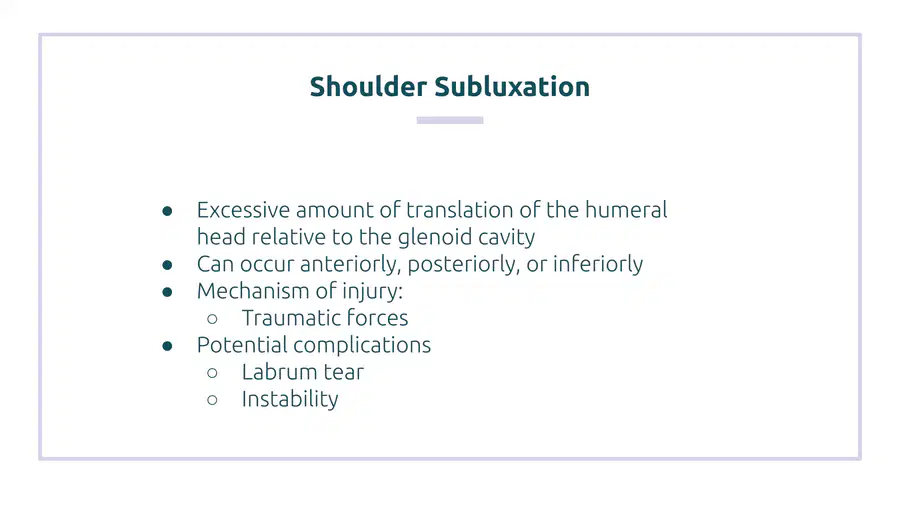
What is a potential complication of shoulder subluxation?
Muscle strain
Labrum tear
Bone fracture
Tendonitis
23
Multiple Choice
Which of the following is a mechanism of injury for shoulder subluxation?
Overuse
Traumatic forces
Thumb wrestling
Arm wrestling
24

25

 Unsupported video type
26
Multiple Choice
What percentage of all dislocations are shoulder dislocations?
25%
50%
75%
90%
27
Multiple Choice
What is the most common type of shoulder dislocation?
Posterior dislocation
Inferior dislocation
Anterior dislocation
Superior dislocation
28

29
Multiple Choice
What is a common mechanism of injury for an anterior dislocation?
Forced abduction, external rotation and extension
Falling on an outstretched hand
Twisting the arm
Hitting the shoulder
30
Multiple Choice
Which of the following is a sign of an anterior dislocation?
Flattened deltoid contour
Swelling of the shoulder
Bruising of the elbow
Pain in the wrist
31

32
Multiple Choice
What is a common mechanism of injury for a posterior dislocation?
Forced abduction and external rotation
Forced adduction and internal rotation
Direct blow to the shoulder
Overhead throwing motion
33
Multiple Choice
Which of the following is a sign of a posterior dislocation?
Swelling and bruising
Flattened anterior deltoid
Limited elbow movement
Pain in the wrist
34

35

36
Multiple Choice
What is a common cause of a labrum tear?
Falling on an outstretched arm
Sitting on hands for long periods
Running on your hands
Eating a heavy meal
37
Multiple Choice
Which type of labrum tear affects the top part of the labrum where the biceps tendon attaches?
SLAP
Bankart
Rotator cuff
Meniscus
38
Multiple Choice
Which of the following is a sign or symptom of a labrum tear?
Sharp shooting pain
Dull/aching pain
Numbness in fingers
Swelling in the elbow
39
Multiple Choice
What type of sensation might be experienced at the front of the shoulder with a labrum tear?
Tingling
Burning
Clicking/catching/grinding
Itching
40

41

42
Multiple Choice
What is a common cause of shoulder impingement?
Increased space in the subacromial arch
Decreased space in the subacromial arch
Excessive stretching of the shoulder
Lack of shoulder movement
43
Multiple Choice
Which of the following is a sign or symptom of shoulder impingement?
Increased internal rotation
Decreased external rotation
Diffuse pain
Sharp pain only during rest
44
Multiple Choice
What is the result of the humerus contacting the acromion?
Subacromial impingement
Subacromial relaxation
Subacromial extension
Subacromial contraction
45
Multiple Choice
In which shoulder position does the soft tissue become entrapped?
Resting Shoulder
Elevated Shoulder
Rotated Shoulder
Relaxed Shoulder
46
47
Multiple Choice
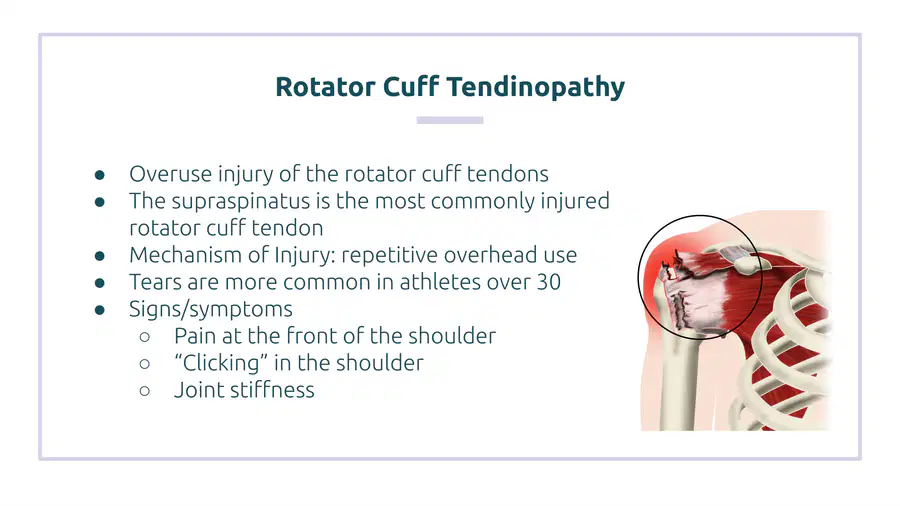
What is the most commonly injured rotator cuff tendon?
Infraspinatus
Supraspinatus
Teres minor
Subscapularis
48
Multiple Choice
Which of the following is a common sign or symptom of rotator cuff tendinopathy?
Pain at the front of the shoulder
Swelling in the wrist
Tingling in the fingers
Bruising on the elbow
49

50
Multiple Choice
What is another name for Adhesive Capsulitis?
Frozen Shoulder Syndrome
Tennis Shoulder
Shoulder Tunnel Syndrome
Rotator Cuff Tear
51
Multiple Choice
Which of the following is a common symptom of Adhesive Capsulitis?
Increased flexibility
Pain in all directions of movement
Enhanced joint strength
Improved range of motion
52

53
Multiple Choice
What is another name for a Brachial Plexus Injury?
Stingers/Burners
Sprains/Strains
Fractures/Breaks
Tears/Ruptures
54
Multiple Choice
Which of the following is a sign or symptom of a Brachial Plexus Injury?
Sharp/burning pain down the arm
Swelling in the arm
Headache
Blurred vision
55

56
Multiple Choice
What is a common cause of biceps tendonitis?
Repeated stretching of the tendon in highly ballistic activities
Lack of exercise
Poor hitting technique
Sleeping on one side
57
Multiple Choice
Which of the following is a symptom of biceps tendonitis?
Tenderness in the bicipital groove
Headache
Elbow pain
Triceps pain
58

59

60
Multiple Choice
What does Thoracic Outlet Syndrome involve the compression of?
Brachial plexus, subclavian artery, and vein
Brachial artery and vein
Carotid artery and jugular vein
Brachial nerve and artery
61
Multiple Choice
Which of the following is a cause of Thoracic Outlet Syndrome?
Narrowed space between the 1st rib and clavicle
Compression of the brachial nerve
Dislocation of the shoulder joint
Fracture of the humerus
62
Multiple Choice
Which of the following is a sign or symptom of Thoracic Outlet Syndrome?
Fever
Paresthesia (abnormal sensation)
Rash
Nausea
63
Multiple Choice
What is a possible sign and symptom of Thoracic Outlet Syndrome related to muscle function?
Muscle weakness
Muscle spasm
Muscle growth
Muscle stiffness
Show answer
Auto Play
Slide 1 / 63
SLIDE
Similar Resources on Wayground

59 questions
Akuntansi sebagai Sistem Informasi
Presentation
•
12th Grade
57 questions
Solubility
Presentation
•
12th Grade
58 questions
Regencia 2nd term quiz short
Presentation
•
KG
58 questions
ICS 700 Lesson 2
Presentation
•
12th Grade
60 questions
S3 Student Learning Profile
Presentation
•
KG - 12th Grade
59 questions
ECONOMICS TOPIC 3 LESSON 7 & 8
Presentation
•
12th Grade
56 questions
สรุปบทเรียนการแทรกสอดและการเลี้ยวเบนของแสง
Presentation
•
KG
58 questions
Media and Freedom 🦅
Presentation
•
12th Grade
Popular Resources on Wayground
24 questions
PBIS-HGMS Day 10

Quiz
•
6th - 8th Grade
10 questions
HCS SCI 03 Summer School Review 3
Quiz
•
3rd Grade
11 questions
Home Scope
Quiz
•
7th - 8th Grade
15 questions
HCS SCI 05 Summer School Assessment 3 Review
Quiz
•
5th Grade
35 questions
Lufkin Road Middle School Student Handbook & Policies Assessment
Quiz
•
7th Grade
18 questions
Geo 11.3 Area of Circles and Sectors
Quiz
•
9th - 11th Grade