
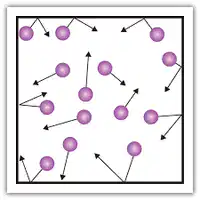
Gases

Presentation
•
Chemistry
•
9th - 12th Grade
•
Practice Problem
•
Medium

Ruba Raslan
Used 6+ times
FREE Resource
22 Slides • 14 Questions
1

Gases
2
Multiple Choice
What are all particles doing right now?
moving and resting
colliding and resting
moving and colliding
3
Multiple Choice
What are the particles in a gas doing?
Vibrating from side to side
Drifting slowly in random directions
Moving quickly in random directions
Moving quickly in the same direction
4
Multiple Choice
Which is a quality that only gasses display
Spread out to fill all available space
Take the shape of their container
Can't be compressed
All of these
5

Kinetic Molecular Theory
Determine the
chemical properties of
matter.
Affect the
physical
properties of
matter.
Based on physical appearance you can distinguish between solids and liquids
However, substances that are gases at room
temperature usually display similar physical
properties despite their different composition
6

• The kinetic theory of gases originated
in the ancient idea that matter consists
of tiny invisible atoms in rapid motion.
In the 17th century, this idea was
revived and used to explain, among
other phenomena, the properties of
gases.
Kinetic Molecular Theory
• The Kinetic Molecular Theory
describes the behavior of matter in terms of particles in motion.
•The model makes several
assumptions about the size, motion,
and energy of gas particles.
7

Particle Size
Gases consist of small
particles that are
separated from one
another by empty space.
Particle Motion
Gas particles are in
constant, random
motion.
Collisions between the gas
particles are elastic.
Particle Energy
Temperature is a
measure of the average
kinetic energy of the
particles in a sample of
matter.
8

As the temperature increases, the velocity increases, and the kinetic energy increases.
There are 2 factors that affect the kinetic energy of the particle; mass and velocity.
Kinetic Molecular Theory
9

The large amount of space between the gas
particles allow gas to be squeezed into smaller
volume.
Kinetic Molecular Theory
Compression
Expansion
An increase in temperature results
in an increase in the kinetic energy
of the gas, resulting in expansion of
the gas.
10

The movement of gases or any other
material from an area of high
concentration to an area of low
concentration.
Kinetic Molecular Theory
Diffusion
Effusion
The movement of gases through a tiny
opening.
11
12

•Gases consist of large numbers of tiny particles that are far apart
relative to their size.
•Collisions between gas particles and between particles of the
container walls are elastic collisions.
•Gas particles are in continuous, rapid, random motion. They therefore possess kinetic energy, which is energy of motion.
•There are no forces of attraction between gas particles.
•The temperature of a gas depends on the average kinetic energy of the gas.
Kinetic Molecular Theory
13
Multiple Choice
The reason gases can be compressed is because:
The particles are very close together.
The particles are merely vibrating.
The particles are very far apart.
The particles are unable to move.
14
Multiple Choice
If a hairspray can is heated, what can be expected of the pressure of the gas inside the can?
The pressure will increase
The pressure will remain constant
The pressure will decrease
The pressure will equalize
15
Multiple Choice
In what direction(s) does air exert pressure?
downwards
everywhere
no where
there's no pressure
16
Multiple Choice
What happens to the average kinetic energy of matter when it is heated?
It increases
It doesn't change
It decreases
It cannot be determined
17

Graham’s Law
The rate of diffusion or effusion of a gas is inversely proportional to the
square root of its molar mass.
Rate of effusion ᾳ
𝟏
𝐌𝐨𝐥𝐚𝐫 𝐌𝐚𝐬𝐬
• Graham’s law also applies to diffusion.
• The rate of diffusion depends mainly on the mass of the particles.
• Lighter particles diffuse more quickly than heavier particles
𝐑𝐚𝐭𝐞 𝐀
𝐑𝐚𝐭𝐞 𝐁
𝐌𝐨𝐥𝐚𝐫 𝐌𝐚𝐬𝐬 𝐁
𝐌𝐨𝐥𝐚𝐫 𝐌𝐚𝐬𝐬 𝐀
=
18

Problem
Ammonia has a molar mass of 17.0 g/mol;
hydrogen chloride has a molar mass of 36.5
g/mol. What is the ratio of their diffusion
rates?
Solution
KNOWN
UNKNOWN
molar massHCl = 36.5
g/mol
ratio of diffusion rates
=?
molar massNH3 = 17.0
g/mol
•State the ratio derived from
Graham’s law.
RateNH3
RateHCl
=
molarmassHCl
molarmassNH3
•Substitute molar massHCl = 36.5
g/mol and molar massNH3 = 17.0
g/mol.
36.5g/mol
17.0g/mol = 1.47
The ratio of diffusion rates is 1.47.
Graham’s Law
19

Pressure
•Pressure is defined as force per unit area.
•Gas particles exert pressure when they collide with the walls of their container.
Pressure
= 𝐅𝐨𝐫𝐜𝐞
𝐀𝐫𝐞𝐚
Air Pressure
•Near the Earth’s surface, the particles of the air are close to one another, and the air is dense, exerting more pressure due to the
gravity. However, as we move away from
the Earth’s surface, the gravity decreases,
the air becomes less dense, and the pressure
decreases.
20

Air Pressure
•Earth is surrounded by an atmosphere that extends into space for hundreds of kilometers.
•Because the particles in air move in every direction,
they exert pressure in all directions.
•Air pressure varies at different points on Earth.
Measuring Air Pressure
•Italian physicist Evangelista Torricelli was
the first to demonstrate that air exerted
pressure.
•Torricelli invented a device named
barometer to measure atmospheric
pressure.
Atmospheric
pressure
Pressure exerted by
mercury column
vacuum
760mm
21

Measuring Air Pressure
The barometer is made of an inverted (upside-
down) glass tube standing in a bath of mercury.
Air pressure pushes down on the surface of the
mercury, making some rise up the tube. The greater
the air pressure, the higher the mercury rises.
GasPressure
Manometers measure gas pressure in a
closed container.
A manometer works much like a
barometer, but instead of measuring
atmospheric pressure, it measures the
pressure difference between the inside and outside of a container.
22

Units of Pressure
The SI unit of pressure is pascal (Pa).
One pascal (Pa) is equal to a force of one Newton per square meter or N/m2.
One atmosphere is equal to 760 mm Hg (millimeter mercury)
or 101.3 kilopascals.
23
Multiple Choice
What is pressure?
The amount of force exerted on a surface
The surface area of an object
The weight of an object
24
Multiple Choice
What decreases as you go up in the atmosphere?
Altitute
Meteor
Atmosphere
Pressure
25
Multiple Choice
How do you Calculate Pressure?
Force(N)/Area(m2)
Area(m2)/Force(N)
Force(kg)/Area(mi2)
26
Multiple Choice
Gas pressure is caused by
Gas molecules heating up
Gas molecules reacting with other gas molecules
Gas molecules hitting the walls of a container
Gas molecules hitting other gas molecules
27

Dalton’s Law of Partial Pressure
When Dalton studied the properties of gases, he found that each gas in a mixture exerts pressure independently of the other gases pressure.
Dalton’s law of partial pressures states that the total pressure of a
mixture of gases is equal to the sum of the pressures of all the gases of the mixture.
The partial pressure of a gas depends on the number of moles, size of the container, and temperature and is independent of the type of gas.
At a given temperature and pressure, the partial pressure of 1mol of
any gas is the same.
Partial pressure can be used to calculate the amount of gas produced in a chemical reaction.
28

Pressure
(A)
Pressure
(B)
𝐏 𝐓𝐨𝐭𝐚𝐥 =
𝐏𝐀+ 𝐏𝐁
Dalton’s Law of Partial Pressure
29

Dalton’s Law of Partial Pressure
A container holds a mixture of two different gases. The oxygen in a
container exerts 80 mmHg of pressure on the inside of the container.
The total pressure inside the container is 120 mmHg. What is the
pressure of the other gas in the container?
Answer:
According to Dalton’s law of Partial Pressure
P total = P1 + P2
120 = 80 + Pressure of unknown gas
Pressure of unknown gas = 120 – 80 = 40 mmHg.
30
Multiple Choice
A student places four gases into a container. The pressures of the gases are: N2=2.1 atm, H2=1.3 atm, He=1.9 atm & Ar=3.4 atm. What is the total pressure?
5.1 atm
7.3 atm
8.7 atm
6.9 atm
31
Multiple Choice
The pressure of the gas in the balloon in the ice water will be:
Greater than that of the balloon in the boiling water.
Less than that of the balloon in the boiling water.
The same as that of the balloon in the boiling water.
Not enough information to answer the statement.
32
Multiple Choice
Why Mountain climbers takes oxygen tank with them ?
Because there is less pressure
Because they cant breath properly
Because there are less gas particles at high altitudes
All of the above
33
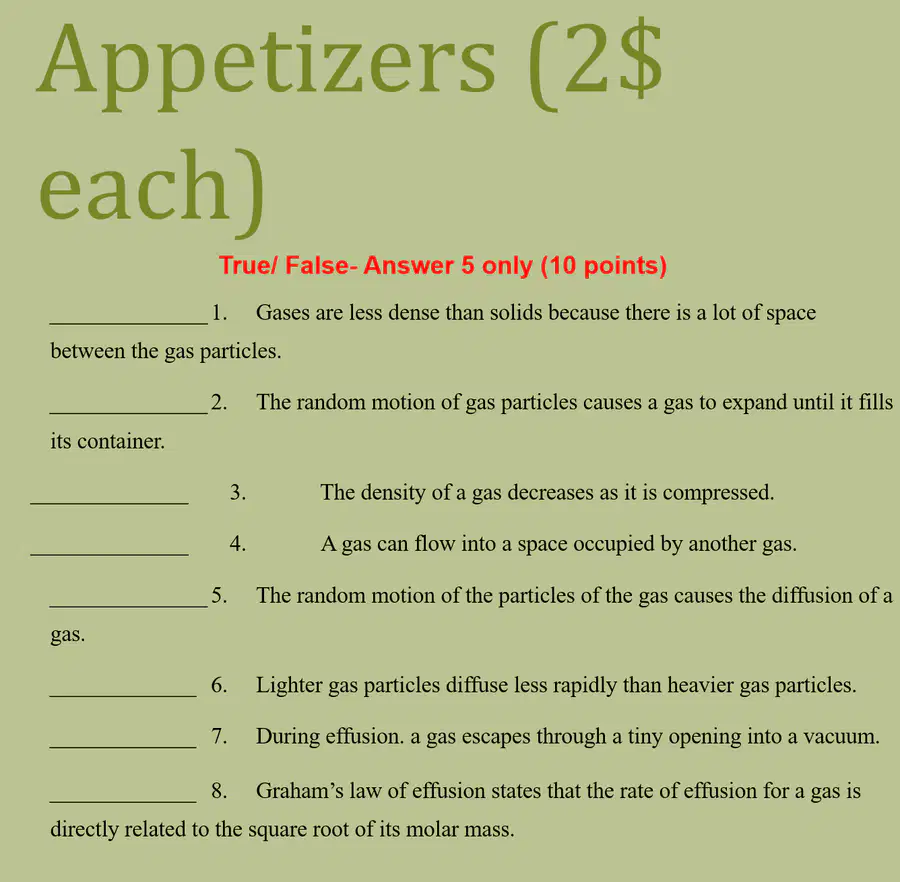
34

Main dish-Pick 5 (3 points each)
35

36

Gases
Show answer
Auto Play
Slide 1 / 36
SLIDE
Similar Resources on Wayground

32 questions
Lab Equipment
Presentation
•
9th - 12th Grade
31 questions
Properties of Solutions - Part 2
Presentation
•
9th - 12th Grade
29 questions
Periodic Trends (lvl)
Presentation
•
9th - 12th Grade
29 questions
Valence Electrons
Presentation
•
9th - 12th Grade
28 questions
Solubility Curves
Presentation
•
10th - 12th Grade
26 questions
Intro to the periodic table
Presentation
•
10th - 12th Grade
31 questions
7.1 Biodiversity Lesson 1
Presentation
•
9th - 12th Grade
31 questions
Cell Growth + Division (part 1)
Presentation
•
9th - 12th Grade
Popular Resources on Wayground
24 questions
PBIS-HGMS Day 10

Quiz
•
6th - 8th Grade
10 questions
HCS SCI 03 Summer School Review 3
Quiz
•
3rd Grade
11 questions
Home Scope
Quiz
•
7th - 8th Grade
15 questions
HCS SCI 05 Summer School Assessment 3 Review
Quiz
•
5th Grade
35 questions
Lufkin Road Middle School Student Handbook & Policies Assessment
Quiz
•
7th Grade
18 questions
Geo 11.3 Area of Circles and Sectors
Quiz
•
9th - 11th Grade