

IGCSE Geography-Lesson 7-Population and Resources

Presentation
•
Geography
•
9th - 10th Grade
•
Practice Problem
•
Easy

Aimee Cooper
Used 4+ times
FREE Resource
17 Slides • 11 Questions
1
To understand different population theories (Malthus and Boserup).
To evaluate how population growth interacts with resource availability.
To debate and form reasoned arguments around population and resources.
2
Open Ended

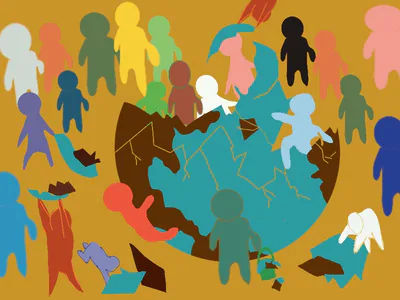
What is this cartoon trying to convey?
3
This image highlights the relationship between population growth and resource availability. As populations grow, they put more pressure on the planet’s finite resources. But do we always reach a crisis point, or can innovation keep up?

4
Over the past 100 years, the world’s population has grown exponentially, meaning it has increased at a faster and faster rate. However, many of the resources we rely on—such as fossil fuels, fresh water, and arable land—are finite.

5
Open Ended

If population growth continues, but resources do not increase at the same rate, what could be the consequences?
6
Thomas Malthus believed that population growth would outpace food supply, leading to famine, war, and disease. He argued that natural "checks," such as starvation and conflict, would control population numbers. His theory suggested that without limits on population growth, disaster was inevitable.


7
Open Ended
Do you think Malthus was right?
8
Esther Boserup disagreed with Malthus. She argued that as populations grow, people will find innovative ways to produce more food, whether through technology, improved farming methods, or scientific advances. She famously said, "Necessity is the mother of invention," meaning that people will always adapt to survive.


9
Malthus and Boserup had very different views on population and resources. Malthus believed that resource scarcity would limit population growth, leading to crisis. Boserup believed human innovation would ensure resources keep up with demand.

10
Poll
Who do you agree with more?
Malthus
Boserup
11
Malthus failed to predict technological advances like the Green Revolution, which dramatically increased food production. He also didn’t consider globalisation, trade, and food imports, which allow countries to access resources from elsewhere. However, in some regions, population growth still leads to food shortages and conflict—does this mean Malthus was partly right?

12
13
Despite advances in food production, hunger remains a major global issue. According to the UN, over 735 million people worldwide suffer from chronic hunger, particularly in regions experiencing conflict, political instability, and economic inequality. While the world produces enough food for everyone, it is often unevenly distributed, with some countries facing severe shortages. Famines—widespread extreme food shortages—continue to occur, particularly in places like Yemen, Somalia, and South Sudan, where drought, war, and economic collapse have devastated food supplies.

14
Open Ended
Malthus’ theory suggested that population growth would lead to mass starvation, while Boserup argued that human innovation could prevent food crises. However, in many cases, hunger is not just about food availability but about who can access it. Is hunger a result of too many people or poor resource management?
15
While Boserup’s theory highlights human innovation, it assumes that all societies can develop new technologies. In reality, poor countries may struggle to invest in agricultural innovation. Intensive farming can also lead to land degradation, such as desertification and soil erosion, reducing food production.

16
Categorize
Population growth happens faster than food supply, leading to inevitable crises.
When food shortages occur, people will develop new farming methods to increase supply.
Wars, famine, and disease act as natural "checks" to control population growth.
The Green Revolution shows innovation can prevent food shortages.
Without population control, resources will run out.
More people = better technology and improved food production.
Famine happens when food production can’t keep up.
Global trade and farming tech prevent food shortages.
Overpopulation leads to conflict over land, water, and energy
More people = more pressure to invent new farming techniques.
Food insecurity proves population growth is a risk.
Human ingenuity will always overcome food shortages
Poorer nations struggle with food as they lack new technology.
Governments should limit births to avoid overpopulation.
Intensive farming damages land, reducing future food supply
Malthus or Boserup
17
In 1972, the Club of Rome published The Limits to Growth, a report based on computer models predicting the long-term impact of population growth, resource depletion, and environmental degradation. The report suggested that if growth continued unchecked, the world could face serious crises by the mid-21st century. However, it also argued that sustainable development and technology could help avoid disaster.

18
Unchecked population and economic growth will lead to resource exhaustion.
Environmental degradation, pollution, and food shortages could cause global collapse.
Advances in technology and sustainable practices could delay or prevent crises.
Governments must take action to control consumption and pollution.

19
Labeling
Leads to crisis (war, famine, disease)
Encourages innovation
Leads to environmental collapse
Limited & will run out
Natural checks, reduce birth rates
Scientific advancement, new farming methods.
Sustainable development, policy changes
Can be expanded through technology
Finite & must be managed
1
8
2
9
4
3
5
6
7
20

21
Multiple Choice
What did the Club of Rome predict in The Limits to Growth?
Unlimited population growth is sustainable
Food production will always increase
Overuse of resources could lead to global collapse
Climate change is not a concern
22
Multiple Choice
How does the Club of Rome’s theory differ from Malthus?
It includes environmental and economic factors
It assumes population will always decline
It believes resources are infinite
It ignores technology’s impact
23
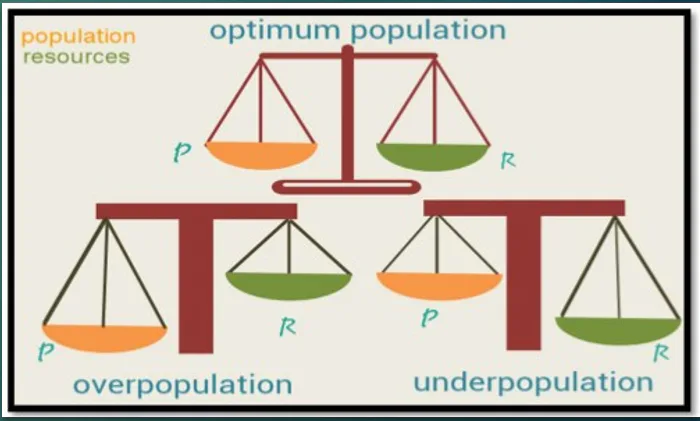
Depending on how societies manage resources, we could face three futures:
Overpopulation – Too many people, not enough resources.
Optimum Population – The right balance between people and resources.
Underpopulation – Too few people to sustain economic growth.
How can we ensure we reach an optimum population level?

24
Open Ended
How can we make sure we achieve the right balance between population and resources.
25


26
Open Ended
Explain the differences in the theories of Malthus and Boserup about the relationship between population and resources. (6 marks)
27
28
To understand different population theories (Malthus and Boserup).
To evaluate how population growth interacts with resource availability.
To debate and form reasoned arguments around population and resources.
To understand different population theories (Malthus and Boserup).
To evaluate how population growth interacts with resource availability.
To debate and form reasoned arguments around population and resources.
Show answer
Auto Play
Slide 1 / 28
SLIDE
Similar Resources on Wayground

22 questions
Forces of Evolution
Presentation
•
9th - 10th Grade
21 questions
Evolução
Presentation
•
9th Grade
21 questions
Photosynthesis
Presentation
•
9th Grade
21 questions
Cinco De Mayo
Presentation
•
10th Grade
20 questions
3 ESO Connectors: Although / However / Despite / In spite of
Presentation
•
9th - 10th Grade
22 questions
Biogeochemical Cycles Lesson
Presentation
•
9th Grade
22 questions
Cell Cycle, DNA Replication, and Cancer
Presentation
•
9th Grade
20 questions
Renaissance Europe
Presentation
•
9th - 10th Grade
Popular Resources on Wayground
10 questions
Safety Day 2026 – Student Review

Quiz
•
9th Grade
21 questions
Continents and Oceans
Quiz
•
6th Grade
20 questions
Parts of Speech
Quiz
•
5th Grade
16 questions
Subject & Predicate
Quiz
•
5th Grade
25 questions
Multiplication Facts
Quiz
•
5th Grade
12 questions
Map Skills
Quiz
•
3rd Grade
22 questions
Continents and Oceans
Quiz
•
5th Grade
15 questions
Rounding Decimals
Quiz
•
5th Grade
Discover more resources for Geography
13 questions
5 Themes of Geography
Presentation
•
9th - 12th Grade
25 questions
Unit 4 Exam Review
Quiz
•
9th Grade
10 questions
Reteach Unit 4: Latin America Review
Presentation
•
9th - 10th Grade
42 questions
AP Human Geography Unit 2
Quiz
•
9th Grade
20 questions
US & Canada Physical and Political Geography
Quiz
•
9th - 12th Grade
7 questions
Prairie, Pacific, and Territories
Presentation
•
9th - 12th Grade
8 questions
The Fight Against Terrorism
Presentation
•
9th - 12th Grade
45 questions
WG North America Test Review
Quiz
•
9th Grade