

Thrombocytopenia In Pregnancy

Presentation
•
Science
•
Professional Development
•
Easy

Worth Thomas
Used 3+ times
FREE Resource
67 Slides • 20 Questions
1

2

3

4
Multiple Choice
A 28-year-old G2P1 at 32 weeks of gestation presents with a platelet count of 125 × 10^9/L. She denies bleeding symptoms. Her blood pressure is 110/70 mm Hg. She has no proteinuria, normal liver function tests, and no prior history of thrombocytopenia outside of pregnancy. Fetal growth is appropriate for gestational age.
Question: What is the most likely diagnosis?
Gestational thrombocytopenia
Immune thrombocytopenia (ITP)
Preeclampsia
Fetal–neonatal alloimmune thrombocytopenia
HELLP syndrome
5

6

7

8
Multiple Choice
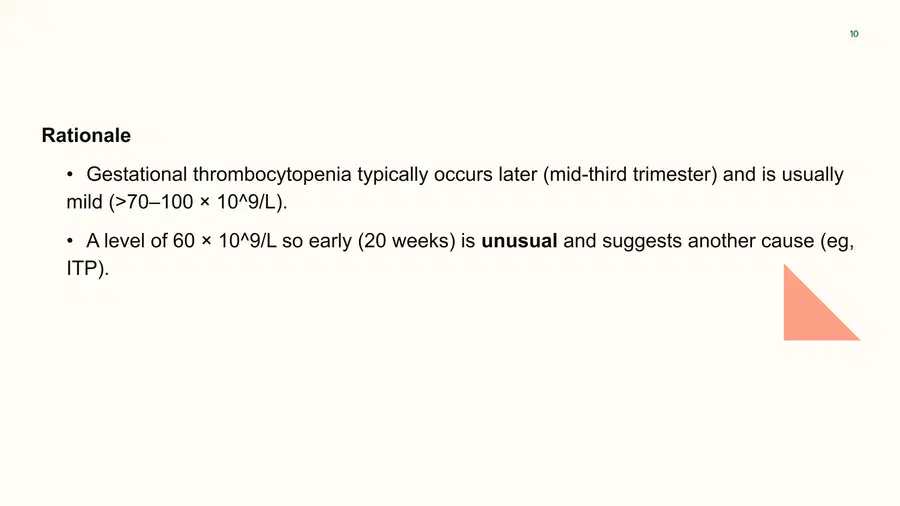
A 39-year-old G3P2 is found to have a platelet count of 60 × 10^9/L at 20 weeks of gestation. In her previous pregnancies, platelet counts were mildly low only at term but normalized postpartum. She currently has no bleeding or bruising.
Question: Which of the following findings in this clinical scenario strongly points away from gestational thrombocytopenia?
Platelet count of 60 × 10^9/L at 20 weeks
Normal blood pressure
Normal liver function tests
Absence of bleeding symptoms
Past pregnancies returning to normal platelet counts postpartum
9

10
11

12
Multiple Choice
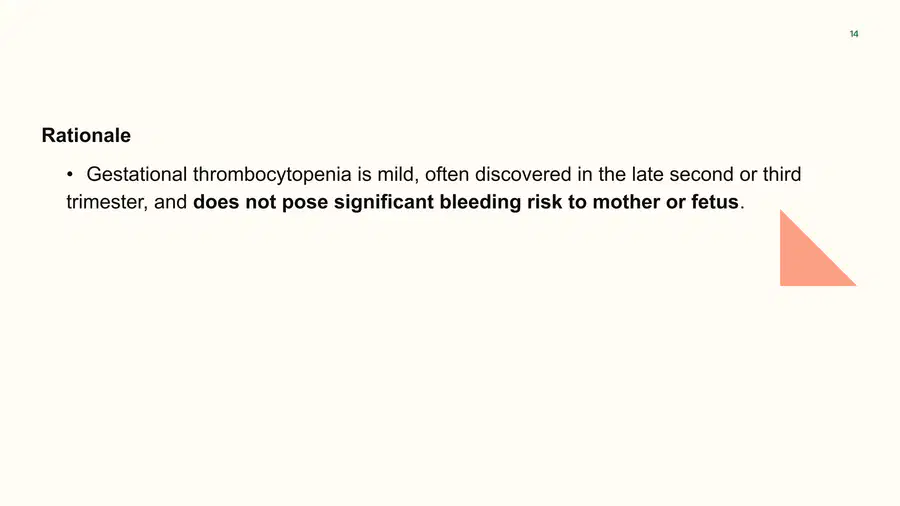
Which of the following statements regarding gestational thrombocytopenia is true?
It typically presents in the first trimester
It almost always leads to severe fetal thrombocytopenia
Platelet counts are usually below 50 × 10^9/L
Diagnosis is one of exclusion with minimal maternal or fetal bleeding risk
Immediate steroid therapy is required
13

14
15

16
Multiple Choice
In differentiating ITP from gestational thrombocytopenia (GT), which historical or clinical feature would most strongly suggest ITP?
Platelet count of 140 × 10^9/L in late third trimester
History of thrombocytopenia outside of pregnancy
Asymptomatic presentation throughout pregnancy
Rapid postpartum normalization of platelets
Intermittent mild elevation of blood pressure
17

18

19

20
Multiple Choice
A 35-year-old G1P0 at 36 weeks of gestation has BP readings of 160/90 mm Hg and a platelet count of 95 × 10^9/L. She also has persistent right upper quadrant pain and mildly elevated liver enzymes.
Question: What is the most appropriate next step in management?
High-dose corticosteroids to correct thrombocytopenia
Continue expectant management
Immediate delivery (given severe features)
Serial platelet transfusions until platelets normalize
Perform plasmapheresis
21

22

23

24
Multiple Choice
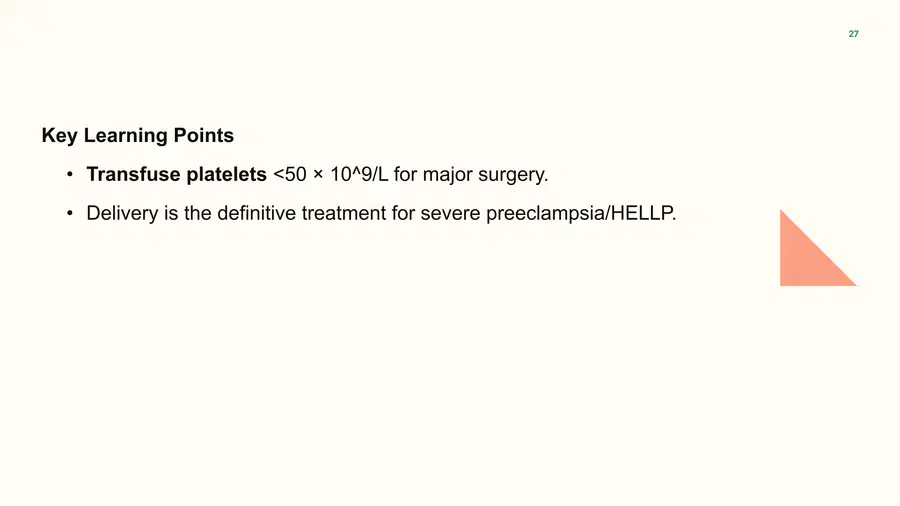
A 29-year-old G2P1 at 33 weeks is admitted with severe preeclampsia. Platelet count is 45 × 10^9/L. An urgent cesarean is planned due to a nonreassuring fetal heart tracing.
Question: How should her thrombocytopenia be managed before surgery?
Proceed without intervention
Platelet transfusion to increase platelet count above 50 × 10^9/L
Splenectomy
IVIG
Uterine curettage
25

26

27
28
Multiple Choice
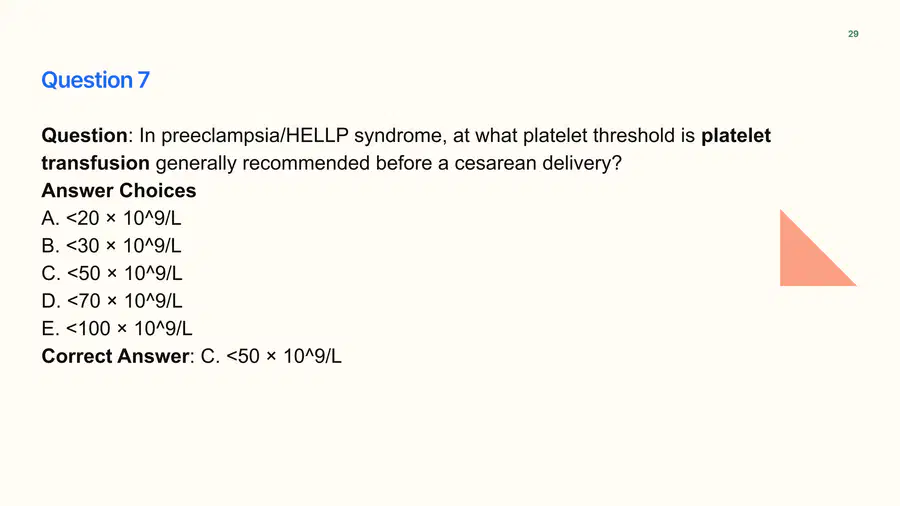
In preeclampsia/HELLP syndrome, at what platelet threshold is platelet transfusion generally recommended before a cesarean delivery?
<20 × 10^9/L
<30 × 10^9/L
<50 × 10^9/L
<70 × 10^9/L
<100 × 10^9/L
29
30

31
Multiple Choice
Which of the following is not typically associated with HELLP syndrome?
Hemolysis
Elevated liver enzymes
Low platelet count
Elevated creatinine
Right upper quadrant pain
32

33
34

35
Multiple Choice
Which statement is true regarding management of preeclampsia with severe features and thrombocytopenia?
Medical therapy can cure preeclampsia without delivery
Platelet transfusions are routinely administered for platelet counts >100 × 10^9/L
Delivery is the definitive cure for preeclampsia
Splenectomy is first-line if platelets <50 × 10^9/L
Steroid therapy alone rapidly normalizes platelet counts in severe preeclampsia
36

37

38

39
Multiple Choice
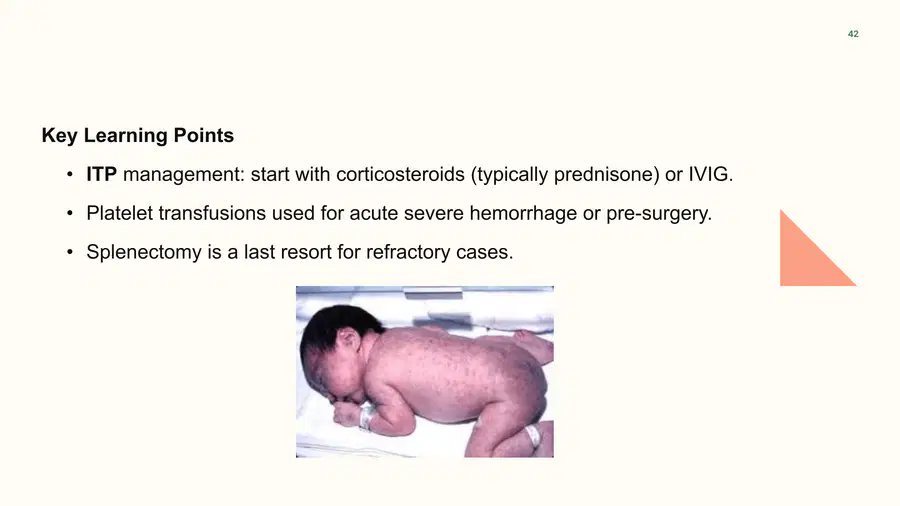
A 30-year-old woman at 28 weeks of gestation has a platelet count of 65 × 10^9/L on routine labs. She has a history of ITP diagnosed 3 years ago. She reports mild gum bleeding occasionally. Blood pressure is normal; LFTs are normal.
Question: What is the best initial management to increase her platelet count?
High-dose IVIG
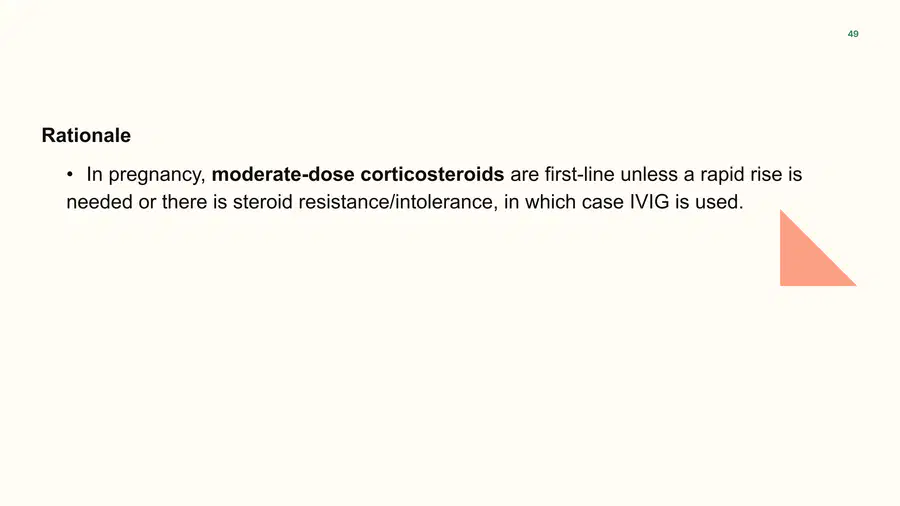
Prednisone 10–20 mg/day
Platelet transfusions
Splenectomy
No intervention
40

41
42
43
Multiple Choice
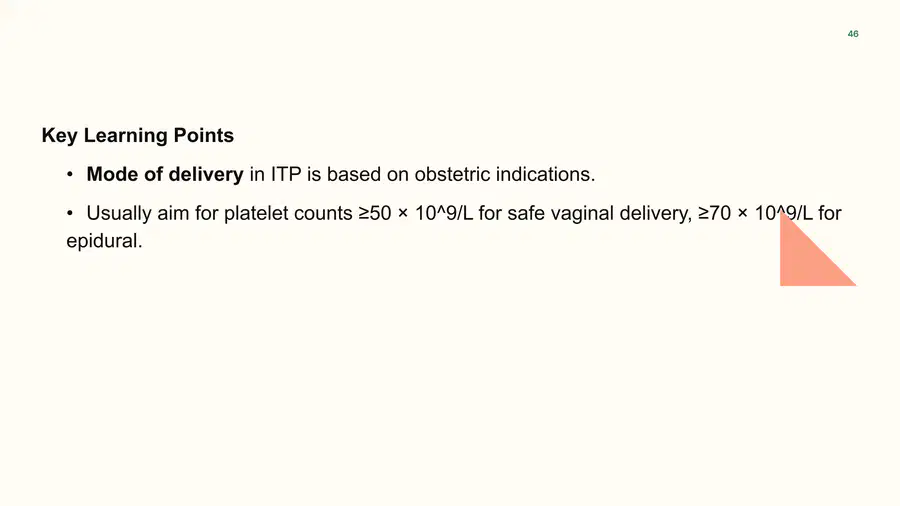
A 32-year-old G2P1 at 38 weeks has a platelet count of 30 × 10^9/L and a known history of ITP. She desires a vaginal delivery and is requesting an epidural for labor analgesia. No significant bleeding is noted except mild bruising.
Question: What is the most appropriate plan for delivery?
Immediate cesarean section
Vaginal delivery is acceptable, but correct maternal platelet count to a safer threshold
Fetal platelet transfusions in utero
High-dose IVIG plus platelet transfusion, then immediate induction
Terminate pregnancy at 38 weeks with no plan for anesthesia
44
45

46
47
Multiple Choice
For patients with ITP in pregnancy, which initial therapy is generally recommended for mild bleeding or platelet counts below 70 × 10^9/L?
IVIG as first-line in every case
High-dose corticosteroids
Platelet transfusions every week
Splenectomy
Aspirin therapy
48

49
50

51
Multiple Choice
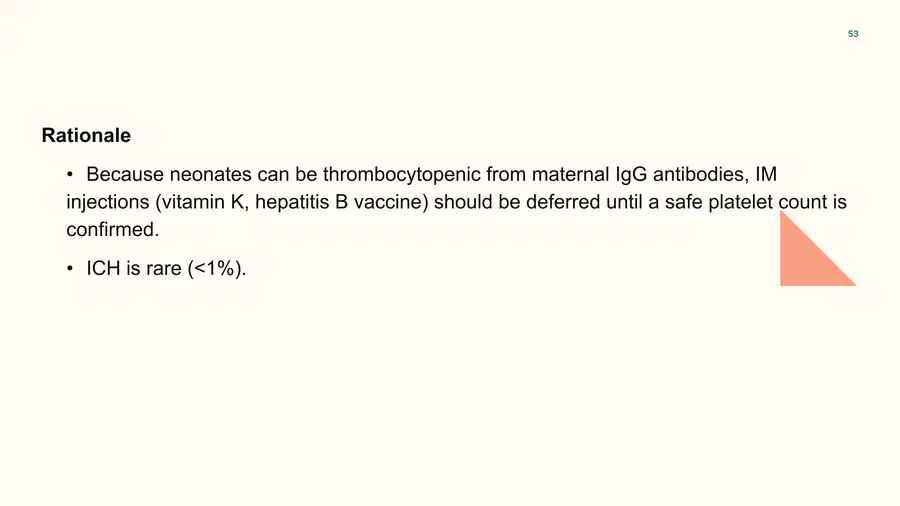
Which statement regarding neonatal management in a mother with ITP is correct?
Neonatal platelet count usually peaks right after birth
Neonatal intracranial hemorrhage is common (>10%)
Intramuscular injections should be delayed until platelet count is known
Maternal platelet count always predicts neonatal platelet count
Neonatal platelet transfusion is mandatory in all cases
52

53
54

55
Multiple Choice
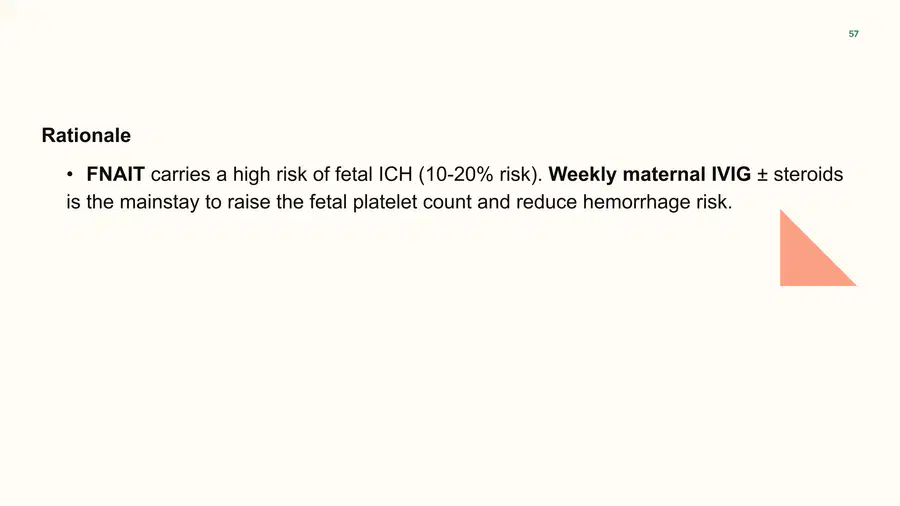
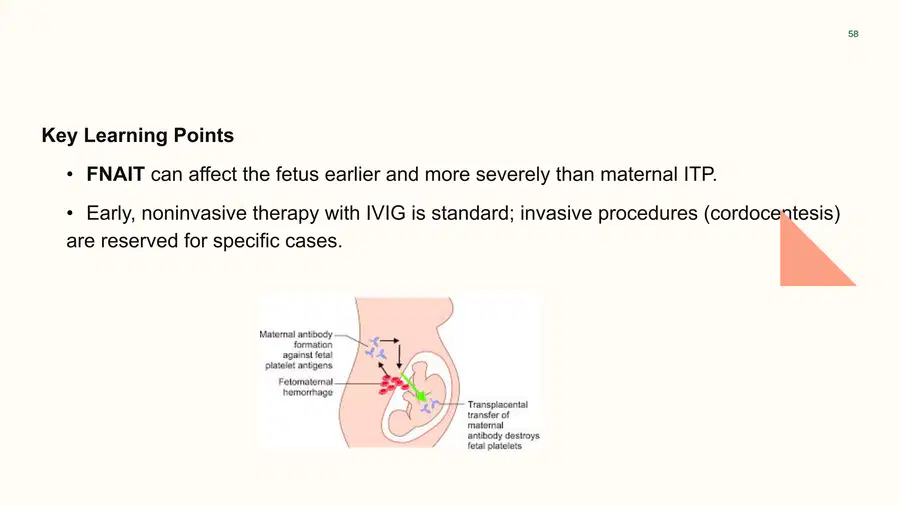
A 26-year-old G2P1 with a prior pregnancy complicated by severe fetal–neonatal alloimmune thrombocytopenia (FNAIT) is now 24 weeks pregnant. The fetus is confirmed positive for HPA-1a, and maternal anti-platelet antibodies are present.
Question: What intervention is most commonly recommended to prevent fetal intracranial hemorrhage?
Maternal high-dose IVIG therapy
Urgent cesarean at 28 weeks
Weekly fetal platelet transfusions
No intervention until onset of labor
Maternal splenectomy
56

57
58
59
Multiple Choice
A 35-year-old with a history of FNAIT leading to neonatal intracranial hemorrhage at 36 weeks in her prior pregnancy. Current fetus is HPA-1a positive. She has been on weekly IVIG since 20 weeks. Cordocentesis at 32 weeks reveals fetal platelets at 45 × 10^9/L.
Question: What is the most appropriate delivery plan?
Immediate cesarean delivery at 32 weeks
Continue IVIG and plan vaginal delivery at term if platelet count can be maintained >50 × 10^9/L
Switch from IVIG to maternal steroids only
Weekly fetal platelet transfusions until 37 weeks
Induce labor at 34 weeks
60

61

62

63
Multiple Choice
Which condition is most commonly associated with severe fetal thrombocytopenia and in utero intracranial hemorrhage?
Gestational thrombocytopenia
Maternal ITP
Fetal–neonatal alloimmune thrombocytopenia (FNAIT)
Preeclampsia
Drug-induced thrombocytopenia
64

65
66

67
Multiple Choice
Which of the following statements about fetal–neonatal alloimmune thrombocytopenia (FNAIT) is true?
It rarely affects first pregnancies
It involves maternal anti-RBC antibodies
It can cause in utero intracranial hemorrhage
It is less severe than ITP
HPA-1a antigen incompatibility is uncommon
68

69
70

71
Multiple Choice
A 31-year-old G1P0 at 34 weeks with ITP has a platelet count of 80 × 10^9/L. She strongly desires an epidural for labor analgesia.
Question: What is the recommended minimum platelet count for safe epidural anesthesia, assuming stable platelet levels and no coagulopathy?
30 × 10^9/L
50 × 10^9/L
70 × 10^9/L
100 × 10^9/L
150 × 10^9/L
72

73

74

75
Multiple Choice
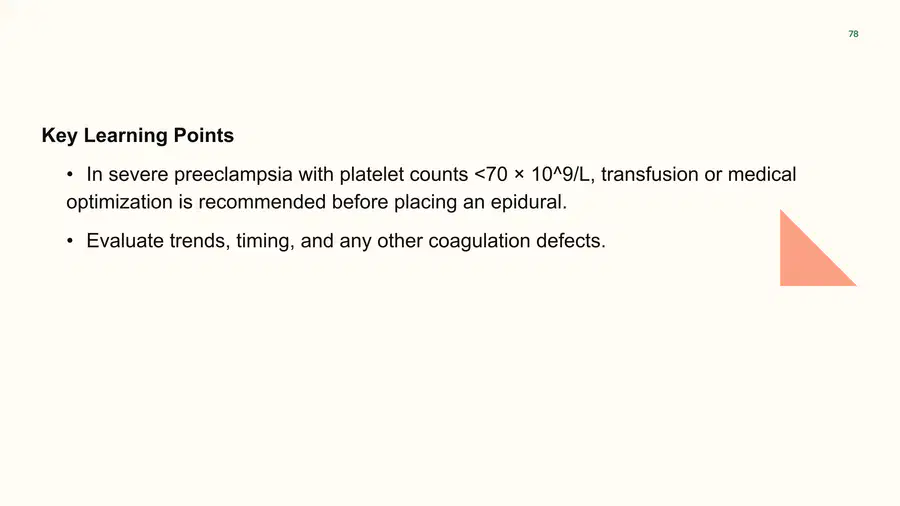
A 29-year-old G2P1 at 38 weeks has severe preeclampsia. Platelet count is 40 × 10^9/L. She wants an epidural for induction of labor.
Question: What is the best recommendation regarding epidural anesthesia in this scenario?
Place the epidural without further intervention
Increase platelets to ≥70 × 10^9/L before epidural
Only spinal anesthesia is acceptable at 40 × 10^9/L
Must use general anesthesia
Deny any anesthesia
76

77
78
79
Multiple Choice
Which statement best describes the safe approach to regional anesthesia when platelet counts are borderline low (65–75 × 10^9/L) and stable?
Neuraxial anesthesia is always contraindicated below 100 × 10^9/L
Generally acceptable if count is stable, platelet function is normal, and no coagulopathy
Requires platelet transfusion in all cases
Only a spinal block is safe
No data exist on this topic
80

81

82

83

84

85

86

87

Show answer
Auto Play
Slide 1 / 87
SLIDE
Similar Resources on Wayground

83 questions
NU CVS drugs (HT) 2568
Presentation
•
University
83 questions
Microbiology Chapter 8
Presentation
•
University
80 questions
Module 2: Leadership Skills in Project Management
Presentation
•
Professional Development
82 questions
Project Moon ฉบับ Anniversary
Presentation
•
Professional Development
81 questions
Cisco 1
Presentation
•
KG - Professional Dev...
81 questions
Unidad 5 llevel 1 2021-2
Presentation
•
University
83 questions
Order Operation Exponents
Presentation
•
KG - University
85 questions
Bahasa Inggris 1 - Meeting 1 and 2
Presentation
•
University
Popular Resources on Wayground
24 questions
PBIS-HGMS Day 10

Quiz
•
6th - 8th Grade
10 questions
HCS SCI 03 Summer School Review 3
Quiz
•
3rd Grade
11 questions
Home Scope
Quiz
•
7th - 8th Grade
15 questions
HCS SCI 05 Summer School Assessment 3 Review
Quiz
•
5th Grade
35 questions
Lufkin Road Middle School Student Handbook & Policies Assessment
Quiz
•
7th Grade
18 questions
Geo 11.3 Area of Circles and Sectors
Quiz
•
9th - 11th Grade