

7.4 Slides

Presentation
•
Social Studies
•
11th Grade
•
Medium

Luc Abbott
Used 10+ times
FREE Resource
17 Slides • 7 Questions
1

A War on Two Fronts
7.4
2
Multiple Choice
On what date did Japan attack Pearl Harbor
September 11, 1941
May 8, 1945
December 7, 1941
June 6, 1944
3
Multiple Choice
What was the Bataan Death March during World War II?
A strategic retreat by Allied forces to defend the Philippines.
A forced march of American and Filipino prisoners of war by Japanese forces, resulting in thousands of deaths.
A celebratory parade marking the liberation of the Philippines.
A campaign by Allied forces to reclaim Bataan from Japanese occupation.
4
Multiple Choice
How did American production contribute to the Allied victory during World War II?
By focusing on producing only consumer goods to maintain morale on the home front.
By manufacturing vast quantities of military equipment, vehicles, and supplies for the Allies.
By trading military equipment exclusively with neutral countries to avoid direct involvement.
By relying on imports from Allied nations to meet wartime production needs.
5
Multiple Choice
What impact did the Battle of the Coral Sea have on the morale of the Allied forces?
It decreased morale significantly
It had no impact on morale
It boosted the morale of the Allied forces
It caused confusion among the troops
6


Allied Strategy
●
Allies shared more unified
goals
●
Roosevelt, Churchill, and
Stalin considered Germany
the most dangerous enemy
●
Agreed to pursue a
“Europe First” strategy
7


War in the Atlantic
●
German U-Boats patrolled the
Atlantic sinking more than 3,500
merchant ships
●
Finally, in mid 1943, the Allies
began winning the war in the
Atlantic
●
Convoys and radar helped Allied
vessels locate U-Boats
8


Soviets and Nazis Battle for Stalingrad
Germany attacked the Soviet Union in 1941, sending
one army north toward Leningrad, a second east
towards Moscow, and a third south toward Stalingrad
●Hitlers forces were unable to conquer all three due
to brutal winter weather
●Narrowed his sights on Southern Soviet Union to
capture the rich oil field
●The struggle for Stalingrad proved to be ferocious
but the Soviets were able to counter and stop
Hitler
●True turning point of the war in Europe
9


War in North Africa
Meanwhile, another campaign was taking
place in the mountains and deserts of North
Africa
●British had been fighting the Germans
and Italians since 1940
●Stalin wanted the U.S. to open a second
front against Germany in Western
Europe
●North Africa presented special
challenges for the Allies
10


War in North Africa
In November 1942, the British won a
major victory in Egypt, and began to push
westward
●Prevented Germany from gaining
access to the Suez Canal and oil fields
in the Middle East
●About the same time, Allied troops
under the command of Dwight
Eisenhower landed in North Africa
taking down the Germans Afrika
Korps
11


Allies Take Over North Africa
The fighting in North Africa taught
American leaders they needed aggressive
officers and troops better trained for desert
fighting
●Eisenhower promoted George S. Patton
to take command of American forces
●Under Patton American forces
advanced east and forced the remaining
Germans and Italians in North Africa to
surrender
12
Multiple Choice
What was a key aspect of the Allied strategy during World War II?
Focus exclusively on defeating Japan before addressing Germany.
Avoid direct conflict with Axis powers by using only economic sanctions.
Rely primarily on the Soviet Union to defeat Axis forces without Western intervention.
Prioritize the liberation of North Africa and Europe before launching a Pacific offensive.
13
Multiple Choice
Why is the Battle of Stalingrad considered a turning point in World War II?
It marked the first successful Allied invasion of German-occupied Europe.
It resulted in the destruction of the Japanese Pacific fleet.
Soviet victory that halted the German advance into the Soviet Union
It led to the immediate liberation of France from Axis control.
14
Multiple Choice
Who was General George S. Patton during World War II?
A naval commander in the Pacific Theater.
A leader of the Manhattan Project to develop the atomic bomb.
U.S. Army general known for his aggressive and effective leadership in Europe and North Africa
A British general who led Allied forces during the Battle of Britain.
15


Axis Powers on the Defensive
Germany was now on the defensive
●
First, the allies decided to
increase bombing of Germany
and invade Italy
●
Second, Roosevelt announced
that the Allies would accept only
unconditional surrender
16


Italy Surrenders
After North Africa, the Allies next eyed
Italy
●
Island of Sicily was the target for an
invasion
●
Could invade Italy without risk of
German U-Boat and have aircraft
protection
●
Eisenhower hoped to trap Axis forces
on Sicily, but they escaped to the
mainland
17


Italy Surrenders
The 38 day campaign achieved
important results
●
Gave the Allies complete control
of the western Mediterranean
●
Paved the way for an invasion of
Italy
●
Ended the rule of Mussolini
18


Allied Bombers Attack Germany
Stalin continued his demand that Roosevelt
and Churchill open a second front in France.
●Bombed German cities at night inflicting
maximum damage- saturation bombing
●By day Allies targeted key political and
industrial centers- Strategic bombing
19

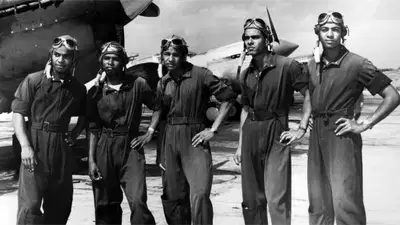
Allied Bombers Attack Germany
The bravery and contributions of
African American fighter squadron,
the Tuskegee Airmen played a key
role in the campaign
●
Escorted bombers protecting them
from enemies
●
In over 1,500 missions, the airmen
did not lose a single bomber
20


Turning Points in the Pacific
Japan continued to advance turning its
attention to Midway
●
American naval base was vital to
the defense of Hawaii
●
Allowing Japan to take Midway
would force the U.S. back to
California
21


Americans Triumph at Midway
●
Navy code breakers intercepted
Japanese messages
●
Admiral Chester Nimitz sent his
only available aircraft carriers to
Midway, while the Japanese navy
was stretched out thousands of
miles
●
On June 4th, 1942, the Japanese
attacked Midway
22


23


Americans Triumph at Midway
●
U.S. dealt Japan a decisive
defeat
●
Midway was the turning point of
the war in the Pacific
●
Japanese forces would never
threaten Hawaii or dominate the
Pacific again
●
Japan was now on the defensive
24

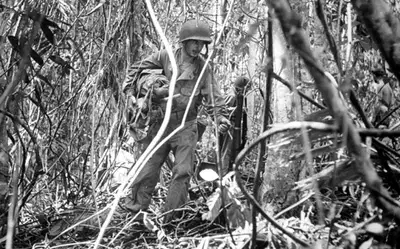
Americans take the Offensive
●Americans lead an assault on the
island of Guadalcanal
●Guadalcanal was part of a U.S.
strategy to approach Japan from
both the southwest Pacific and
central Pacific
●Wanted to force Japan to fight a
two war front and capture bases to
attack
A War on Two Fronts
7.4
Show answer
Auto Play
Slide 1 / 24
SLIDE
Similar Resources on Wayground

17 questions
The Chicano Movement of the 1960s
Presentation
•
11th Grade
20 questions
Chapter 7: Section 3: Challenges for the New Nation
Presentation
•
KG
18 questions
Sectionalism
Presentation
•
11th Grade
20 questions
USHC 7.2 WWII HOMEFRONT
Presentation
•
11th Grade
18 questions
VSC 3.6-3.7 Historia Temprana de America 1789-1809
Presentation
•
KG - 11th Grade
17 questions
Industrial revolution
Presentation
•
10th Grade
20 questions
PASSIVE VOICE
Presentation
•
11th Grade
20 questions
Providing Public Good
Presentation
•
11th Grade
Popular Resources on Wayground
24 questions
PBIS-HGMS Day 10

Quiz
•
6th - 8th Grade
10 questions
HCS SCI 03 Summer School Review 3
Quiz
•
3rd Grade
11 questions
Home Scope
Quiz
•
7th - 8th Grade
15 questions
HCS SCI 05 Summer School Assessment 3 Review
Quiz
•
5th Grade
35 questions
Lufkin Road Middle School Student Handbook & Policies Assessment
Quiz
•
7th Grade
18 questions
Geo 11.3 Area of Circles and Sectors
Quiz
•
9th - 11th Grade