Organising Your Time B1 Listening
Presentation
•
English
•
6th - 8th Grade
•
Practice Problem
•
Hard
Darren Walshe
FREE Resource
8 Slides • 30 Questions
1
B1 Listening
Organising Your Time
2
3
Multiple Choice
a device that makes a sound or shows you when a certain amount of time has passed
4
Multiple Choice

a student who gets the best marks at school
grade A student
5
Multiple Choice
how much is being done or achieved
measurement
productivity
efficiency
completion
6
Multiple Choice
having good judgement or common sense
sensible
7
Multiple Choice
a list of things you need to do
a summary of completed tasks
a list of things you want to buy
a schedule of upcoming events
a 'to do' list
8
Multiple Choice
to start making a noise (as an alarm or signal)
to get on
to sit up
to go off
to set down
9
Multiple Choice
to earn or merit something because of what you have done
to deserve
to waste
to lose
to ignore
10
Multiple Choice
to spend time doing something useless
to spend time wisely
to take a break
to waste time
to engage in productive activities
12
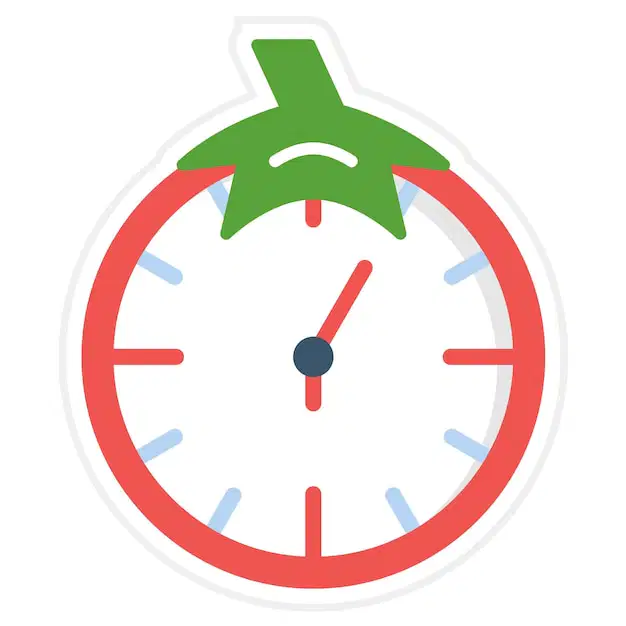
Host: On 'Star Students' today we're speaking to Peter, who is going to tell us about the Pomodoro Technique, a system to help manage your time. It was invented by an Italian man called Francesco Cirillo in the 1980s. Now, he called it the Pomodoro Technique after a tomato-shaped timer that his mother used to use when she was cooking. Pomodoro is Italian for tomato. And this tomato has helped Peter become an A-grade student. So, Peter, welcome to the studio.
Peter: Thanks.
Host: Tell us about the Pomodoro Technique. What's it about?
Peter: It's about getting maximum productivity from your available time. I use it for studying, but professionals use it at work.
Host: Is it difficult to follow?
Peter: No. It's actually very simple. It's about breaking down your work into separate jobs and then using a timer to separate your time into periods of intensive work and short breaks.
Host: OK, well, that sounds sensible. So, how do you start?
Peter: First of all, you should think about the task you need to complete. For example, writing an essay for homework. You need to think about all the stages of the task and write a clear to-do list on a piece of paper. When you are ready to start you set the timer to 25 minutes and you start working on the first item on the list.
Host: OK … but what happens when the timer goes off?
Peter: When the timer goes off you must take a short break of between 3 to 5 minutes. One 25-minute session is one 'pomodoro' so when you have completed this, you deserve a short break. You should try to move about a bit during the break.
Then, set the timer for another 25 minutes and keep working. At the end of the next 'pomodoro' you have another short break. As you complete the items on the 'to-do' list you should tick them off, to give you a feeling of satisfaction that you're getting the job done.
Host: OK … I get it. Can you use any timer? Most people have timers on their phones these days. Could you use that?
13
Peter: You could, but the danger is that then you can check messages on your phone or you start looking at apps. I use my dad's kitchen timer and I make sure I switch off my phone when I'm studying. I get so much more done. In the breaks I sometimes check my phone but only if I've completed some of the items on my to-do list.
Host: Three to five minutes isn't long for a break. Is that enough time?
Peter: Well, when you've had four or five short breaks you can take a longer break, and then you start again.
Host: And it works?
Peter: Yes, it works for me! It stops me wasting time. My work is much more effective when I use the timer. It's like short, intense periods of work. I actually get my homework done a lot quicker now, which leaves me more free time, so for me it works really well.
Host: Oh, I think I'll give it a try. Thanks so much for coming in, Peter.
Peter: You're welcome. Thanks for inviting me.
14
15
Multiple Choice
The Pomodoro Technique was invented in the 1980s.
True
False
16
Multiple Choice
Students and workers can use the technique.
True
False
17
Multiple Choice
The technique is a bit complicated to use.
True
False
18
Multiple Choice
You need to break down your tasks into smaller sections.
True
False
19
Multiple Choice
Each break is called a ‘pomodoro’.
True
False
20
Multiple Choice
Peter uses an app on his mobile to time himself.
True
False
21
Multiple Choice
After four or five short breaks you can have a longer break.
True
False
22
Multiple Choice
Peter takes less time to do his homework these days.
True
False
23
24
Drag and Drop
25
Drag and Drop
26
Drag and Drop

27
Drag and Drop

28
Drag and Drop

29
Drag and Drop

30
31
Fill in the Blanks
It is important to find the most (
32
Fill in the Blanks
We can be more
if we work together as a team. (product)
33
Fill in the Blanks
Do you think that is a (
idea? (sense)
34
Fill in the Blanks
I keep all my notes in (
35
Fill in the Blanks
You can use a
to help you cook the perfect boiled egg. (time)
36
Fill in the Blanks
You will feel really (
when you finish. (satisfaction)
37
Fill in the Blanks
It isn't a very (
38
Fill in the Blanks
The Pomodoro Technique is a system to help you (
B1 Listening
Organising Your Time
Show answer
Auto Play
Slide 1 / 38
SLIDE

Similar Resources on Wayground
29 questions
Personal and Possessive Pronouns
Presentation
•
6th - 8th Grade
32 questions
Subject Verb Agreement Review
Presentation
•
7th Grade
34 questions
Parts of Speech Review
Presentation
•
6th - 8th Grade
33 questions
Persuasive Techniques
Presentation
•
6th - 8th Grade
32 questions
Context Clues Lesson
Presentation
•
6th - 8th Grade
32 questions
Past form of to be-Was were
Presentation
•
6th - 9th Grade
37 questions
Parts of Speech Review
Presentation
•
6th - 8th Grade
30 questions
Connotation and Denotation
Presentation
•
7th - 8th Grade
Popular Resources on Wayground
10 questions
Safety Day 2026 – Student Review
Quiz
•
9th Grade
21 questions
Continents and Oceans
Quiz
•
6th Grade
20 questions
Parts of Speech
Quiz
•
5th Grade
16 questions
Subject & Predicate
Quiz
•
5th Grade
25 questions
Multiplication Facts
Quiz
•
5th Grade
12 questions
Map Skills
Quiz
•
3rd Grade
22 questions
Continents and Oceans
Quiz
•
5th Grade
15 questions
Rounding Decimals
Quiz
•
5th Grade
Discover more resources for English
20 questions
Context Clues
Quiz
•
6th Grade
10 questions
Inference and Textual Evidence
Quiz
•
7th Grade
25 questions
Making Inferences
Quiz
•
6th - 8th Grade
20 questions
Figurative Language Review
Quiz
•
6th Grade
15 questions
Plot Elements
Quiz
•
6th Grade
10 questions
Figurative Language
Quiz
•
7th Grade
20 questions
Figurative Language Review
Quiz
•
8th Grade
10 questions
Main Idea and Supporting Details
Quiz
•
3rd - 6th Grade