

SEL 5th Session

Presentation
•
English
•
6th - 8th Grade
•
Practice Problem
•
Easy
+8
Standards-aligned

Jana Mousa
Used 18+ times
FREE Resource
11 Slides • 10 Questions
1
Poll

On a scale of Loki, How are you feeling today?
1
2
3
4
5
2
Open Ended
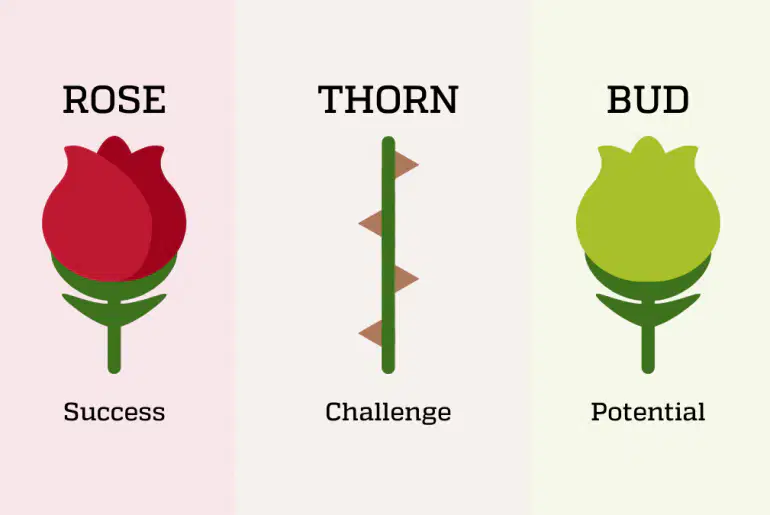
Tell us about your current or previous week!
Rose - a small win or accomplishment
Thorn - a challenge they faced
Bud - something they are looking forward to
3
Poll
Imagine this:
You’re standing outside your classroom, holding a paper in your hands. It’s your turn to give a presentation. You’ve practiced a hundred times, you know every word by heart, but the moment your name is called, your stomach flips. Your palms are sweaty, your heart feels like it’s doing a drum solo, and suddenly, you’re not so sure you’ll remember a single word.
Sounds familiar?
yes
no
4
Open Ended
Have you ever felt butterflies in your stomach or your heartbeat racing, even when you were totally prepared for something, like a big exam or a presentation? It’s like your body didn’t get the memo that you’ve got this!
“Why do you think this happens?”
“What part of your body is in charge of these reactions?”
5
-This happens because a part of your brain, called the Amygdala, acts like a security guard. Its job is to keep you safe by responding to threats or challenges—real or imagined.
-The funny thing is, your Amygdala can’t always tell the difference between a tiger chasing you or just being nervous before a test.
-So, it sends out signals to your body to prepare for action: your heart races, your breathing quickens, and yes, you might feel those butterflies.
Emotions are created by our brain. It is the way our brain gives meaning to bodily sensations based on past experience.
6
Today, we’re going to explore how understanding these reactions, and the amazing teamwork of different parts of your brain, can help you stay calm and take back control in moments like these. Let’s find out how to train our brain to work for us, not against us!
7
1. Identify the six main parts of the brain (brain stem, hippocampus, amygdala, prefrontal cortex, cerebrum, and cerebellum) and their general functions.
2. Explain the specific roles of the amygdala, hippocampus, and prefrontal cortex using relatable analogies.
3. Analyze real-life scenarios to determine which brain part is most active during different emotional or stress responses.
8
Let's have a general overview of our Brain Parts:
https://youtu.be/Q6vqSehMYQQ?si=JVZE0993tsOFc50W
9
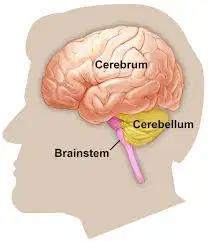
1. Brain Stem: this connects directly to the spinal cord and is responsible for involuntary actions-that means all of the things our body does without us thinking about it things like our heart rate our breathing and our digestion are controlled by the brain stem
2. Cerebellum: is a small region located in the rear of the brain. It helps us move and balance
3. Cerebrum: is the largest section of our brain, and that's great because it has got a lot of work to do the cerebrum helps us to listen, speak, see and think.
10
11
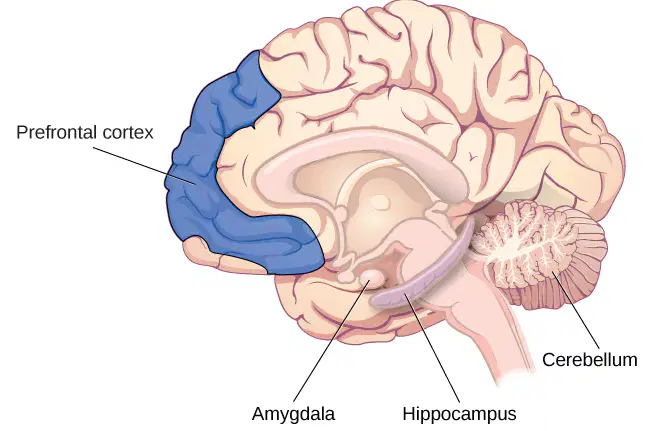
1.Amygdala: is a pair of almond-shaped structures that reacts to fear, danger and threat. The amygdala regulates our emotional state by acting as the brain's "Security Guard", protecting us from threats.
When a person is in a positive emotional state --> it sends incoming information on to the conscious, thinking, reasoning brain.
When a person is in a negative emotional state (stressed or fearful)--> it prevents the input from passing along, effectively blocking higher-level thinking and reasoned judgment.
-->Amygdala itself processes signals as an autmatic reflexive response of "Fight, Flight or Freeze"
12
1.Amygdala: Each emotion is located in a specific part of the brain. For example, the amygdala (part of the limbic system, which plays a role in processing emotional reactions) is supposed to be the 'fear center. ' When the right stimuli are presented, a specific emotion is triggered, accompanied by a fixed facial expression.
It helps evaluate the emotional valence of situations, recognize threats, and prepare the body for fight-or-flight reactions by increasing heart rate and breathing rate.
13
Multiple Choice
The Amygdala's function is to...
act as a “the manager” protecting us from threats and pain.
act as a “the Security Guard” protecting us from threats with a stress reaction (fight/flight/freeze).
act as a “the Security Guard” acting like a storage vault of learning and memory.
14
2. Hippocampus: these twin crescent-shaped bodies reside in the central brain area, one behind each ear.
It acts like "the Manager" which assists in managing our response to fear and threats, and it is a storage vault of memory and learning.
Examples:
-Staying Safe
Once, you touched a hot stove and burned your finger. Your hippocampus stored that memory so next time, you instinctively avoid touching the hot stove.
-Reassessing a Threat
You hear a loud bang and feel scared, but then your hippocampus remembers you’re near a construction site. It helps you realize there’s no real danger, calming your response.
15
3. The Prefrontal Cortex: It is the learning, reasoning and thinking center pf the brain.
This highly evolved area of the brain controls our decision making, focuses our attention and allows us to learn to read, write, compute, analyze, predict, comprehend and interpret.
16
1. Amygdala – “the Security Guard” – protecting us from threats with a stress reaction (fight/flight/freeze).
2. Hippocampus – “the Manager” – helps to manage our response to fear and threats, and acts like a storage vault of learning and memory.
3. Prefrontal cortex – “the Planner” – is the learning, reasoning and thinking part of the brain. It controls decision-making, planning, focusing attention and problem-solving.
17
Multiple Choice
1. You hear a sudden loud noise in the middle of the night. Your body tenses, and your heartbeat quickens. Which brain part is responsible for this reaction?
Amygdala
Hippocampus
Prefrontal Cortex (PFC)
18
Multiple Choice
2. You’re planning a school project and deciding how to divide the tasks among your group members to finish on time. Which brain part is most active?
Amygdala
Hippocampus
Prefrontal Cortex (PFC)
19
Multiple Choice
3. You’re in gym class, and a ball suddenly flies toward your face. You duck quickly to avoid getting hit, and then laugh when you realize you’re safe. Which two brain parts are working together?
Amygdala and Prefrontal Cortex
Amygdala and Hippocampus
Prefrontal Cortex (PFC) and Hippocampus
20
Multiple Choice
4. You’re reviewing flashcards for a big test. You remember the answer to a question because you studied it last night, and you think carefully about how to phrase it. Which two brain parts are at work?
Amygdala and Prefrontal Cortex
Hippocampus and Amygdala
Prefrontal Cortex (PFC) and Hippocampus
21
Match
Exist Card: Match the following
Prefrontal Cortex (PFC)
Amygdala
Hippocampus
"The Planner"
“The Security Guard”
"The Manager"
"The Planner"
“The Security Guard”
"The Manager"
On a scale of Loki, How are you feeling today?
1
2
3
4
5
Show answer
Auto Play
Slide 1 / 21
POLL
Similar Resources on Wayground

17 questions
Inferences: Citing Evidence
Presentation
•
6th - 8th Grade
15 questions
Review: Informational Texts
Presentation
•
6th - 8th Grade
15 questions
Informational Writing
Presentation
•
6th - 8th Grade
17 questions
Dictionary Skills
Presentation
•
6th - 8th Grade
15 questions
Middle school - parts of speech
Presentation
•
6th - 8th Grade
17 questions
Reading Inventory Practice
Presentation
•
6th - 8th Grade
15 questions
Active Listening
Presentation
•
6th - 8th Grade
16 questions
Simile
Presentation
•
6th - 8th Grade
Popular Resources on Wayground
10 questions
Safety Day 2026 – Student Review

Quiz
•
9th Grade
21 questions
Continents and Oceans
Quiz
•
6th Grade
20 questions
Parts of Speech
Quiz
•
5th Grade
16 questions
Subject & Predicate
Quiz
•
5th Grade
25 questions
Multiplication Facts
Quiz
•
5th Grade
12 questions
Map Skills
Quiz
•
3rd Grade
22 questions
Continents and Oceans
Quiz
•
5th Grade
15 questions
Rounding Decimals
Quiz
•
5th Grade
Discover more resources for English
20 questions
Context Clues
Quiz
•
6th Grade
10 questions
Inference and Textual Evidence
Quiz
•
7th Grade
25 questions
Making Inferences
Quiz
•
6th - 8th Grade
20 questions
Figurative Language Review
Quiz
•
6th Grade
15 questions
Plot Elements
Quiz
•
6th Grade
10 questions
Figurative Language
Quiz
•
7th Grade
20 questions
Figurative Language Review
Quiz
•
8th Grade
10 questions
Main Idea and Supporting Details
Quiz
•
3rd - 6th Grade