

Chapter 17

Presentation
•
Science
•
University
•
Hard
+7
Standards-aligned

Janecia Ochonogor
FREE Resource
13 Slides • 4 Questions
1
Chapter 17
Introduction to Leukemia and the Acute Leukimas

2
Classification of Leukemia
Cell morphology review
Immunological markers and cytochemical staining
Flow cymmentary to determine blast immunephenotype
3
AML with minimal differentiation | AML without maturation | | |
|---|---|---|---|
FAB M0 | AML M1 | | |
4
Leukemia
Myleoid: encompasses granulocytic, monocytic, megakaryocytic, and erythrocytic leukemia
Acute myeloid leukemia
Chronic myeloid leukemia
Lymphoid: encompasses B cell or T cell leukemia
Acute lymphoblastic leukemia
Chronic lymphocytic leukemia
5
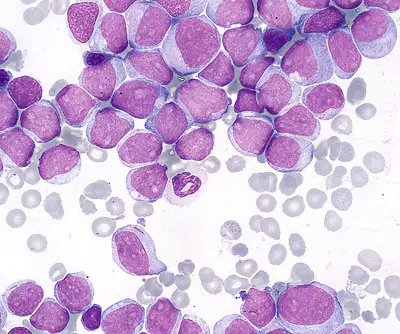
Myeloid Leukemia
6
T-ALL | B-ALL | Burkitt |
|---|---|---|
|
|
|
Acute lymphoblastic leukemia
7
Features | Acute Leukemia | Chronic Leukemia |
|---|---|---|
Age | All ages, usually children | Adults |
Clinical onset | Sudden | Insidious |
Course (untreated) | less than 6 months | 2-6 year |
Leukemic cells | Immature; many blasts | Mature |
Anemia | Mild to severe | Mild |
Thrombocytopenia | Mild to severe | Mild |
WBC | Variable | Increased |
Organomegaly | Mild | Prominent |
Acute vs Chronic Leukemia
8
Match
Match Leukemia with description
Myeloid Leukemia
Lymphoid Leukemia
Chronic Myeloid Leukemia
Acute Lymphoblastic Leukemia
Acute Myeloid Leukemia
Granulocytic monocytic, megakaryocytic
B cell and T cell origin
Chronic Myeloid Leukemia is a slow-growing cancer that affects the blood and bone marrow.
Acute Lymphoblastic Leukemia is a fast-growing type of leukemia that affects the lymphoid cells.
Acute Myeloid Leukemia is a rapidly progressing disease that requires immediate treatment.
Granulocytic monocytic, megakaryocytic
B cell and T cell origin
Chronic Myeloid Leukemia is a slow-growing cancer that affects the blood and bone marrow.
Acute Lymphoblastic Leukemia is a fast-growing type of leukemia that affects the lymphoid cells.
Acute Myeloid Leukemia is a rapidly progressing disease that requires immediate treatment.
9
Categorize
Blast cells
Rapid progression
Frequent infections
Enlarged lymph nodes
Enlarged spleen and liver
Anemia: Mild to severe
Anemia: mild
Increased WBC
Mature Cells; less blast
Younger children predominant
Organize these options into the right categories
10
Acute Leukemia
Factor | AML | ALL |
|---|---|---|
Age | Common in adults, rare in children | Common in children, rare in adults |
Blood | Anemia, neutropenia, thrombocytosis, myeloblast, and promyelocytes | Anemia, neutropenia, thrombocytosis, lymphoblasts, and prolymphocytes |
Morphology | Medium to large blasts, more cytoplasm than lymphoblasts, cytoplasmic granules, Auer rods; fine nuclear chromatin and distinct nucleoli | Small or medium blasts scare cytoplasm, no granules, fine nuclear chromatin,n and indistinct nucleoli |
Cytochemistry | Positive peroxidase and sudan black B | Negative peroxidase and sudan black B |
Extramedullary and focal disease | Common in spleen and liver, less common in lymph nodes and CNS | Common in lymph nodes, spleen, and liver, CNS, and gonads. |
11
Feature | AML | ALL |
|---|---|---|
Blast Nuclei | Usually larger, finely dispersed chromatin, and variable nucleoli | Variable size small to medium, fine to more mature chromatin, and may or may not have nucleoli |
Cytoplasm | Moderately abundant, fine small granules are often present, and may see Auer rods | Usually scant, coarse granules may be present |
Background marrow | dysplastic may be present | dysplastic usually not present |
12
Categorize
Translocation in young patients with maturation
FISH and RT-PCR for reliable testing
Auer rods, myeloblasts with abundant basophilic cytoplams and azurophilic granules.
Eosinophils precursors increases normally
Inversion of chromosome 16 and t(16;16) (p13.1;q22)
abnormal eosinophils appear immature
Purple violet granules; large
Granulocytic and monocytic differentiation
hypergranular or microgranular
Giant granules, obscuring the nucleus
Auer rods, stack or bundles
inversion of long arm of chromosomes 3 results
Myeloblasts may show myelomonocytic or mekaryocytic morph.
Dysplastic morp features may be seen in blood and bone marow
Organize these options into the right categories
AML with recurrent genetic abnormalities
13
Categorize
Infants and children under 3 without down syndrome
Hepatosplenomegaly, anemia, thrombocytopenia
Bone marrow show dysplastic megakaryoytes
No evidence of organomegaly and peripheral basophilia
Not from CML origin
monocytic differentiation is common
exon 12 of NPM1
Immature myelocytes or monocytic differentiation in immunophenotype
Organize these options into the right categories
14
AML with myelodysplasia-related changes | Therapy-related myeloid neoplasms |
|---|---|
|
|
15
AML with minimal differentiation | AML without maturation | AML with maturation | Acute Myelomonocytic Leukemia |
|---|---|---|---|
|
|
|
|
16
Acute monoblastic and monocytic Leukemia | Pure Erythroid Leukemia | Acute Megakaryoblastic Leukemia |
|---|---|---|
|
|
|
17
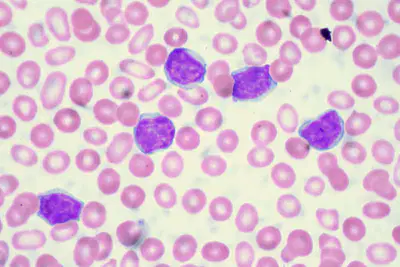
Lymphoblastic Leukemia and Lymphoma
Chapter 17
Introduction to Leukemia and the Acute Leukimas
Show answer
Auto Play
Slide 1 / 17
SLIDE
Similar Resources on Wayground

14 questions
Quiz 5 QUICK REFRESH
Presentation
•
University
11 questions
Lesson_PD_antimycobacterials_Aj.Ben
Presentation
•
University
11 questions
Hazardous Materials
Presentation
•
KG - University
13 questions
Exploring the Strength of Steel
Presentation
•
University
17 questions
Introduction into Primary Care
Presentation
•
University
13 questions
GU Quiz
Presentation
•
University - Professi...
11 questions
A1 quiz
Presentation
•
12th Grade
10 questions
1. Words in Context (SAT) (SAT Reading)
Presentation
•
12th Grade
Popular Resources on Wayground
10 questions
HCS SCI 03 Summer School Review 4

Quiz
•
3rd Grade
11 questions
HSMS - Standard Response Protocol
Quiz
•
6th - 8th Grade
16 questions
1.1-1.2 Quiz Review
Quiz
•
9th - 12th Grade
12 questions
Exponent Expressions
Quiz
•
6th Grade
20 questions
Adding and Subtracting Integers
Quiz
•
6th - 7th Grade
11 questions
Northeast States
Quiz
•
3rd - 4th Grade
10 questions
Characterization
Quiz
•
3rd - 7th Grade
10 questions
Common Denominators
Quiz
•
5th Grade