
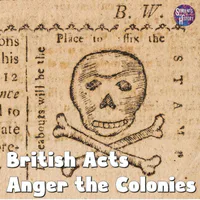
British Actions Colonial Responses

Presentation
•
Social Studies
•
6th Grade
•
Practice Problem
•
Hard

Alicia DeLoughery
Used 24+ times
FREE Resource
19 Slides • 0 Questions
1


Understanding British Policies and Colonial Responses
This Photo by Unknown Author is licensed under CC BY-SA-NC
2


Proclamation of 1763
●
Issued by King George III after
the French and Indian War.
●
Restricted colonial expansion
west of the Appalachian
●
to prevent conflicts with
Native Americans.
3

Colonial Reaction to the Proclamation
Some colonists ignored the proclamation and moved west anyway.
Anger over not being able to settle new lands.
Many colonists felt restricted and ignored.
4


Sugar Act
●
Passed in 1764 to raise revenue
for Britain.
●
Taxed sugar, molasses, and
other goods.
●
Aimed to reduce smuggling and
increase trade regulation.
5


Colonial Reaction to the Sugar Act
●Colonists protested the tax,
claiming "no taxation without
representation."
●Some merchants boycotted
British goods.
●Increased tension between
Britain and the colonies.
6


Quartering Act
●
Enacted in 1765, required
colonists to house British troops.
●
Colonists had to provide food and
shelter for soldiers.
●
Seen as an invasion of privacy
and rights.
7

●Colonists were upset about
having to support soldiers.
●Many viewed it as a violation of
their rights.
●Led to increased resentment
towards British authority.
Colonial Reaction to
the Quartering Act
●

8


Stamp Act
●
Introduced in 1765, taxed printed
materials like newspapers and
legal documents.
●
Required a stamp to be
purchased for these items.
●
Sparked widespread protests and
anger.
9


Colonial Reaction to the Stamp Act
●Formation of the Sons of Liberty,
a group protesting the act.
●Boycotts of British goods became common.
●The Stamp Act Congress was
formed to address grievances.
10


Sons of Liberty
●
A secret organization formed to
oppose British policies.
●
Organized protests, boycotts, and
acts of defiance.
●
Key figures included Samuel
Adams and John Hancock.
11


Declaratory Act
●
Passed in 1766, asserted British
authority over the colonies.
●
Stated that Britain could tax and
legislate for the colonies.
●
Colonists felt their rights were
being ignored.
12


Townshend Acts
●
Enacted in 1767, taxed goods like
tea, glass, and paper.
●
Aimed to raise revenue and
assert British control.
●
Led to more boycotts and
protests from colonists.
13

Colonial Reaction to the Townshend Acts
Colonists
organized
boycotts of taxed
goods.
Increased support
for the Sons of
Liberty.
Tensions
escalated, leading
to events like the
Boston Massacre.
14


Boston Massacre
●
Occurred in 1770, a confrontation
between colonists and British
soldiers.
●
Resulted in the death of five
colonists.
●
Used as propaganda to fuel anti-
British sentiment.
15


Boston Tea Party
●
In 1773, colonists protested the
Tea Act by dumping tea into
Boston Harbor.
●
Aimed to challenge British
taxation and monopoly.
●
Led to harsh British responses,
including the Coercive Acts.
16


Committees of Correspondence
●Formed to coordinate resistance
against British policies.
●Allowed colonies to share
information and strategies.
●Strengthened colonial unity and
opposition to Britain.
17


Conclusion: Growing Tensions
●
British policies led to increasing
colonial anger and resistance.
●
Boycotts and protests united the
colonies against Britain.
●
Set the stage for the American
Revolution.
18


Discussion Questions
●How did each British policy affect
the relationship with the colonies?
●What were the most effective
colonial responses to British
actions?
●Why do you think the colonists
felt so strongly about these
issues?
19


Exit Ticket
●
Write a brief response: "How did
the British policies lead to the
desire for independence?"
●
Reflect on what you learned
today about the colonial
responses.
Understanding British Policies and Colonial Responses
This Photo by Unknown Author is licensed under CC BY-SA-NC
Show answer
Auto Play
Slide 1 / 19
SLIDE
Similar Resources on Wayground

13 questions
Motion and Measurement of Distance
Presentation
•
6th Grade
16 questions
Ancient Egypt Vocabulary
Presentation
•
6th Grade
16 questions
Peloponnesian Wars
Presentation
•
6th Grade
16 questions
Canada Today
Presentation
•
6th Grade
17 questions
6th 2.2 Water on Earth
Presentation
•
6th Grade
17 questions
Galapagos Island, Easter Island, and Machu Picchu
Presentation
•
6th Grade
14 questions
Human Origins
Presentation
•
6th Grade
15 questions
Four Empires
Presentation
•
6th Grade
Popular Resources on Wayground
10 questions
Safety Day 2026 – Student Review

Quiz
•
9th Grade
21 questions
Continents and Oceans
Quiz
•
6th Grade
20 questions
Parts of Speech
Quiz
•
5th Grade
16 questions
Subject & Predicate
Quiz
•
5th Grade
25 questions
Multiplication Facts
Quiz
•
5th Grade
12 questions
Map Skills
Quiz
•
3rd Grade
22 questions
Continents and Oceans
Quiz
•
5th Grade
15 questions
Rounding Decimals
Quiz
•
5th Grade
Discover more resources for Social Studies
19 questions
Foundations of America
Quiz
•
6th - 8th Grade
5 questions
Mesopotamia Video Quiz

Interactive video
•
6th Grade
10 questions
Exploring the Age of Exploration: Key Events and Figures
Interactive video
•
6th - 10th Grade
15 questions
Middle Ages of the Middle East Vocab List (CFA #2)
Quiz
•
6th - 8th Grade
13 questions
Ancient Egypt
Interactive video
•
6th Grade
17 questions
Timelines
Quiz
•
6th Grade
11 questions
SWANA Unit test
Quiz
•
6th Grade
13 questions
Canada Map
Quiz
•
6th Grade