Search Header Logo
Test 3 Review PSA

Test 3 Review PSA

Assessment

Presentation

Chemistry

9th - 12th Grade

Practice Problem

Medium

Created by

Sherri Christensen

Used 2+ times

FREE Resource

28 Slides • 59 Questions

1

media

2

Multiple Choice

__________ are the building blocks of matter.

1

Atoms

2

Elements

3

Compounds

3

Multiple Choice

I can see atoms.

1

True

2

False

4

Multiple Choice

Atoms make up everything,

1

True

2

False

5

Multiple Select

Choose the subatomic particles found in an atom.

1

protons

2

electrons

3

neutrons

4

omnitrons

6

media

7

Labelling

Match the part of the atom to its name.

Drag labels to their correct position on the image

Electron Cloud

nucleus

8

media

​electron cloud

9

Multiple Choice

A proton is the same mass as a __________.

1

neutron

2

electron

3

omnitron

10

Multiple Choice

Electrons are massless.

1

True

2

False

11

Match

Match the atomic subparticle to its charge.

proton

electron

neutron

positive (+)

negative (-)

neutral (no charge)

12

Categorize

Options (7)

neutron

proton

electron

omnitron

paper towels

summer

winter

Organize these options into the right categories - yes, some are lame and have nothing to do with what you are learning right now.

nucleus
electron cloud
I have no idea
seasons of the year

13

media

14

media

15

media

16

media

​4

17

media

18

media

19

Match

Match the following group names:

Group 1

Group 2

Group 3

Group 17

Group 18

Alkali metals

Alkaline earth metals

Rare earth metals

Halogens

Noble gases

20

Match

Match the following group names

Group 13

Group 14

Group 15

Group16

Groups 3-12

Boron group

Carbon group

Nitrogen group

Oxygen group

Transition metals

21

Labelling

Label the following periodic table

Drag labels to their correct position on the image

transition metals

metals

nonmetals

matalloids

22

Categorize

Options (11)

shiny, silvery solids

good conductors of heat and electricity

malleable and ductile

located ot the left of the metalloids

gases, or dull brittle solids

poor conductors

right of the metalloids

solids

semi-conductors

physcial properties like metals

chemical properties like nonmetals

Organize these options into the right categories

Metals
Nonmetals
Metalloids

23

media

24

Multiple Choice

What is a Bohr Model

1

diagrams for funsies

2

simple diagrams that show the atomic structure of an atom

3

diagrams that show where it is at on the periodic table

25

media

26

Multiple Select

The atomic number informs you of the which of the following:

1

number of protons

2

number of electrons

3

number of neutrons

4

mass of the atom

27

Multiple Choice

Carbon has the same number of protons as nitrogen and oxygen.

1

True

2

False

28

Multiple Choice

All atoms are neutral.

1

True

2

False

29

media

30

Match

Matching.

average mass of all the isotopes of an atoms

rounded atomic mass

mass number

atomic mass

mass number

Protons + Neutrons

31

Multiple Choice

To find the number of neutrons in an atom, subtract the atomic ______ from the ________ number.

1

mass, number

2

number, mass

3

nuclei, quarks

32

Labelling

Matchi.ng

Drag labels to their correct position on the image

Element name

element symbol

Atomic Mass

Atomic number

33

Multiple Choice

Question image

What is the atomic number of magnesium?

1

12

2

24.305

3

24

34

Multiple Choice

Question image

What is the mass number of magnesium?

1

12

2

24.305

3

24

35

Multiple Choice

Question image

What is the atomic mass of magnesium?

1

12

2

24.305

3

24

36

Multiple Choice

Question image

How many protons does magnesium have?

1

12

2

24.305

3

24

37

Multiple Choice

Question image

How many electrons does magnesium have?

1

12

2

24.305

3

24

38

Multiple Choice

Question image

How many neutrons does magnesium have?

1

12

2

24.305

3

24

39

media

40

Multiple Choice

What is charged atom called?

1

ion

2

isotope

3

atom

41

media

42

Multiple Choice

If an atom ______ and electron, it becomes ________ charged.

1

loses, negatively

2

loses, positively

3

gains, positively

43

media

44

media

45

media

46

Match

Matching.

cation

anion

atom

positively charged atom

negatively charged atom

Has no charge

47

Categorize

Options (9)

Al+3

Be +2

K +1

Cl -1

P -3

O -2

He

Li

Ga

Organize these options into the right categories

Cation
Anion
Atom

48

To find the charge of an atom, subtract the electrons from the protons.

​Ionic Charge = protons - electrons

49

media

50

Multiple Choice

If a sodium ion has only 10 electrons, what is the net charge of the ion?

1

-1

2

+1

3

10

51

Multiple Choice

If a sulfur ion has only 18 electrons, what is the net charge of the ion?

1

-2

2

+2

3

8

52

media

53

media

54

Multiple Choice

Question image
How many neutrons does the isotope of lithium have?
1
8
2
3
3
5

55

Multiple Choice

How is carbon-12 different from carbon-14?
1
They have a different number of protons
2
they have a different number of electrons
3
they have a different number of neutrons

56

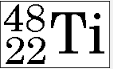
Multiple Choice

Question image
How many protons does this isotope of titanium have?
1
48
2
22
3
26

57

Multiple Choice

Atoms of a certain isotope have 73 neutrons and a mass of 123.  What is the atomic number?

1

50

2

73

3

123

58

Multiple Choice

Atoms of a certain isotope have 73 neutrons and a mass of 123.  How many protons are there?

1

50

2

72

3

123

59

Multiple Choice

Atoms of a certain isotope have 73 neutrons and a mass of 123.  How many electrons are there?

1

50

2

73

3

123

60

Multiple Choice

Atoms of a certain isotope have 73 neutrons and a mass of 123.  What is the name of the element?


1

Tin

2

Tantalum

3

Zipium

61

Multiple Choice

Atoms of a certain isotope have 73 neutrons and a mass of 123.  What is the isotopic symbol for this isotope?

1

Tin -73

2

Tin - 123

3

Ti - 50

62

media

63

media

64

media

65

media

66

Multiple Choice

How many electrons go in the first energy level ?

1

6

2

8

3

2

67

Multiple Choice

How many electrons go in the second energy level ?

1

6

2

8

3

2

68

Multiple Choice

Question image

This is a Bohr Diagram of Aluminum. How many valence electrons does Aluminum have?

1

3

2

4

3

5

69

Multiple Choice

How many valence electrons does Lithium (Li) have?

1

8

2

1

3

5

70

Multiple Choice

How many valence electrons does Bromine (Br) have?

1

5

2

6

3

7

71

  • Period 1 has 1 Energy level

  • Period 2 has 2 Energy levels

  • Period 3 has 3 energy levels

  • Period 4 has 4 energy levels

  • Period 5 has 5 energy levels

  • Period 6 has 6 energy levels

  • Period 7 has 7 energy levels

media

72

Multiple Choice

How many energy levels does Calcium have in period 4

1

1

2

2

3

3

4

4

73

Multiple Choice

How many energy levels does sodium (Na) have in period 3?

1

1

2

2

3

3

4

4

74

Multiple Choice

How many energy levels does Neon have in period 2?

1

1

2

2

3

3

4

4

75

Multiple Choice

Find an element with 3 valence electrons in Group 13.

1

Silicon (Si)

2

Aluminum (Al)

3

Neon (Ne)

76

Multiple Choice

Question image

An element that is a liquid at room temperature.

1

Bromine (Br)

2

Silicon (Si)

3

Carbon (C)

4

Hydrogen (H)

77

Multiple Choice

Question image
Locate Bromine on the periodic table, how many protons does Bromine have? 
1
80
2
45
3
35
4
0

78

Multiple Choice

Question image

What element is in period 4, group 1?

1

K - Potassium

2

V - Vandium

3

C - Carbon

4

Ti - Titanium

79

Multiple Choice

Question image

What element is in group 2, period 6?

1

Sr - Strontium

2

Ba - Barium

3

S - Sulfur

4

O - Oxygen

80


The OCTET (8) Rule-

Atoms tend to form compounds that give them EIGHT valence electrons and thus the electron configuration of a noble gas.

media

81

Multiple Choice

What is the OCTET rule in easy words mean?

1

energy levels are happy when they have 8 electrons (except the first level, it only needs 2)

2

energy levels are happy when they have 18 electrons (except the first level, it only needs 2)

3

energy levels are sad when they have 8 electrons (except the first level, it only needs 2)

82

Multiple Choice

How many valence electrons does an element want to have?

1

0

2

10

3

2

4

8

83

An exception to an octet 

Some atoms are happy with two electrons in their outer shell - this is called the DUET rule. It applies to:
Hydrogen
Helium
Lithium
Beryllium
Boron

media

84

Multiple Choice

What does the period number tell us about an element?

1

The number of electron levels

2

The number of valence electrons

3

The number of total electrons

85

Multiple Choice

What does the group number tell us about an element?

1

The number of electron levels

2

The number of valence electrons

3

The number of protons

86

Multiple Choice

How many more electrons does oxygen need to get an octet of valence electrons?

1

4

2

2

3

8

87

Multiple Choice

How many more electrons does Neon need to get an octet of valence electrons?

1

4

2

2

3

none, it has a full octet.

media

Show answer

Auto Play

Slide 1 / 87

SLIDE