
2.2 Notes

Presentation
•
Biology
•
7th Grade
•
Practice Problem
•
Medium
+4
Standards-aligned

Andrea Incalcaterra
Used 6+ times
FREE Resource
30 Slides • 26 Questions
1

2

3
Multiple Choice
The process of grouping together things based on similarities
4
Multiple Choice
Why do biologists use Classification?
5
Multiple Choice
The scientific study of how living things are classified
6

7

8

9

10

11

12

13

14

15

16

17
Multiple Choice
Carolus Linnaeus devised a naming system that placed organisms in groups based on their observable features. What was this naming system called?
18
Multiple Choice
What is the first word in an organism's scientific name?
19
Multiple Choice
What is the second word in an organism's scientific name?
species
20
Multiple Choice
A group of similar organisms that can mate with each other and produce offspring that can also mate and reproduce
21
Multiple Choice
What language did Linnaeus use?
22
Multiple Choice
Why did Linnaeus use Latin for his naming system?
23
Multiple Choice
What basic functions do scientific names serve?
24
Multiple Choice
A dichotomous key is
25

26

27

28
Multiple Choice
How many levels are there in the classification of living things?
29
Multiple Choice
The more classification levels that two organisms share, the...
more characteristics they have in common
30
Multiple Choice
List the 8 levels of classification in order from largest to smallest.
31

32

33

34

35

36

37

38

39

40
Multiple Choice
What are the 3 domains of living things?
41
Multiple Choice
How are organisms placed in domains?
based on cell type, ability to make food, and number of cells.
based on their diet and behavior.
by the habitat of the organisms.
based on their color and size.
42
Multiple Choice
Bacteria are unicellular
and multicellular organisms.
prokaryotic organisms.
eukaryotic organisms
protists
43
Multiple Choice
How many cells does Archaea have?
Multiple cells
(multicellular)
One cell
(unicellular)
44
Multiple Choice
What does the Greek word Archaea mean?
Ancient
45
Multiple Choice
How does domain Archaea differ from bacteria?
Archaea differ from bacteria due to their structure & chemical makeup
46
Multiple Choice
Organisms in the domain Eukarya are eukaryotes, which means they are
organisms with a nucleus
bacteria
47
Multiple Choice
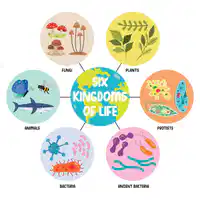
Which domain are protists, fungus, plants, and animals in?
48

49

50

51

52

53
Multiple Choice
Why are protist known as the odds and ends kingdom?
54
Multiple Choice
How do fungi obtain food?
Fungi use photosynthesis and are autotrophs.
Fungi obtain food by absorbing nutrients from their surroundings, which makes them heterotrophs.
55
Multiple Choice
How many cells do plants have and how did they obtain food?
Plants are unicellular and get food from the soil.
Plants are multicellular and obtain food through photosynthesis (autotrophs).
Plants are multicellular and obtain food through digestion.
Plants are multicellular and rely on animals for food (heterotroph).
56
Multiple Choice
What characteristics do organisms in the animal kingdom share?
Multicellular, heterotrophic, eukaryotic
multicellular prokaryote
multicellular, autotroph, eukaryote
Show answer
Auto Play
Slide 1 / 56
SLIDE
Similar Resources on Wayground

50 questions
Biomes and Ecosystems
Presentation
•
7th Grade
50 questions
WEEK 6-8: BIOTIC AND ABIOTIC FACTORS
Presentation
•
7th Grade
54 questions
Photosynthesis
Presentation
•
7th Grade
45 questions
Gregor Mendel
Presentation
•
7th Grade
55 questions
Physics TEKS
Presentation
•
7th Grade
49 questions
Animal and Plant Behavior
Presentation
•
7th Grade
47 questions
Genetic Mutations
Presentation
•
7th Grade
50 questions
Kisi-Kisi Kelas 7 IPA
Presentation
•
7th Grade
Popular Resources on Wayground
10 questions
Safety Day 2026 – Student Review

Quiz
•
9th Grade
21 questions
Continents and Oceans
Quiz
•
6th Grade
20 questions
Parts of Speech
Quiz
•
5th Grade
16 questions
Subject & Predicate
Quiz
•
5th Grade
25 questions
Multiplication Facts
Quiz
•
5th Grade
12 questions
Map Skills
Quiz
•
3rd Grade
22 questions
Continents and Oceans
Quiz
•
5th Grade
15 questions
Rounding Decimals
Quiz
•
5th Grade
Discover more resources for Biology
10 questions
Exploring the Phases of Mitosis and Cell Division

Interactive video
•
6th - 10th Grade
14 questions
Autosomal Pedigree
Quiz
•
7th Grade
10 questions
Exploring Evidence of Evolution
Interactive video
•
6th - 10th Grade
6 questions
Levels of Organization
Presentation
•
7th Grade
10 questions
Exploring Cell Membrane Transport Mechanisms
Interactive video
•
6th - 10th Grade
13 questions
Fast and Curious: Cell Discovery and Cell Basics
Quiz
•
7th Grade
16 questions
Cellular Respiration
Quiz
•
7th - 8th Grade
40 questions
Human Body Systems
Quiz
•
7th Grade