

1.4.18 Prefixes, Ch 13-14 Close Read, Logical Fallacy

Presentation
•
English
•
7th Grade
•
Practice Problem
•
Medium
+6
Standards-aligned

Victoria Massack
Used 4+ times
FREE Resource
16 Slides • 3 Questions
1
Prefixes, The Finest Hours Close Read Chapters 13-14, Define Logical Fallacy

Lesson 1.4.17
2
Word Work: Prefixes
Learners can:
identify and sort words based on prefix
pronounce multisyllabic words correctly
3
Fore-, Super-, Trans-, Under-
Prefix | Definition |
|---|---|
fore- | front, superior |
super- | over, above |
trans- | across, beyond, through |
under- | not enough, below |
4
Categorize
foreclose
forehead
forefather
forefront
superlative
supervise
supersede
superficial
transparent
transatlantic
transportation
translucent
underestimate
underdog
underhand
undercover
Sort the words based on their prefix
5
Reading: The Finest Hours Ch 13-14 Close Read

Learners can:
use text evidence to support claims about plot development
differentiate between direct and indirect characterization
analyze a passage to explain the importance of its literary devices
6
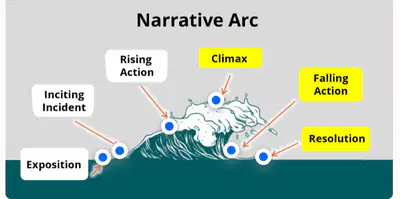
Climax: the turning point or twist of the story, often the most suspenseful and exciting part of the plot
Falling Action: the events that unfold after the turning point where problems begin to be solved
Resolution: the end of the story, including what happens to the characters as a result of the story's conflict
Plot Development
7
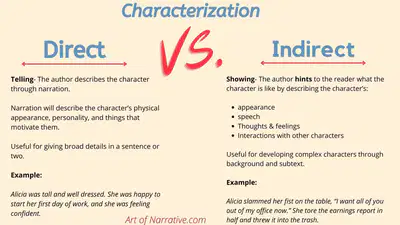
Direct characterization is when the author tells you exactly how someone is in the text.
Indirect characterization requires you to make a guess about a character based on what they say, do, or think in the story. You can also make inferences about a character based on how they are treated by other characters.
Characterization Review
8
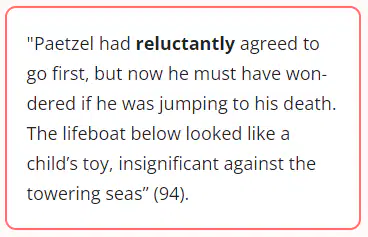
If you look at the words that describe Paetzel, you can make an inference about him.
By using the word reluctantly, the authors help you understand Paetzel's situation a bit better.
Because Paetzel is in danger, he must be cautious, and he must be scared of the physical challenge it will be to get onboard the Yukatat.
In this example, the writers use diction to reveal more about Paetzel's character.
Analyzing for Character/Diction
9
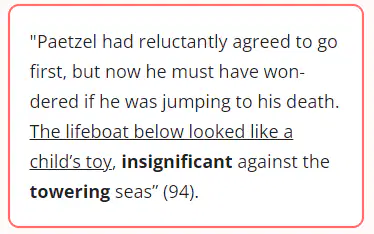
This passage also showcases imagery and figurative language.
The authors compare the lifeboat to a child's toy to show how small, "insignificant," and vulnerable it is.
The writers also call the seas "towering" to emphasize their height and intensity.
In both cases, the authors' diction helps readers imagine what the scene looks like.
Analyzing for Imagery/Figurative Language
10
Writing: Define Logical Fallacy
Learners can:
identify the correct use of semicolons to separate two independent clauses
explain the concept of logical fallacy in their own words
recall characteristics of logical fallacies
11
Grammar Time! Semicolons
A semicolon ( ; ) is used to join two independent clauses.
Recall that an independent clause is a complete thought or sentence. It can stand on its own.
12
Semicolon Use Examples
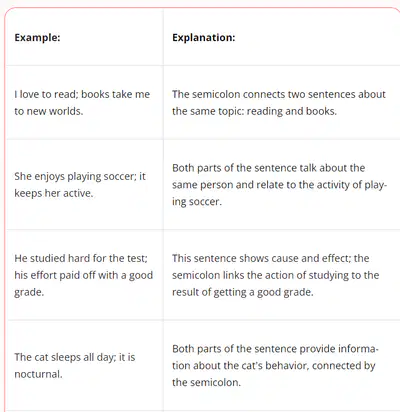
You can use a semicolon to combine two independent clauses when you want to show a close relationship between the two ideas.
Adverbial conjunctions are words or phrases that connect sentences or clauses and show how things relate. They are words such as however, therefore, meanwhile, and nevertheless.
You do not use a semicolon when you are combining sentences with coordinating conjunctions (for, and, nor, but, or, yet, so).
13
Multiple Choice
What sentence correctly uses semicolons to combine two closely related sentences?
Eventually, the Army Corps of Engineers would sink the ship; where it sat off the coast.
Worried about the beaches and wildlife; environmentalists tried to get the Pendleton wreckage removed.
People were worried about the environmental impact of the Pendleton wreckage; however, the government did not agree about the best way to salvage the ship.
Some people avoided the location of the wreckage; but John Fitzgerald's family liked to visit Chatham.
14

Take a look at the picture of the two dogs to the left.
They both appear white with black spots, which may lead some to draw the conclusion that they are the same breed.
However, one dog is actually wearing a piece of white clothing with black spots, while the other dog's spots are part of its natural coat.
In argumentative writing, errors in reasoning can undermine your argument.
Fallacy: a false or mistaken idea
15

Think about the following words and their definitions:
logic: the study of laws of reasoning and validity
fallacy: a false or mistaken idea
On your own, think about those two definitions, the picture of the two dogs, and the title of today's lesson, "Writing: Define Logical Fallacy." What do you think is a logical fallacy, and how does it relate to argumentative writing?
So, what is a logical fallacy?
16

A logical fallacy is an error in reasoning that damages the logic of your argument
There are two types of logical fallacies
hasty generalizations
slippery slopes
Logical Fallacy
17


A hasty generalization is a conclusion based on insufficient evidence. People make a decision before they have all the facts.
Example: After reading "The Monsters Are Due on Maple Street," I know that kindness cannot stop a mob mentality.
A fair argument will include more evidence.
Hasty Generalization
A slippery slope is an unsupported claim that a small action will lead inevitably to another potentially disastrous action or event.
Example: If you share your food with one person, everyone will want some. Soon, you will not have any food for yourself, and you will starve.
Sharing your food with one person is unlikely to lead to your starvation.
Slippery Slope
18
Match
Match the following
a logical fallacy in which people make it seem like something will happen just because some other small event happens
a logical fallacy that occurs when someone makes a conclusion based on insufficient evidence, before they have all the facts
--
slippery slope
hasty generalization
--
slippery slope
hasty generalization
--
19
The rest of class is choice time. You can be working on:
iReady Reading Practice
Silent Reading
Get help from Mrs. Massack
Overdue edio lessons
Choice Time

Prefixes, The Finest Hours Close Read Chapters 13-14, Define Logical Fallacy
Lesson 1.4.17
Show answer
Auto Play
Slide 1 / 19
SLIDE
Similar Resources on Wayground

13 questions
Adverbs of frequency
Presentation
•
7th Grade
12 questions
Simple Past
Presentation
•
7th Grade
12 questions
Drawing Conclusions/Making Inferences
Presentation
•
7th Grade
16 questions
Coordinating and Subordinating Conjunctions
Presentation
•
7th Grade
14 questions
Analyzing Interactions in Text
Presentation
•
7th Grade
15 questions
Poerty
Presentation
•
7th Grade
13 questions
Inferencing
Presentation
•
7th Grade
13 questions
Adjectives
Presentation
•
7th Grade
Popular Resources on Wayground
24 questions
PBIS-HGMS Day 10

Quiz
•
6th - 8th Grade
10 questions
HCS SCI 03 Summer School Review 3
Quiz
•
3rd Grade
11 questions
Home Scope
Quiz
•
7th - 8th Grade
15 questions
HCS SCI 05 Summer School Assessment 3 Review
Quiz
•
5th Grade
35 questions
Lufkin Road Middle School Student Handbook & Policies Assessment
Quiz
•
7th Grade
18 questions
Geo 11.3 Area of Circles and Sectors
Quiz
•
9th - 11th Grade