kinetic theory of gases
Presentation
•
Science
•
9th Grade
•
Practice Problem
•
Medium
Standards-aligned
April Elmore
Used 6+ times
FREE Resource
0 Slides • 16 Questions
1
Multiple Choice
Which best describes a solid?
The state of matter that has a fixed shape and fixed volume
The molecules of a solid move with a high speed in random order
The state of matter that has a fixed volume and takes the shape of its container
Molecules move past one another, vibrate, and rotate
2
Multiple Choice
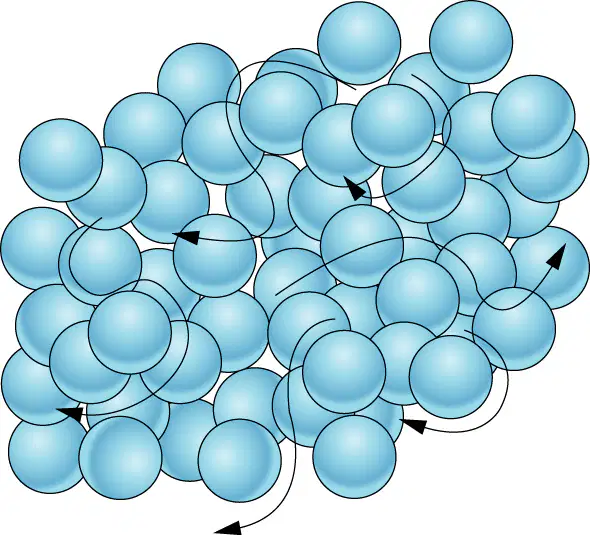
Which state of matter is shown?
sold
liquid
gas
plasma
3
Multiple Choice
Which is an assumption of the kinetic theory of gases?
Gas are made up of particles that move at a constant, random motion
Gases can be compressed
Evaporation is a state change
When particles of a gas collide a large amount of energy is lost
4
Multiple Choice
Which is FALSE about melting?
solid change to a liquid
particles gain enough energy to move past each other
the heat of fusion is needed to melt a solid
the heat of vaporization is needed to melt a solid
5
Multiple Choice
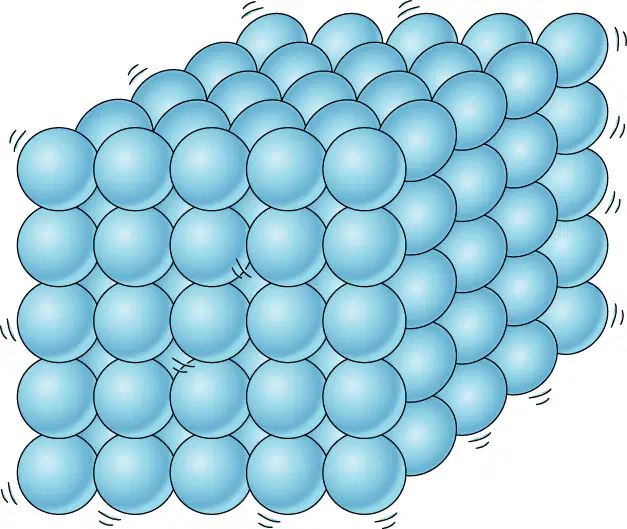
Which state is shown.
gas
solid
liquid
plasma
6
Multiple Choice
Which part of the graph has no temperature change
The part labeled ice
The part labeled freezing/melting
The part labeled water
The part labeled gas
7
Multiple Choice
Most matter __________ when heated
condenses
solidifies
contracts
expands
8
Multiple Choice
What occurs when the vapor pressure of a liquid equals the atmospheric pressure?
condensation
freezing
melting
boiling
9
Multiple Choice
What happens to KE when the temperature increases?
Nothing
It increases because particles move faster
It decreases because particles slow down
10
Multiple Choice
Why does the balloon shrink in liquid nitrogen?
The particles move apart and speed up
The particles slow down and move closer together since the temperature decreases.
Balloon shrink in all liquids
The liquid nitrogen damages the balloon.
11
Multiple Choice
Which state of matter is shown?
gas
liquid
solid
plasma
12
Multiple Choice
This state has the lowest amount of energy. The particles mainly vibrate.
gas
solid
liquid
plasma
13
Multiple Choice
According to the kinetic molecular theory, all collisions between gas molecules are inelastic; all kinetic energy is lost.
True
False
14
Multiple Choice
Liquid changing to a gas just at its surface.
condensation
evaporation
melting
boiling
15
Multiple Select
What is true about an amorphous solid?
It does not have a melting point- it has a range of temperatures at which it melts
It behaves like all other solids
Glass and butter are examples
16
Multiple Choice
What is sublimation?
changing from a solid to a vapor
vapor changes to a solid
vapor changes to a liquid
liquid changes to a solid
Which best describes a solid?
The state of matter that has a fixed shape and fixed volume
The molecules of a solid move with a high speed in random order
The state of matter that has a fixed volume and takes the shape of its container
Molecules move past one another, vibrate, and rotate
Show answer
Auto Play
Slide 1 / 16
MULTIPLE CHOICE

Similar Resources on Wayground
11 questions
CIRCULATORY SYSTEM
Presentation
•
10th Grade
10 questions
Macromolecules
Presentation
•
9th Grade
12 questions
Prokaryote and Eukaryote Review
Presentation
•
9th Grade
10 questions
Evidence of Evolution
Presentation
•
9th Grade
11 questions
Isotopes
Presentation
•
8th - 9th Grade
10 questions
DNA
Presentation
•
9th Grade
10 questions
Big Bang theory
Presentation
•
8th - 9th Grade
10 questions
Solubilité
Presentation
•
9th Grade
Popular Resources on Wayground
24 questions
PBIS-HGMS Day 10
Quiz
•
6th - 8th Grade
10 questions
HCS SCI 03 Summer School Review 3
Quiz
•
3rd Grade
11 questions
Home Scope
Quiz
•
7th - 8th Grade
15 questions
HCS SCI 05 Summer School Assessment 3 Review
Quiz
•
5th Grade
35 questions
Lufkin Road Middle School Student Handbook & Policies Assessment
Quiz
•
7th Grade
18 questions
Geo 11.3 Area of Circles and Sectors
Quiz
•
9th - 11th Grade