

Oscillation - A Level Physics

Presentation
•
Physics
•
12th Grade
•
Practice Problem
•
Easy

Muhammad Arief Kurniawan
Used 1+ times
FREE Resource
26 Slides • 6 Questions
1

By Muhammad Arief Kurniawan
Mutiara Harapan Islamic School
2
An object oscillates when it moves back and forth repeatedly, on either side of some equilibrium position.
If we stop the object from oscillating, it returns to the equilibrium position
3


If you pluck a guitar string, it continues to vibrate for some time after you have released it.
Every oscillator has a natural frequency with which it vibrates freely after an initial disturbance.
Free Oscillations
if you sit on a bus, you may notice that the vibrations from the engine are transmitted to your body causing you to vibrate with the same frequency.
these are not free vibrations of your body; they are forced vibrations.
Forced Oscillations
4
Categorize
the vibrations of a cymbal after it has been struck
the wing beat of a mosquito
the movement of the pendulum in a upright clock
the shaking of a building during an earthquake
State which of the following are free oscillations and which are forced
5

Amplitude, period, frequency, phase
6
Amplitude, period and frequency

the shape of this graph is a sine curve, and the motion is described as sinusoidal.
The maximum displacement from the equilibrium position is called the amplitude x0
The period T is the time for complete oscillation. Note that the oscillating object must go from one side to the other and back again (or the equivalent)
The frequency f is the number of oscillation per unit time.

7
Open Ended

From the displacement-time graph shown, determine the amplitude, period and frequency of the oscillations represented.
8
Phase: the point that an oscillating particle has reached withen the complete cycle of an oscillation
Phase difference: the difference in the phases of two oscillating particles measured in degrees or radians


9
Match
Match the following
Phase difference : π/2 rad
Phase difference : undefined
Phase difference : π rad
Phase difference : π/2 rad
Phase difference : undefined
Phase difference : π rad
10
Open Ended

Why would it not make sense to ask the phase difference about this figure
11

12
A body executes simple harmonic motion if its acceleration is directly proportional to its displacement from its equilibrium position, and in the opposite direction to its displacement

13

a mass that oscillates
a position where the mass is in equilibrium
a restoring force that acts to return the mass to its equilibrium position
14


15
Dropdown

16
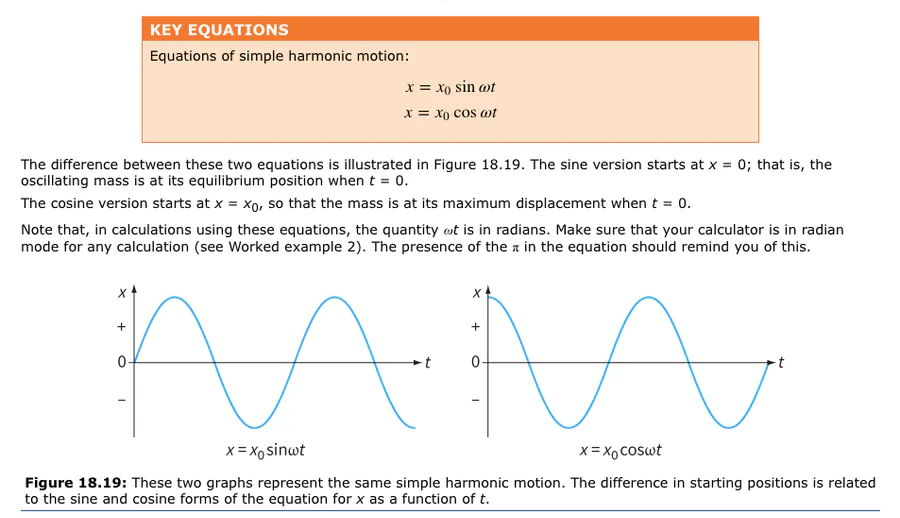
17
Open Ended

18
The greater the displacement x, the greater the acceleration a.

the minus sign shows that, when the object is displaced to the right, the direction of its acceleration is to the left.
19
Equation for velocity

a greater amplitude means that the oscillator has to travel a greater distance in the same time - hence it has a greater speed
Increasing the frequency means a shorter period. a given distance is covered in a shorter time - hence it has a greater speed
20

21
Energy Graph


22
23

24

Oscillations
25
an oscillation in which resistive forces causes the energy of the system to be transferred to the surroundings as internal energy
Damped

26
Damping can be very useful if we want to get rid of vibrations.
damping is achieved by introducing the force of friction into a mechanical system. Damping has the effect of removing energy from the oscillating system.

27

28
a system oscillates with maximum amplitude by absorbing energy from a vibrating source. it occurs when the frequency of the driving force is equal to the natural frequency of the oscillating system.

29

Millenium "Wobble" Bridge

When 2000 people swayed in time with the bridge, it caused the amplitude of the bridge's oscillations to increase (become resonance).
30
Damping is useful if we want to reduce the damaging effects of resonance.
An everyday example of damping can be seen on some doors

critical damping is the minimum amount of damping required to return an oscillator to its equilibrium position without oscillating

31


the particle of water in the food forced to vibrate and they absorbed the energy of microwave radiation.
Microwave
it uses the radiowaves that will be matched with the frequency of the organ's body.
MRI
Television
32

@tsitegar
By Muhammad Arief Kurniawan
Mutiara Harapan Islamic School
Show answer
Auto Play
Slide 1 / 32
SLIDE
Similar Resources on Wayground

24 questions
Human rights
Presentation
•
12th Grade
26 questions
Measuring Electric Fields Lesson 3
Presentation
•
12th Grade
23 questions
Lesson 1.3
Presentation
•
12th Grade
25 questions
Deep Sea Currents
Presentation
•
KG - University
22 questions
7.1 Stages of pregnancy
Presentation
•
12th Grade
23 questions
KINEMATICS REVIEW LESSON
Presentation
•
11th Grade
23 questions
Electromagnetism, Magnetic Fields, Currents
Presentation
•
12th Grade
22 questions
ECONOMICS TOPIC 3 LESSON 2
Presentation
•
12th Grade
Popular Resources on Wayground
10 questions
Safety Day 2026 – Student Review

Quiz
•
9th Grade
21 questions
Continents and Oceans
Quiz
•
6th Grade
20 questions
Parts of Speech
Quiz
•
5th Grade
16 questions
Subject & Predicate
Quiz
•
5th Grade
25 questions
Multiplication Facts
Quiz
•
5th Grade
12 questions
Map Skills
Quiz
•
3rd Grade
22 questions
Continents and Oceans
Quiz
•
5th Grade
15 questions
Rounding Decimals
Quiz
•
5th Grade
